About Pisaster giganteus (Stimpson, 1857)
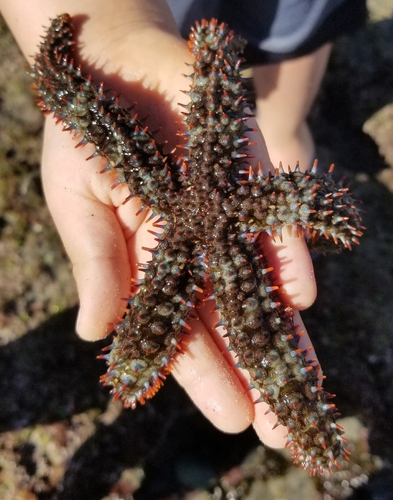
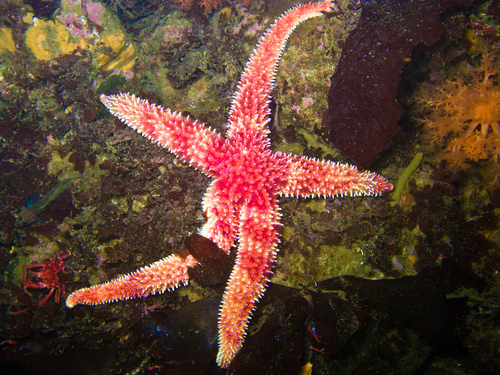
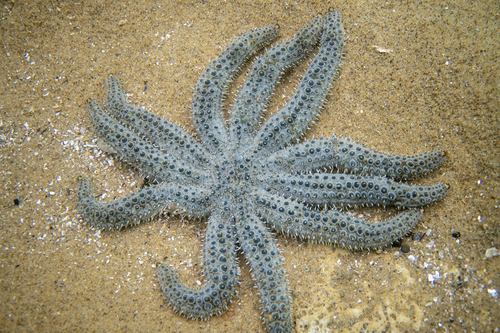
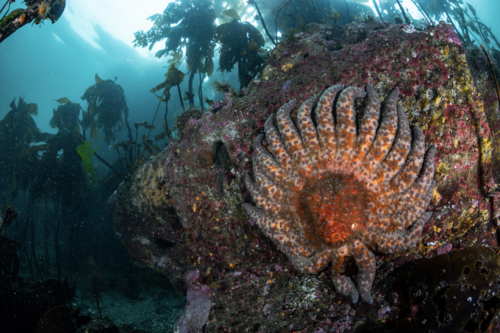
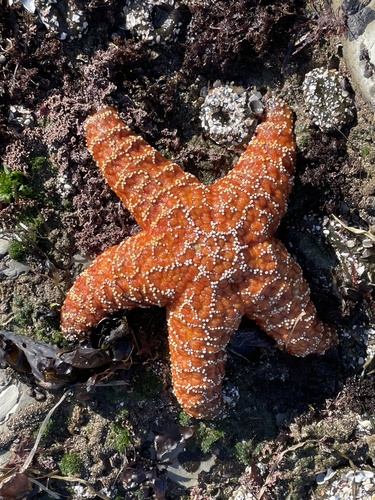
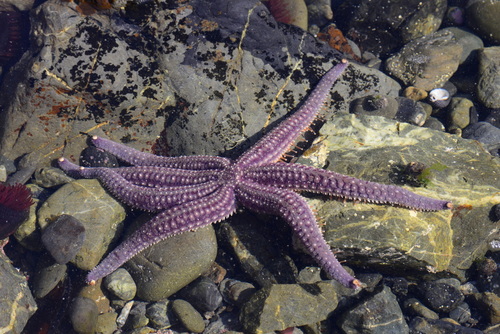
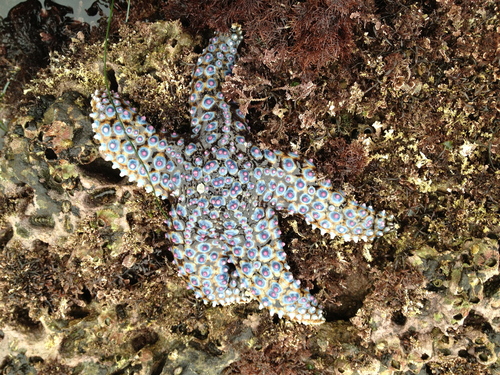
This species holds the scientific name Pisaster giganteus (Stimpson, 1857), commonly referred to as the giant sea star. Giant sea stars have a dense body with wide arms. Their body surface is most often tan or brown, though it can occasionally be yellowish or gray, and they have no distinct body pattern. They possess thick, blunt spines that are bluish in color, with swollen tips that can be white, pink, or purple. These spines are surrounded by brown fuzz and plier-shaped pedicellariae, which the giant sea star uses as a protective mechanism against predators. When measured from the tip of one arm to the opposite arm, adult giant sea stars range from 36 to 48 cm (14 to 19 in) across. This species can be found at water depths as great as 88 m (289 ft). Giant sea stars typically live on protected low-tide coastlines, and they are commonly found attached to rocks, attached to pier supports, or lying on sand. For reproduction, giant sea stars produce small eggs, and their sperm have spherical heads. When larvae first hatch, they are bilaterally symmetrical. Once they mature into adulthood, their bodies have radial symmetry centered on a central point. The gonads of giant sea stars develop during winter, in time for their spawning season that falls between March and April.