About Pisaster brevispinus (Stimpson, 1857)
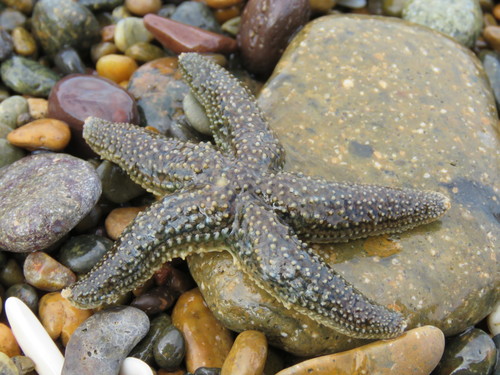
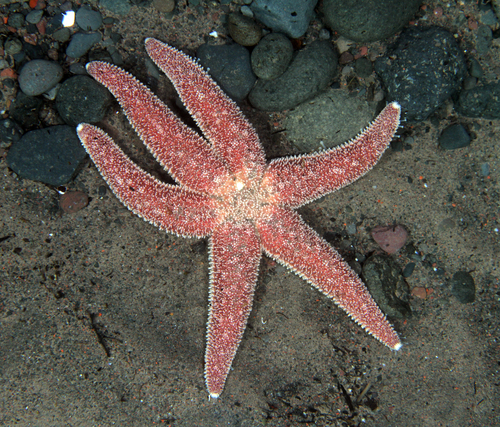
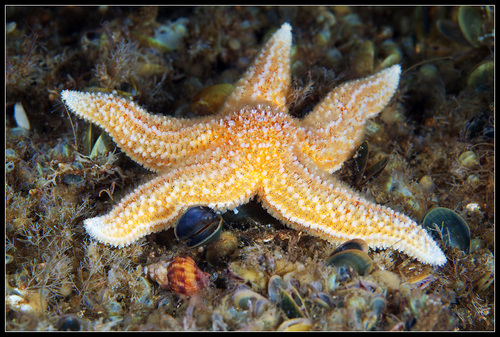
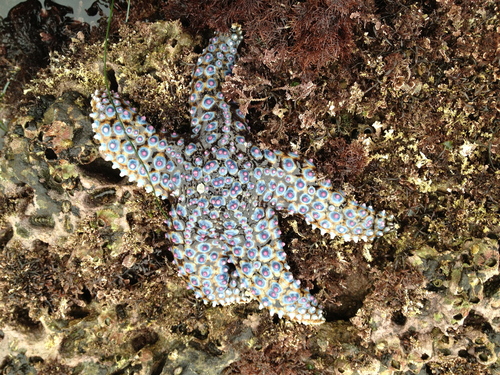
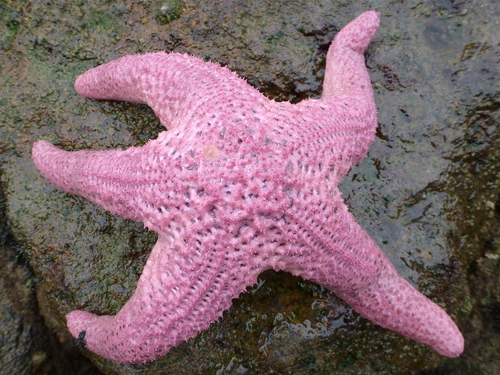
This species has the scientific name Pisaster brevispinus (Stimpson, 1857), and is commonly called the pink sea star. It has five thick arms and a large central disc, and is one of the largest sea stars in the world. Its typical diameter is 320 millimetres (13 in), and exceptionally large individuals can reach 90 centimetres (35 in) across. The largest pink sea stars may weigh up to 4.5 kilograms (9.9 lb). The upper (aboral) surface of the sea star is generally pink, sometimes with gray shadings. The radius of each arm measures between 2.8 and 5.0 times the radius of its central disc. An obvious madreporite, a structure that filters water the animal uses, is located on the upper surface of the central disc. The mouth is positioned on the underside of the central disc. Short spines around 2 millimetres (0.079 in) long cover the upper surface; one row of spines usually runs along the top of each arm, while other spines are scattered across the surface with no clear pattern, either alone or in clumps of two or three. Tiny pincers called pedicellariae are present on both the upper and lower surfaces. These structures are thought to be used to remove encrusting organisms that would otherwise grow on the sea star. On the lower (oral) side, deep grooves that contain four rows of tube feet radiate out from the mouth. The pink sea star uses its tube feet to move around and capture prey. The tube feet surrounding the mouth are particularly long, at least as long as the radius of the central disc, which helps the animal dig prey out from the sea bottom. The pink sea star is found along the Pacific coast of North America, ranging from Sitka, Alaska to La Jolla, California, including within Puget Sound. It inhabits relatively shallow water, from the lower intertidal zone down to 110 metres (360 ft) deep. It does not tolerate being out of water well, so it is only found on beaches during very low tides. It prefers calm waters such as bays and harbors over open ocean coastlines. It lives on the seabed, and favors sandy and muddy bottoms where its main prey lives, but can sometimes be found on rocky bottoms or on pilings. It does not live in areas with low salinity. Pink sea stars are primarily gonochoric, meaning each individual is either male or female. Each arm contains two gonads. When spawning, the sea stars lift their central discs off the seabed to release microscopic gametes into the water. Their eggs are 165 micrometres (0.0065 in) in diameter. It is thought that groups of pink sea stars use environmental signals to coordinate their spawning, which increases the chance of fertilization. After fertilization occurs, the zygote develops into a planktonic larva that feeds on small algae. The larva goes through several developmental stages: it becomes a gastrula in 2 to 3 days, a bipinnaria in 5 days, and finally develops into a brachiolaria. Towards the end of the brachiolaria stage, the larva forms a large sack-like structure called a primordium, and begins searching for a suitable surface to settle on. After settling onto the seabed, the larva develops into a juvenile sea star.