About Piranga rubra (Linnaeus, 1758)
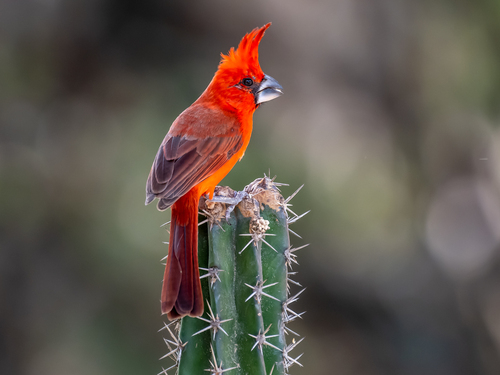
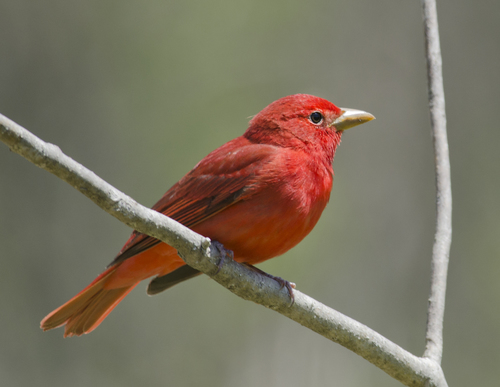
Description: Adult Piranga rubra have stout, pointed bills. They measure 17 cm (6.7 in) in length, with an average weight of 30.1 g (1.06 oz) that ranges from 25.8–33.6 g (0.99–1.19 oz). Their wingspan falls between 28 and 30 cm. Adult males are rose red, and look similar to the hepatic tanager, though hepatic tanagers have a dark bill. Females have orangish underparts, olive-colored upper bodies, and olive-brown wings and tail. Like all birds, all red and orange coloration of this species is obtained through their diet. The summer tanager has a song similar to that of the American robin, so similar that new birdwatchers sometimes misidentify this species as an American robin. Its song is made up of melodic units repeated in a steady stream. However, the summer tanager's song is much more monotonous than the song of the American robin (Turdus migratorius), and often only includes as few as three or four distinct units. It is clearer and less nasal than the song of the scarlet tanager. The summer tanager also has a sharp, agitated call that sounds like pi-tuk or pik-i-tuk-i-tuk.
Distribution and habitat: The summer tanager's preferred habitat varies by region: in the southeastern United States, it prefers pine-oak and mixed forests, while in the southwest United States it prefers riparian lowlands. These birds spend their breeding season across the southern United States and northern Mexico, reaching as far north as Iowa and New Jersey in the eastern part of their range. They overwinter in Mexico, Central America and northern South America. This tanager is an extremely rare vagrant visitor to western Europe.
Behaviour and ecology: These birds often stay out of sight, foraging high in trees, and sometimes fly out to catch insects in flight. They eat mainly insects, but also regularly add fruit to their diets. Fruit from Cymbopetalum mayanum (Annonaceae) is a particularly preferred food for them in their winter ranges, and the birds will forage in human-altered habitat. Because of this, these trees can be planted to attract summer tanagers to residential areas, and they may also be attracted to bird feeders. Summer tanagers have also been recorded eating larger invertebrate prey, including snails and slugs. There is additionally one record of an individual attempting to eat a vertebrate, a green anole, at a migratory stopover site in Mississippi. Summer tanagers build a cup-shaped nest on a horizontal tree branch, at heights ranging from 4 to 45 feet above the ground.