About Piranga olivacea (J.F.Gmelin, 1789)
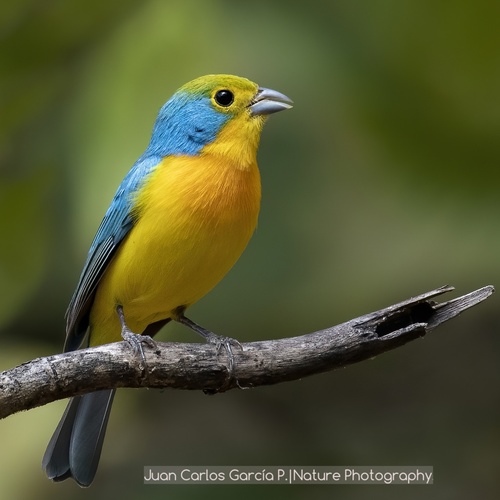
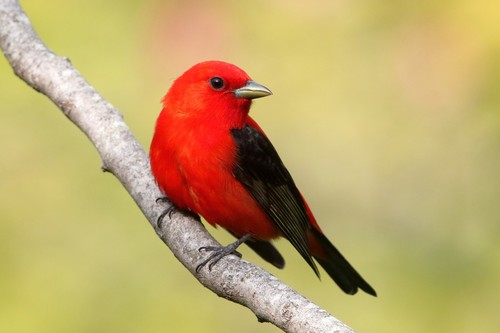
This species, the scarlet tanager (scientific name Piranga olivacea), is a mid-sized passerine bird. It is slightly the smallest of the four Piranga species that breed north of the Mexican border. Its weight ranges from 23.5 to 38 grams (0.83 to 1.34 ounces), with an average weight of 25 grams (0.88 ounces) during the breeding season and an average of 35 grams (1.2 ounces) at the start of migration. Body length ranges from 16 to 19 centimeters (6.3 to 7.5 inches), and wingspan ranges from 25 to 30 centimeters (9.8 to 11.8 inches). Adult birds of both sexes have pale, horn-colored, fairly stout, smooth-textured bills. Adult breeding males are crimson-red with black wings and tails. Their red coloration is intense and deep, darker than the red of male northern cardinals and male summer tanagers, two related species that occasionally share the same range. Neither northern cardinals nor summer tanagers have black wings. Females have yellowish underparts and olive-colored upperparts, with wings and tails that are yellow-olive in tone. Adult males have winter plumage that resembles female plumage, though their wings and tail remain darker. Young males briefly have a more complex, mixed variegated plumage that is intermediate between adult male and adult female plumage. The species' specific epithet olivacea, which means "the olive-colored one", comes from a description based on a female or immature specimen. Throughout the 19th century, authors tried to assign the specific epithet erythromelas, meaning "the red-and-black one", to this species instead, but older scientific names always take priority. Female, immature, and nonbreeding scarlet tanagers can be told apart from the same age and sex groups of related tanagers: summer tanagers of matching groups are more brownish overall, while western tanagers of matching groups always have bold white wing bars and more yellowish undersides than scarlet tanagers. The scarlet tanager's song is similar to a hoarser version of the American robin's song, and only differs slightly from the songs of summer and western tanagers. The scarlet tanager's call is a distinctly recognizable chip-burr or chip-churr, which is very different from the pit-i-tuck call of the summer tanager and the softer, rolled pri-tic or prit-i-tic call of the western tanager.