About Piranga ludoviciana (A.Wilson, 1811)
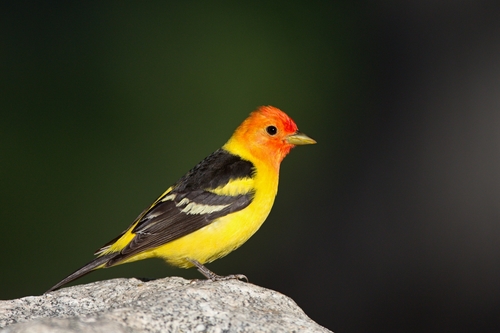
This species, Piranga ludoviciana, has the following measurements: length 6.3–7.5 inches (16–19 cm), weight 0.8–1.3 ounces (24–36 g), and wingspan 11.5 inches (29 cm). Adult individuals have pale, stout pointed bills, yellow underparts, and light wing bars. Breeding adult males have a bright red face, a yellow nape, shoulder, and rump, with black upper back, wings, and tail; in non-breeding plumage, the head only has at most a reddish cast, and the body has an olive tinge. Females have a yellow head, an olive back, and dark wings and tail. The species' song is made of disconnected short phrases that resembles the song of an American robin, but is hoarser and rather monotonous. Its call is described as pit-er-ick.
Piranga ludoviciana breeds in coniferous or mixed woods across western North America, from the Mexico-U.S. border as far north as southern Alaska, making it the northernmost-breeding tanager. The full breeding range extends along western North America's western coast from southeastern Alaska south to northern Baja California, Mexico, and east to western Texas, north through central New Mexico, central Colorado, extreme northwest Nebraska, and areas of western South Dakota to southern Northwest Territories, Canada. The species builds a flimsy cup nest on a horizontal tree branch, usually in a conifer, and lays four bluish-green eggs marked with brown spots. It is a migratory species; most individuals winter from central Mexico to Costa Rica, with some also wintering in Southern California. The full wintering range stretches from central Costa Rica north through Nicaragua, Honduras, El Salvador, and Guatemala to southern Baja California Sur, extreme southeastern Sonora in western Mexico, and southern Tamaulipas in northeastern Mexico. They do not typically occur in the Caribbean lowlands, have been reported wintering further north, and have been observed as far south as Panama. Vagrants are rare to casual in the eastern United States.
Piranga ludoviciana occurs in both natural and disturbed habitats. During the breeding season, it is found primarily in relatively open coniferous forests and mixed woodlands. It has also been recorded in recently logged areas in northwestern California less than five years post-harvest, where the youngest sites were dominated by cutleaf burnweed (Erechtites glomerata) and slightly older sites were mostly composed of tanoak (Lithocarpus densiflorus) with smaller amounts of snowbrush ceanothus (Ceanothus velutinus), whitebark raspberry (Rubus leucodermis), and Sierra gooseberry (Ribes roezlii). During spring and fall migration, individuals have been captured in agricultural areas along New Mexico's Rio Grande made up primarily of alfalfa (Medicago sativa) and corn (Zea mays). The species has also been observed in saltcedar (Tamarix species) communities and Russian olive (Elaeagnus angustifolia) vegetation: in New Mexico, it was observed in nearly pure stands of 10 to 23 foot (3–7 m) tall saltcedar, and in fall migration along the Rio Grande in saltcedar communities; ten individuals were observed across three Russian olive sites in Colorado, Utah, and Idaho, where Russian olive dominated and cheatgrass (Bromus tectorum) made up a substantial portion of the understory; during fall migration along the Rio Grande, the species was most often captured in vegetation with a Rio Grande cottonwood (Populus deltoides subsp. wislizenii) overstory and a moderate to dense Russian olive understory. During migration, the species occurs in a wider range of areas including lowland woodlands of Southern California, desert oases, riparian areas, parks, and orchards. Within its wintering range, it occupies pine (Pinus spp.) and pine-oak (Quercus spp.) woodlands, as well as low-canopied scrub forests, forest edges, and coffee plantations.
The species breeds across a wide range of elevations, from around 183 feet (56 m) in the Northwest up to 10,000 feet (3,050 m). In the northern part of its breeding range, it has been observed at sites over 8,300 feet (2,530 m) in Oregon and as low as 183 feet (56 m) in Oregon's Central Willamette Valley. In the southern portion of its breeding range, it is more typically found on high-elevation sites, having been recorded at 8,270 feet (2,520 m) in Arizona and 9,500 feet (2,900 m) in Nevada.
Piranga ludoviciana forages across many habitats in all successional stages, from grass-forb communities to stands of large trees with over 70% cover. In western Oregon, it was not observed using grass and forb successional stages, but was observed foraging in non-nesting areas such as shrub/sapling and young second-growth (16–40 years old) stands typically made up of Douglas fir. The species is most often observed foraging in forest canopies: in a California area primarily dominated by giant sequoia (Sequoiadendron giganteum), 60% to 75% of its foraging time was spent above 35 feet (10 m), with less than 2% of foraging time below 12 feet (4 m); in coniferous forests of western Montana, it was typically observed foraging in canopy foliage above 26 feet (8 m); in mixed conifer-oak forests in California, it forages between 16 and 92 feet (5–28 m). In Douglas fir-dominated vegetation in British Columbia, 96.9% of observations found the species perched on stems less than 1 inch (<2.5 cm) in diameter, and nearly 85% of observations were either near the branch tip or in the middle of the branch. It foraged on larger trees, with nearly 80% of observations on trees with a trunk diameter of more than about 8 inches (20.0 cm), and over 80% of observations on trees 33 feet (10 m) or taller. It used taller trees and trees with larger diameters significantly more often than these trees are available across all silvicultural treatments analyzed.
Piranga ludoviciana may preferentially forage on certain tree species. In a California study of insect-gleaning birds in mixed conifer-oak forest, the species used white fir more often and incense-cedar (Calocedrus decurrens) less often than expected based on availability. Sugar pine (Pinus lambertiana), Douglas fir, and California black oak (Quercus kelloggii) were used slightly more often than their availability, but this was not statistically significant as 95% confidence intervals overlapped with proportional use. Ponderosa pine was used in proportion to its availability. In mostly Douglas fir-dominated communities in British Columbia, 88.9% of foraging observations were in Douglas fir, 7.4% in ponderosa pine, and 3.7% in other living tree species. Overall, preference for Douglas fir was significantly (p<0.001) greater than its availability. When separated by silvicultural treatment, only 3-year-old light cut sites (where Douglas fir and ponderosa pine larger than 14 inches (35 cm) in diameter at breast height, and other species larger than 6 inches (15 cm) dbh were harvested) and selectively logged sites (where 20% of 6- to 8-inch dbh (15.2–20.3 cm) trees, 25% of 8- to 12-inch dbh (20.3–30.5 cm) trees, 45% of 12- to 24-inch dbh (30.5–61.0 cm) trees, and 75% of >24-inch dbh (>61.0 cm) trees were removed) showed significantly greater use of Douglas fir than expected from availability. The species has also been reported foraging on quaking aspen, balsam poplar (Populus balsamifera subsp. balsamifera), speckled alder (Alnus rugosa), and white spruce in central Alberta.
Although Piranga ludoviciana occurs in stands of varying ages and has been observed at higher densities in young sites, it is typically detected more often in relatively mature stands. For example, in British Columbia's Prince Rupert Forest Region, it occurs more often in mature (50–60 years old) and old-growth (100+ years) quaking aspen than in young (<23 years old) trembling aspen stands. In Alberta, it was detected significantly (p<0.001) more often in old (120+ years old) quaking aspen mixed-wood stands than in mature (50–65 years old) or young (20–30 years old) mixed-wood stands. The same trend has been found in other communities: in Washington, it was observed on sites dominated by older (35-year- and 60-year-old) red alder (Alnus rubra), but not on sites with young (4-year- and 10-year-old) red alder; while it was fairly common on recently harvested sites, it was detected at the most points in "mature" and "old-growth" ponderosa pine in northern Idaho and western Montana; in British Columbia, it had higher densities in mature (over 10 m / 33 ft tall) conifer plots and young conifer/mature conifer transition plots than in young (1–10 m / 3–33 ft tall) conifer plots; in northern California, it occurred at an average density of 53.2 birds per 100 hectares in sawtimber Douglas fir stands (>80–150 years old), 37.0 per 100 ha in mature Douglas fir stands (>100 years old), and 3.1 per 100 ha in sapling Douglas fir stands (<20 years old). Higher densities recorded in young Douglas fir forest in Oregon were in stands 40 to 72 years old, compared to 80 to 120 year old mature forest and 200 to 525 year old old-growth forest.
During migration, Piranga ludoviciana travels alone or in groups of up to 30 birds. At the Rio Grande Nature Center during fall migration, hatching-year individuals were captured on average in early September, later than adult individuals which were captured in mid-August. Migration timing, bird condition, and site differences between spring and fall migration have been studied at this location.
Piranga ludoviciana obtains food through foliage gleaning and hawking, with the usage rate of each method varying by location. In a California mixed conifer-oak forest made up mainly of white fir, Douglas fir, incense-cedar, and California black oak, around 47% of foraging observations were gleaning, around 40% were hawking, lunging occurred in around 6% of observations, and hovering occurred in around 7% of observations. In contrast, in mainly Douglas fir-dominated communities in interior British Columbia, gleaning made up 93.2% of foraging observations, with hawking occurring in just 3.7% of observations and hovering in 3.1%. The species primarily gleans from foliage: in California's mixed conifer-oak woodland, 45% of foraging observations were foliage gleaning, 10% were gleaning from twigs, 5% were gleaning from branches, with the remainder being hawking; in British Columbia, 88.3% of gleaning observations were on foliage, 10.5% on branches and twigs, and 1.2% on trunks.
Around 18% of the species' diet is fruit, and around 82% is a wide range of insects. Fruits eaten include hawthorn apples (Crataegus spp.), raspberries (Rubus spp.), mulberries (Morus spp.), elderberries (Sambucus spp.), serviceberries (Amelanchier spp.), and wild and cultivated cherries (Prunus spp.). Individuals have been observed foraging for nectar from Perry's agave (Agave parryi), eucalyptus (Eucalyptus spp.), and have been recorded eating Russian olive fruits and human-provided food including bird seed and dried fruit. Piranga ludoviciana is a major consumer of western spruce budworms (Choristoneura occidentalis), and has also been observed eating Douglas fir tussock moth larvae (Orgyia pseudotsugata). In August, hymenopterans (mostly wasps and ants) made up 75% of insect content found in the species' stomachs. Other insects found were beetles (Coleoptera, 12%, mainly click beetles (Elateridae) and woodborers (Bupestridae)), true bugs (Hemiptera, 8%), grasshoppers (Orthoptera, 4%), and caterpillars (Lepidoptera, 2%).