About Piranga bidentata Swainson, 1827
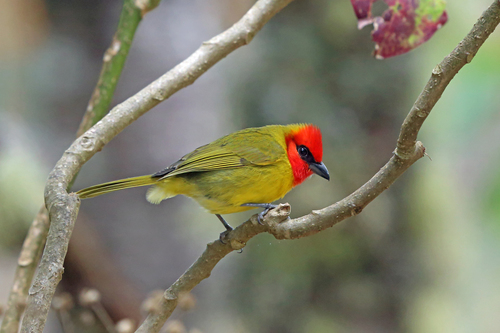
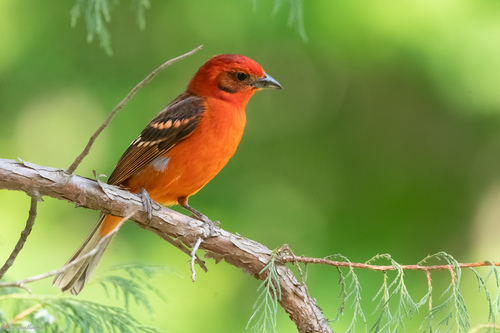
The flame-colored tanager (Piranga bidentata Swainson, 1827) is 18 to 19 cm (7.1 to 7.5 in) long. The nominate subspecies weighs 33.3 to 39.4 g (1.17 to 1.39 oz), while subspecies P. b. flammea weighs 32 to 48.4 g (1.13 to 1.71 oz). The head and underparts of a nominate subspecies male are red-orange, becoming yellower toward the vent area. It has a brown patch below the eye, extending from the bill to behind the eye. Its mantle and back are dusky orange with an olive tint, and its rump is paler with little or no streaking. Females follow a similar pattern, but their head and underparts are yellow, and their back is olive with black streaks. Male P. b. flammea is a paler red-orange than the nominate subspecies. P. b. sanguinolenta is also similar to the nominate, but its head and underparts are bright red to orange-red. P. b. citrea is paler and more orange on the underparts compared to the nominate. The subspecies of flame-colored tanager have the following distributions: P. b. bidentata is found principally from the Mexican states of Sonora and Chihuahua in western Mexico south to Guerrero, and east to near Mexico City. It occasionally reaches southern Arizona, and less frequently reaches western Texas. P. b. flammea is found in Nayarit state, Mexico and the Islas Marías. P. b. sanguinolenta is found from the Mexican states of Nuevo León and Tamaulipas in eastern Mexico south through Guatemala, Honduras, and El Salvador into north central Nicaragua. P. b. citrea is found in Costa Rica and western Panama. The flame-colored tanager inhabits the canopy of humid montane forest, and also lives among large trees in non-forested areas such as pastures, coffee plantations, and gardens. Across most of its range, it is also found in open oak and pine-oak woodlands. It is generally a mountain-dwelling bird, but can be found near sea level in Guatemala. In Mexico, it occurs from 800 m (2,600 ft) to treeline, and in Panama it lives at 1,200 m (3,900 ft) and higher. On the Caribbean slope in Costa Rica it ranges from 1,850 to 2,850 m (6,070 to 9,350 ft), and on the Pacific slope it can be found as low as 900 m (3,000 ft). It is largely resident, but may move to lower elevations in winter. Individuals found in the United States are pre- and post-breeding wanderers and very rare nesters; there have been several sightings and one collected specimen in Texas. Bird watchers observed and recorded a flame-colored tanager in southeastern Wisconsin in April 2023, as reported by USA Today Network-WIS.