About Piprites chloris (Temminck, 1822)
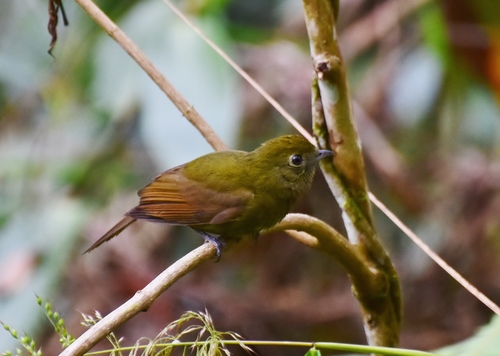
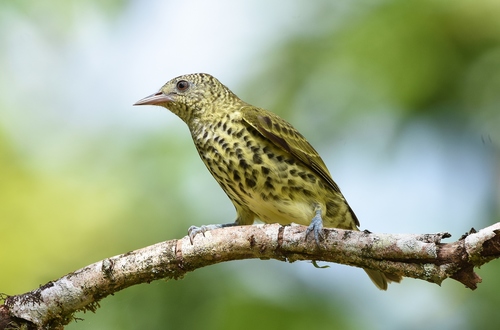
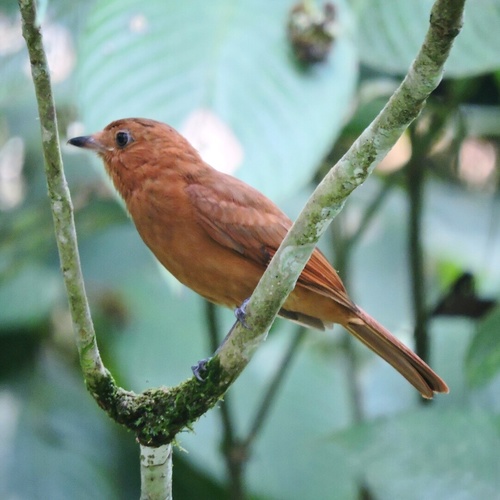
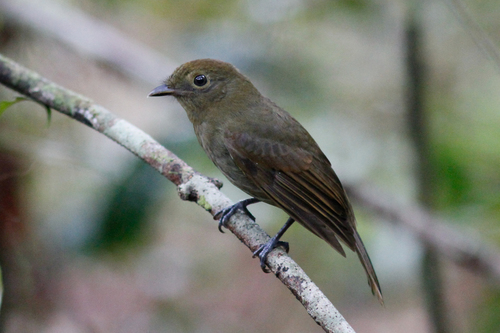
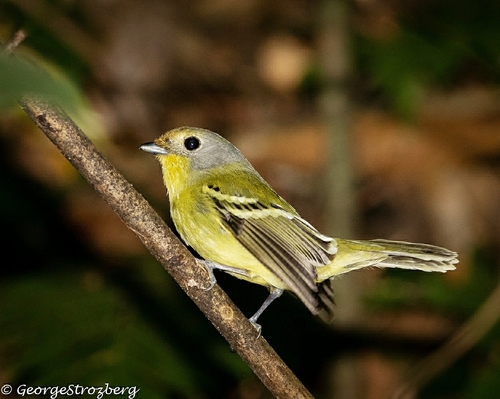
Wing-barred piprites, with the scientific name Piprites chloris (Temminck, 1822), measures 12.5 to 14 cm (4.9 to 5.5 in) in length and weighs 15 to 21 g (0.53 to 0.74 oz). Both sexes share identical plumage. Adult nominate subspecies P. c. chloris have a golden forehead, an olive-green crown, and a slightly grayish olive-green nape. They have golden lores and a distinct bold yellow eyering. Their upperparts and tail are olive-green, with paler green edges along the tail feathers. Their wings are olive-green, with paler green edges on the flight feathers and large creamy to white tips on the wing coverts that form visible bars when the wing is closed. Their underparts are yellow with an olive tint on the breast. The other subspecies of wing-barred piprites differ from the nominate subspecies and from each other as follows: P. c. antioquiae has brighter green upperparts than the nominate, with less gray on the nape, and clearer, brighter yellow underparts with less olive; P. c. perijana has brighter olive upperparts than the nominate, with a gray nape and gray sides of the neck, and wide yellowish white tips on the tail feathers; P. c. tschudii has brighter olive upperparts than the nominate, with a gray nape and gray sides of the neck; P. c. chlorion has a yellow throat, light grayish underparts with a whiter belly than the nominate, and yellowish undertail coverts; P. c. grisescens is grayer overall than the nominate; P. c. boliviana is similar to chlorion, with a yellower breast and vent and a gray band across the belly. All subspecies have a dark iris, a grayish bill, and light pinkish gray legs and feet. Wing-barred piprites has a disjunct distribution, and the range of the nominate subspecies P. c. chloris is separate from all other subspecies. The subspecies are distributed as follows: P. c. antioquiae is found at the northern end of Colombia's Central Andes and in the middle Magdalena River Valley; P. c. perijana is found in Serranía del Perijá on the Colombia-Venezuela border and the eastern Andes in Venezuela's Táchira state; P. c. tschudii ranges through Guainía Department in extreme eastern Colombia, southern Amazonas state in extreme southern Venezuela, western and central Amazonian Brazil to the Negro and lower Juruá rivers, and south through eastern Ecuador to Junín Department in Peru; P. c. chlorion ranges through the Venezuelan Coastal Range, from eastern Venezuela's Amazonas and Bolívar states south into eastern Colombia, and east through the Guianas and northern Brazil from the lower Negro and lower Madeira rivers to the Atlantic coast; P. c. grisescens is found in eastern Pará and Maranhão states in northeastern Brazil; P. c. boliviana is found in southwestern Amazonian Brazil between the upper Juruá and upper Madeira rivers, and in northern and eastern Bolivia; the population in southeastern Peru may belong to this subspecies; P. c. chloris (nominate) is found in eastern Brazil from southern Mato Grosso do Sul east to São Paulo state and south to northern Rio Grande do Sul, eastern Paraguay, and Argentina's Misiones Province; it also occurs intermittently along the Brazilian coast from Pernambuco to Santa Catarina. Wing-barred piprites inhabits humid primary forest and mature secondary woodland, where it favors dense understory and also vine tangles in the canopy. In the southern part of its range it occurs in Araucaria forest, and in the northern part it occurs in cloudforest. In Brazil, it mostly occurs from sea level to 1,000 m (3,300 ft), but is found locally as high as 1,700 m (5,600 ft). In Venezuela, it occurs between 350 and 2,000 m (1,100 and 6,600 ft) elevation. It reaches up to 800 m (2,600 ft) in Colombia, 1,100 m (3,600 ft) in Ecuador, and 1,500 m (4,900 ft) in Peru.