About Pipreola arcuata (Lafresnaye, 1843)
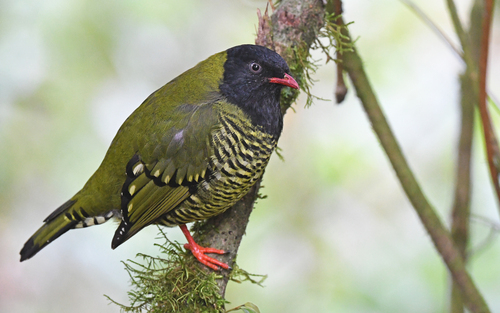
This species, commonly called the barred fruiteater, has the scientific name Pipreola arcuata (Lafresnaye, 1843). The barred fruiteater is one of the largest species in its genus, with a body length of 22 to 23 cm (8.7 to 9.1 inches) and a weight of 112 to 128 g (4.0 to 4.5 ounces). Males and females have different plumage, but unlike other fruiteaters, both sexes have barred breasts. For adult males of the nominate subspecies, the entire head, neck, and upper breast are black. Their upperparts are olive-green, and their wings and tail are mostly this same olive-green color. The greater coverts and tertials of the wing have large yellow spots. The tail has a black bar near its tip, and the feather tips are whitish. Their underparts are yellow with distinct crisp black bars. Females have an olive-green head instead of the male's black head, and the black-barred yellow underparts extend to include the throat and upper breast. Both sexes have an iris that can be red, orange, yellow, or chestnut, a crimson bill that sometimes has a black tip, and scarlet legs and feet. The subspecies P. a. viridicauda has pale yellow to creamy irises, and less black and white on its outer tail feathers than the nominate subspecies. The barred fruiteater has a disjunct distribution. The nominate subspecies has a much larger, though still discontinuous, range. It occurs in the Serranía del Perijá along the Colombia-Venezuela border, in the Venezuelan Andes from Lara west into the eastern Andes of Colombia, from the central and western Andes of Colombia south through the Andes of Ecuador to far northern Peru's Piura Department, and on the eastern slope of the Peruvian Andes from Amazonas south to Pasco Department. Subspecies P. a. viridicauda is found on the eastern slope of the Andes from Peru's Junín Department south into Bolivia's La Paz and Cochabamba departments. The barred fruiteater lives in the interior and edges of temperate zone montane forest, including cloudforest. Its elevation range varies by location: it is found between 1,800 and 3,100 m (5,900 and 10,200 ft) in Venezuela, between 2,000 and 3,400 m (6,600 and 11,200 ft) in Colombia, mostly between 2,500 and 3,300 m (8,200 and 10,800 ft) in Ecuador, and between 2,100 and 3,500 m (6,900 and 11,500 ft) in Peru.