About Pipra pipra (Linnaeus, 1758)
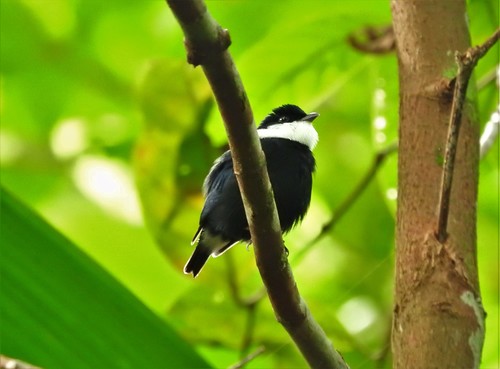
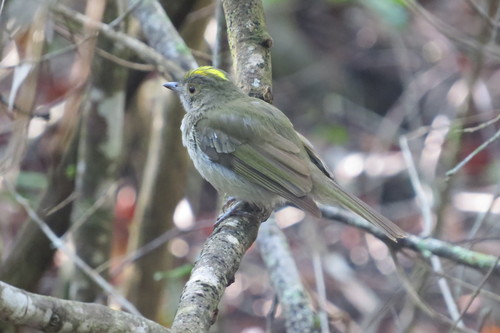
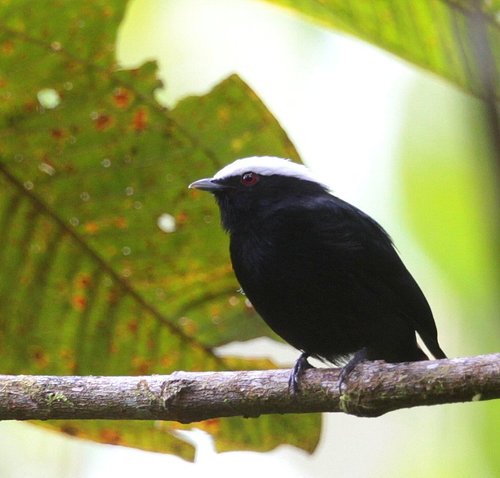
The white-crowned manakin, scientifically named Pipra pipra (Linnaeus, 1758), measures 9–10 cm (3.5–3.9 in) in total length. Males of the nominate subspecies have an average weight of 11.0 g (0.39 oz), while females are slightly heavier, averaging 12.8 g (0.45 oz). It is a compact, short-tailed bird with a stout hooked bill, dark legs, red eyes, and striking male plumage. Adult males are mostly black with a white crown that can be erected into a low crest. Their call is a buzzy jeeeee; when displaying, the call is louder and preceded by a popping p-p-p chee. Females and young males are olive-green with a grey head and throat, and grey-green or olive underparts. The female of the eastern Andean subspecies coracina is brighter and greener both above and below than the nominate pipra subspecies, but the combination of a grey head and red eyes makes specific identification relatively easy for female white-crowned manakins of any race. The white-crowned manakin is a widespread species, with populations in southern Central America, northern South America, and parts of Amazonia. There are reports of an extremely isolated population in a relatively small area of the Atlantic Forest of eastern Brazil. It is common in mountain foothills, and breeds mainly between 800 and 1600 m, though in northeastern Venezuela it occurs down to sea level. This species lives in the understory of wet forest and adjacent tall second growth. It occupies dense humid forest and adjacent tall secondary woodland, but is also found in younger secondary forest, sandy-belt forests, and isolated forest 'islands' in savannas within the Orinoco and Rio Negro drainages, including Amazonian caatingas or campinaranas. In Ecuador, this manakin is largely absent from level-ground terra firme forest, and instead prefers hilly terra firme above 250 m. In the Colombian Andes it generally occurs at 600–1,200 m, though at the species' northernmost extremity it has been recorded as low as 100 m. Like other manakins, this species has a breeding display at a communal lek. However, the leks of this species are much more dispersed than the small cleared areas used by most manakins: 3-4 males stay just within earshot of each other, and can be up to 100 m apart. Males fly between horizontal perches that are 3–12 m high and up to 50 m apart with a swooping flight; when a female is present, males use a slow butterfly-like flutter. The white-crowned manakin feeds low in trees on fruit and some insects, which it plucks from foliage while in flight.