About Pipra filicauda Spix, 1825
The wire-tailed manakin, Pipra filicauda Spix, 1825, is a sexually dimorphic species. When the eponymous tail filaments are excluded, the species measures 11 to 12 cm (4.3 to 4.7 in) in length. A male's tail filaments add approximately 4 cm (1.6 in) to its total length, while a female's tail filaments add about 2.5 cm (1.0 in). The average weight of the species is roughly 14 g (0.49 oz).
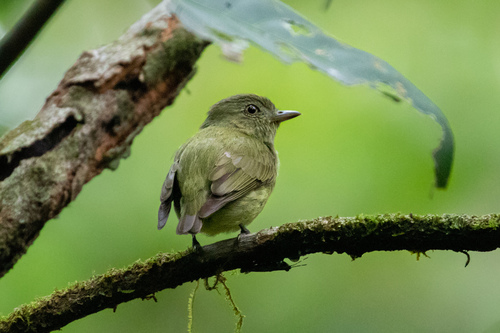
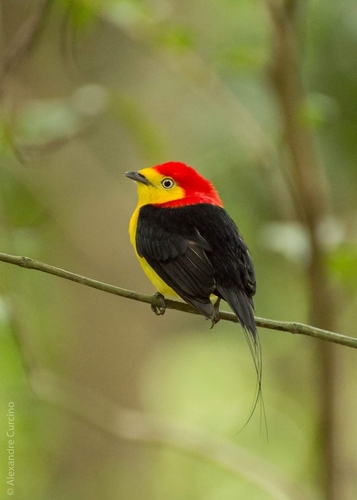
For the nominate subspecies, adult males have a yellow forecrown, face, and throat. The rest of their crown, nape, and sides of the neck are bright red. Their remaining upperparts, wings, and tail are black, and their entire underparts are yellow. They have a white or whitish iris. Adult females have mostly dull olive-green head, upperparts, wings, and tail. Their face and breast carry a yellow tinge, and their lower breast and belly are grayish, with the lightest gray on the belly. Their iris is pale gray, magenta, or whitish. Both sexes have a blackish bill and sooty reddish legs and feet. Immature birds of both sexes resemble adult females, but have a brown iris. The subspecies P. f. subpallida is essentially identical to the nominate subspecies, except that males are slightly paler across their entire body.
There are two subspecies of wire-tailed manakin; the nominate subspecies is the more northwesterly of the two and has a much smaller range. It occurs east of the Andes in Colombia, extending into western Venezuela on both sides of the Andes. North of the Andes, its range reaches northeastern Zulia and southern Lara. South of the Andes, its range extends from Táchira and western Apure northeast to a north-south line roughly running from the Federal District and Miranda south to southern Apure.
Subspecies P. f. subpallida is found from eastern Ecuador and northeastern Peru (north of the middle Ucayali River) east across western and southern Amazonas in Venezuela, and into northwestern and central Brazil. In Brazil, its range extends east north of the Amazon to the Branco and Negro rivers, and south of the Amazon to the upper Juruá and middle Purus rivers.
The wire-tailed manakin lives in a variety of somewhat open landscapes, and in all of these landscapes it favors areas along watercourses. These habitats include gallery forest, secondary forest, and open woodlands. In Venezuela, the species also occurs in coffee and cacao plantations.
Its maximum elevation range differs by region: up to 500 m (1,600 ft) in Colombia and Ecuador; up to 1,000 m (3,300 ft) north of the Orinoco River in Venezuela, and only up to 300 m (1,000 ft) south of the Orinoco in Venezuela; and up to 600 m (2,000 ft) in Brazil.