About Pipra fasciicauda Hellmayr, 1906
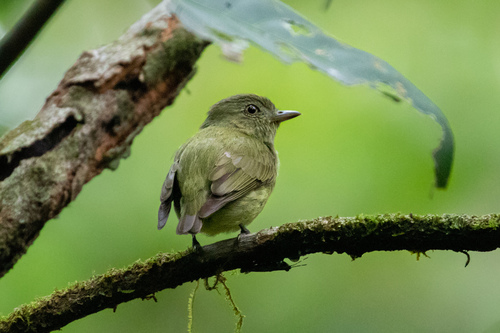
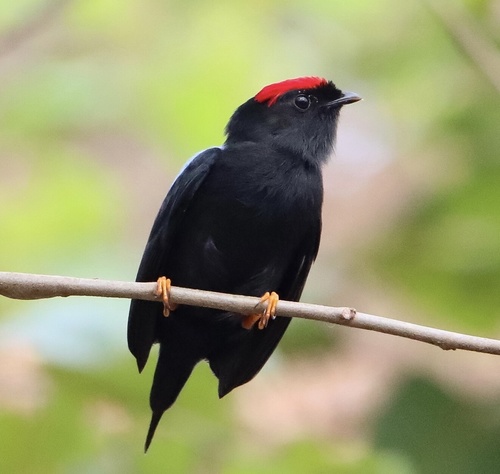
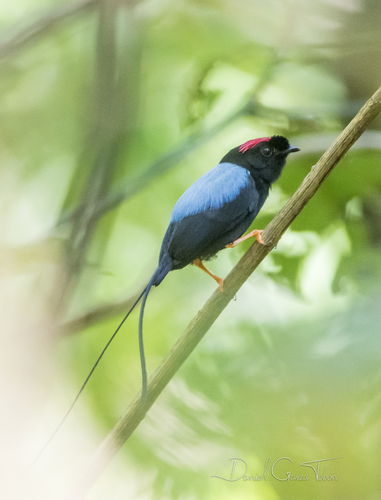
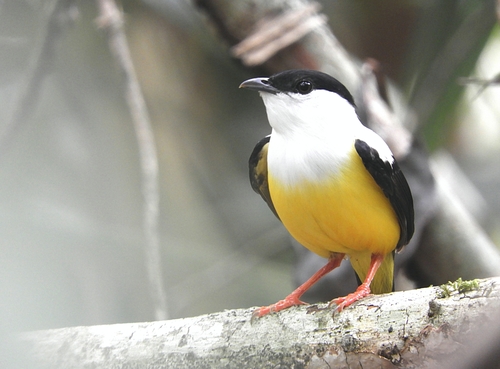
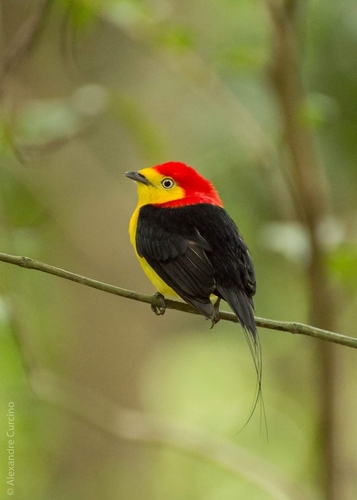
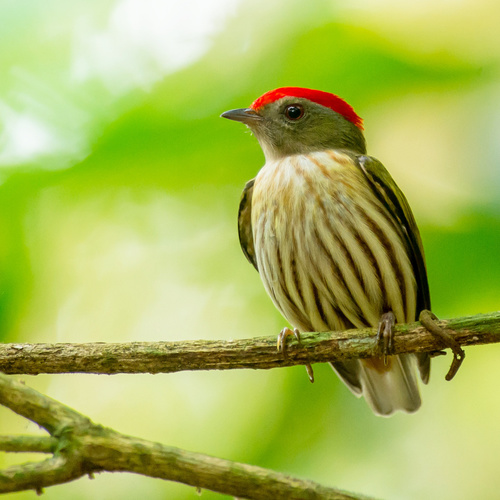
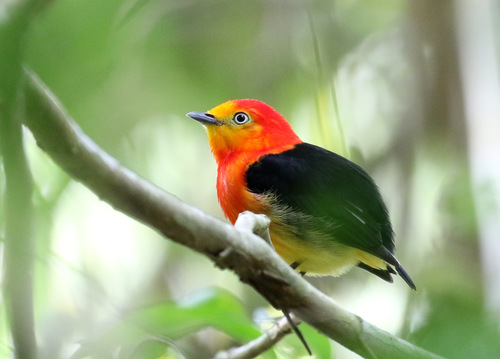
The band-tailed manakin (Pipra fasciicauda Hellmayr, 1906) measures 10 to 11 cm (3.9 to 4.3 in) in length and weighs 11.5 to 19 g (0.41 to 0.67 oz), and is sexually dimorphic. For the nominate subspecies P. f. fasciicauda, adult males have a yellow face and throat; the rest of the head, nape, and upper mantle are red. Their remaining upperparts, wings, and tail are mostly black, with a white base to the tail and a white patch on the inner webs of the flight feathers that appears as a stripe during flight. The red plumage from the nape extends onto the breast, mixed with some yellow, and the rest of the underparts are light creamy yellow. Adult males have a white or whitish iris. Adult females have mostly dull olive-green head, upperparts, wings, and tail. Their face and breast carry a yellow tinge, while their lower breast and belly are grayish, lightest on the belly. Their iris ranges from pale gray or magenta to whitish. Both sexes have a blackish bill with some pale gray on the mandible, dull reddish legs, and sooty gray feet. Immature males resemble adult females except they have a brown or gray iris. Other subspecies differ only slightly from the nominate: P. f. calamae has slightly more red on its breast, P. f. scarlatina has even more deeper red breast plumage, and P. f. saturata has a nearly entirely red breast and upper belly. Formative plumage is overall olive-green, with distinct molt limits in the greater coverts. Juvenile feathers are dull green with some yellow wash; new, larger coverts are a brighter green, with denser barbules that protrude 2-3 mm past the old feathers. In this plumage, iris color ranges from pinkish to white; the upper mandible of the bill is gray with a pale base, and the lower mandible is mainly a pale shade. The band-tailed manakin is native to the southern Amazon Basin and the Pantanal. The five recognized subspecies have the following distributions: P. f. calamae occurs in west-central Brazil, along the upper Madeira River and in far northwestern Mato Grosso. P. f. saturata is found in the Huallaga River watershed in northern Peru's Department of San Martín. P. f. purusiana ranges from eastern Peru between Loreto and Cuzco departments east into western Brazil's Acre and western Amazonas states. P. f. fasciicauda ranges from Madre de Dios and northern Puno departments in southeastern Peru east into Bolivia's northern Santa Cruz Department. P. f. scarlatina is found in central Brazil roughly bounded by central Pará, western Mato Grosso do Sul, southern Goiás, western Minas Gerais, and northwestern São Paulo states, extending into far northern Bolivia's Pando and Beni departments and far northeastern Argentina's Misiones Province; it also has isolated populations in northeastern Brazil's Ceará and Alagoas states. This species inhabits lowland várzea and gallery forests. It occurs up to an elevation of 600 m (2,000 ft) in Brazil and 1,000 m (3,300 ft) in Peru.