About Pipilo erythrophthalmus (Linnaeus, 1758)
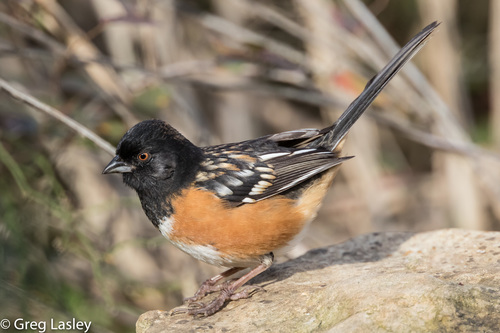
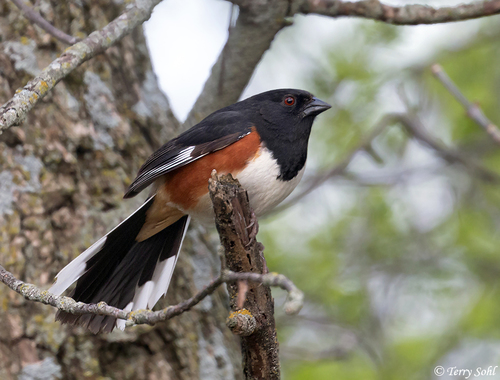
The eastern towhee (Pipilo erythrophthalmus, first described by Linnaeus in 1758) is a large, striking New World sparrow species. It measures 17.3 to 23 cm (6.8 to 9.1 inches) in total length, with a wingspan of 20 to 30 cm (7.9 to 11.8 inches). Body mass ranges from 32 to 53 g (1.1 to 1.9 oz), with an average of 40 g (1.4 oz). Adult eastern towhees have rufous sides, a white belly, and a long dark tail with white edges. Most populations have red eyes, while southeastern US populations have a yellow-eyed "white-eye morph." Males have black heads, upper bodies, and tails; these areas are brown in females. Juveniles are solid brown overall. Eastern towhees of all ages and both sexes are generally easy to distinguish from other species. Their range occasionally overlaps with their sister species, the spotted towhee, in the Great Plains, and rare hybrids between the two species have been recorded. The eastern towhee is distributed across the eastern United States and southeastern Canada. Its range extends from southern Saskatchewan, southwestern Ontario, and Quebec south to Florida, and west to eastern Texas. Populations north of southern New England through northern Indiana and Illinois to southern Iowa are primarily summer residents. The nominate subspecies P. e. erythrophthalmus breeds in the northernmost part of the species' range, and migrates south to the southern and eastern parts of the species' range for winter. The other recognized subspecies are mostly non-migratory residents. P. e. canaster ranges from south-central Louisiana north to northeastern Louisiana, east through Mississippi, extreme southwestern Tennessee, northern Alabama and Georgia, central South Carolina to western North Carolina, and south to northwestern Florida and east along the Gulf Coast. The range of P. e. rileyi runs from northern Florida through southern Georgia and coastal South Carolina to east-central North Carolina. P. e. alleni is found only in peninsular Florida. Eastern towhees occupy vegetation in disturbed areas, such as old-field successional vegetation and shrubby power line right-of-ways. In northwestern Arkansas, eastern towhees occurred in old-field vegetation where dwarf sumac (Rhus copallina) was present at 28.6% frequency, winged elm (Ulmus alata) at 21% frequency, and black cherry (Prunus serotina) at 19.2% frequency. Shrubby vegetation along power lines is commonly used by the species; in Maryland, eastern towhee territories along a power line right-of-way aligned with shrubby areas that included Allegheny blackberry (Rubus allegheniensis) and blueberry (Vaccinium spp.), alongside other species such as hawthorn (Crataegus spp.), red maple (Acer rubrum), black cherry, and black locust (Robinia pseudoacacia). Between 1966 and 2015, the eastern towhee population declined more than 1.5% annually across the Atlantic seaboard and the northern part of its breeding range. In summer, eastern towhees occur from near sea level up to 6,500 ft (2,000 m) along the Tennessee-North Carolina border; one literature review recorded individuals up to 3,000 ft (910 m) in New Hampshire. Eastern towhees spend most of their time close to the ground. In spring in Pennsylvania, eastern towhees were observed below 3 ft (0.91 m) from the ground significantly (p<0.05) more often than expected by random chance, and observed above 3 ft (0.91 m) significantly less often than expected. In a Louisiana bottomland forest, 62% of eastern towhee observations were within 2 ft (0.61 m) of the ground, and only 4% were above 25 ft (7.6 m). In spring, this pattern shifted slightly: detections below 25 ft dropped from 70% to 65%, and detections in the canopy (over 25 ft) increased from 4% to 7. Eastern towhees can be found in many habitats, from tallgrass prairies and marshes to mature forests, but they are most common in early successional stands, habitat edges, and areas with similar vegetation structure across eastern forests. In most communities, they are more abundant in young successional stands, with multiple studies finding higher abundance on early successional sites than later-successional sites. In West Virginia, a 15-year-old clearcut had a higher mean number of breeding eastern towhees (0.70 birds per 50-m radius) and higher nest success (58%) than an unharvested stand of yellow-poplar, black cherry, red maple, sugar maple, and white ash. In a southern Missouri oak-hickory forest, eastern towhees were not present before clearcutting or in the nearby uncut forest after cutting, but occurred at a mean density of 9.3 birds per 10 ha in a 3-year-old clearcut. A study of stands of varying ages in central New York found that eastern towhee density peaked in early successional stands. While eastern towhees generally prefer young successional sites, variation between habitat types and years has been observed. A 1995 study found higher relative abundance of eastern towhees in young (2 to 6 year old) loblolly and longleaf pine stands than mature (32 to 98 year old) stands, but when the same stands were compared in 1996, the 95% confidence intervals for relative abundance on the two sites overlapped substantially. How eastern towhees respond to succession depends on the habitat. In Pennsylvania, there was a significant (p<0.05) difference in eastern towhee density between mature mixed-oak forest and stands clearcut about 5 years previously. However, there was no significant difference in density between a 1-year-old mixed aspen clearcut, a 5-year-old aspen clearcut, and a mature aspen stand. Eastern towhee abundance peaks at different successional stages in different habitats: in central hardwood forests they are most abundant in regenerating stands, while in loblolly and shortleaf pine forests they are most common in pole timber and mature stands. Additionally, one study concluded that "early successional" is too broad a term to describe optimal eastern towhee habitat, because high density of small trees was negatively associated with eastern towhee density in the eastern panhandle of West Virginia. Eastern towhees generally prefer sites with early successional characteristics, specifically low canopy cover and a dense understory. Multiple studies have found negative correlations between eastern towhee abundance and overstory density. Across 6 habitat types in Pennsylvania, average eastern towhee density was significantly (p<0.05) negatively correlated with both overstory tree density and overstory tree basal area. In a western Virginia hardwood forest, eastern towhee count was also significantly (p<0.05) inversely correlated with total percent canopy cover. In a loblolly pine forest in South Carolina, the average number of eastern towhee breeding territories per experimental unit was significantly (p≤0.008) negatively correlated with mid-story (10 to 46 ft / 3.0 to 14.0 m) pine (Pinus spp.) and deciduous wood volume. Many studies have found a positive correlation between eastern towhee abundance and understory density. In the same South Carolina loblolly pine forest, understory (0 to 10 ft / 0.0 to 3.0 m) pine volume was significantly (p<0.001) positively correlated with the average number of eastern towhee territories per experimental unit. One study found average eastern towhee density across 6 habitat types was significantly (p<0.05) positively correlated with density of short (2 to 5 foot / 0.5 to 1.5 m) shrubs. In east-central Florida slash pine (P. elliottii) flatwoods with understories dominated by myrtle oak (Quercus myrtifolia) and sand live oak (Q. geminata), and in scrub sites with scattered slash pine and cabbage palmetto (Sabal palmetto), eastern towhee densities were significantly (p=0.01) negatively correlated with mean shrub height. Eastern towhees may prefer or avoid specific plant communities. In Iowa riparian vegetation, eastern towhee density was significantly (p≤0.01) positively associated with total plant and vine species richness, and negatively correlated with forb and deciduous tree species richness. In West Virginia, eastern towhees were associated with plant species that grow on drier ridgetops, such as blackberry (p<0.02), black cherry (p<0.002), and black locust (p<0.04). These sites typically have open canopies and low tree density. Eastern towhee density was negatively associated with plants of moister parts of the study area, such as black tupelo (Nyssa sylvatica, p<0.006), red maple (p<0.001), and witch hazel (p<0.03). In central New Jersey, eastern towhees were significantly (p=0.03) more abundant in gray dogwood (Cornus racemosa) shrubland than in either eastern redcedar (Juniperus virginiana) or multiflora rose (Rosa multiflora) shrublands. Eastern towhees typically nest on or near the ground. Multiple literature reviews note most eastern towhee nests are located below 5 feet (1.5 m). In a cowbird parasitism study on Sanibel Island, all 5 located eastern towhee nests were within 6 feet (1.8 m) of the ground. Literature reviews have recorded nests as high as 18 feet (5.5 m). In mixed aspen stands of varying ages in Pennsylvania, nests higher off the ground had significantly (p<0.001) lower nest success. Out of 13 unsuccessful eastern towhee nests, 11 were more than 1 foot (0.30 m) above the ground. In West Virginia, there were no significant (p>0.05) differences in the surrounding habitat between successful and unsuccessful eastern towhee nests. Large snags (≥9 inches diameter at breast height / ≥22.9 cm) did not affect nesting success. In even-aged mixed-aspen stands in Pennsylvania, nesting success was not significantly (p>0.05) affected by stand age or distance to habitat edge. Eastern towhees build nests in a variety of plant species including grape and blueberry (Vaccinium spp.). In South Carolina loblolly and longleaf pine forests and clearcuts, the majority of observed nests were located in grape, tree sparkleberry (V. arboreum), and oak (Quercus spp.). On an oak-hickory site in West Virginia, 27% of 41 eastern towhee nests were found in grape, 17% in blackberry (Rubus spp.), 12% in greenbrier (Smilax spp.), 12% in mountain-laurel (Kalmia latifolia), with additional nests in Virginia creeper (Parthenocissus quinquefolia), spice bush (Lindera benzoin), and azalea (Rhododendron spp.). In a Pennsylvania power line right-of-way, the 6 observed eastern towhee nests were found in Allegheny blackberry, witch-hazel (Hamamelis virginiana), blueberry, white oak (Q. alba), a combination of eastern hayscented fern (Dennstaedtia punctilobula) and sweetfern (Comptonia peregrina), and directly on the ground. According to literature reviews, ground nests are embedded in litter in dry areas, and typically occur at the base of grasses, forbs, low shrubs, or small trees. Foraging habitat selection by eastern towhees has been studied in Massachusetts and New Jersey. When foraging in a southeastern Massachusetts pitch pine barren, eastern towhees preferred species such as pitch pine, bear oak (Q. ilicifolia), and other deciduous trees, mostly oaks. They avoided ericaceous species, and their use of different tree species differed significantly (p<0.001) from what would be expected based on availability. On two New Jersey sites, eastern towhee foraging preference changed over the course of the breeding season. On an oak-dominated site (primarily black oak Q. velutina), eastern towhees used oaks in May proportional to oak density, as expected. In June and July, after relative arthropod biomass declined in oaks, they used oaks less often than expected. On a pitch pine-dominated site, use of oaks (primarily bear oak and blackjack oak, Q. marilandica) was greater than expected in May, but proportional to availability in June and July. These negative correlations between date and oak use were significant (p<0.025) for both sites. Use of the oak-dominated site also decreased significantly (p<0.05) through the summer. Eastern towhees often prefer edge habitats. In northern Florida, the mean abundance of eastern towhees at the interface between a baldcypress (Taxodium distichum) stand and a 13-year-old planted slash pine stand was 22 breeding birds; mean abundance was 15 in the planted slash pine stand, 18 at the edge of the baldcypress stand, and eastern towhees were not found in the interior of either the baldcypress forest or the clearcut. In eastern Tennessee, eastern towhee density declined with increasing distance from the edge between a power line right-of-way and an oak-hickory forest. At the edge, density was just over 10 pairs per 40 ha, while 197 feet (60 m) from the edge, density dropped to 1 pair per 40 ha. In experimentally clearcut Pennsylvanian forests containing white oak, northern red oak (Q. rubra), chestnut oak (Q. prinus), scarlet oak (Q. coccinea), red maple, quaking aspen, bigtooth aspen, and pitch pine, male towhees were detected significantly (p<0.05) more often than expected in the most patchily arranged clearcut areas. Multiple studies have examined how habitat patch size affects eastern towhees. In New Jersey mixed-oak forest, eastern towhee frequency generally increased with patch size, although the species was detected in all plot sizes from 0.5 to 59 acres (0.20 to 23.88 ha), except plots of 0.02 acres (0.01 ha). On one South Carolina site, eastern towhee frequency of occurrence increased as clearcut size increased from less than 2.5 acres (1.0 hectare) up to clearcuts from 21 to about 32 acres (8.5 to 12.8 ha). On another South Carolina site, eastern towhee frequency declined as clearcut size increased from 19 to 48 to 62 acres (7.7 to 19.4 to 25.1 ha). Eastern towhees only bred in Iowa riparian vegetation patches that were at least 650 feet (200 m) wide. In southern and eastern Pennsylvania, eastern towhee nest success was not significantly (p≥0.10) different between sites with gradual edges and more distinct edges between wildlife habitat openings and oak-hickory forest. Eastern towhees primarily forage on the ground, though they also glean food from vegetation. In a southeastern Massachusetts pitch pine barren, 73.5% of male and 80.4% of female foraging observations were on the ground. When foraging on the ground, eastern towhees use a distinctive scratching technique where both feet kick back simultaneously; a laboratory study found four eastern towhees used this method to successfully obtain seed buried almost 1 inch (2.5 cm) deep. When foraging above ground, most time is spent gleaning from foliage; in Massachusetts, 22.5% of male and 16.3% of female foraging observations were gleaning from foliage. Eastern towhees were also observed gleaning from twigs, branches, and trunks. When gleaning, eastern towhees occurred significantly (p<0.01) more often on the distal half of tree branches than would be expected if they used proximal and distal portions equally. Hovering was observed in 0.5% of male and 0.3% of female foraging observations, and eastern towhees were never observed catching food mid-air. Eastern towhees eat a mixture of plant and animal matter. Literature reviews report they eat seeds, fruits, many invertebrates, and occasionally small amphibians, snakes, and lizards. They have also been observed foraging at bird feeders. Animal matter makes up a larger proportion of the diet during the breeding season: in fall and winter, plants make up 79% and 85% of the diet respectively, and this drops to 53% in spring and 43% in summer. Common insect prey include beetles (Coleoptera), grasshoppers and crickets (Orthoptera), ants, wasps, and bees (Hymenoptera), and moths and caterpillars (Lepidoptera). They eat other invertebrates such as spiders (Araneae), millipedes (Diplopoda), centipedes (Chilopoda), and snails (Gastropoda) less often. Plant foods that make up at least 5% of the eastern towhee diet include ragweed (Ambrosia spp.), oak, smartweed (Polygonum spp.), and corn (Zea mays) in the Northeast, and blackberry, oak, panicgrass (Panicum spp.), ragweed, and wax-myrtle (Morella cerifera) in the Southeast.