About Piper nigrum L.
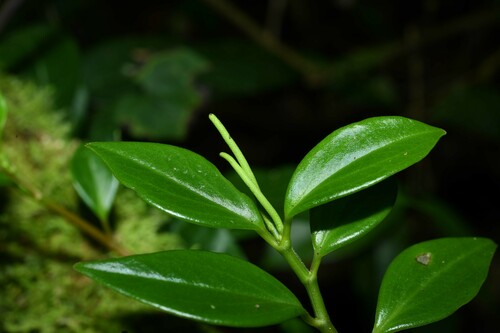
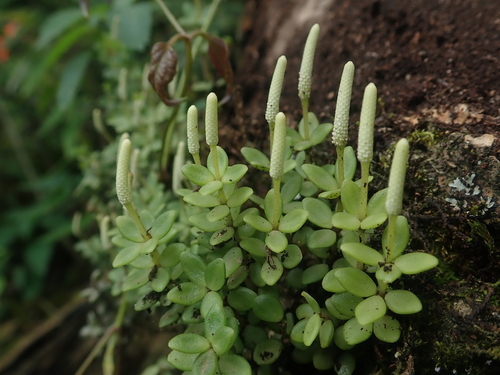
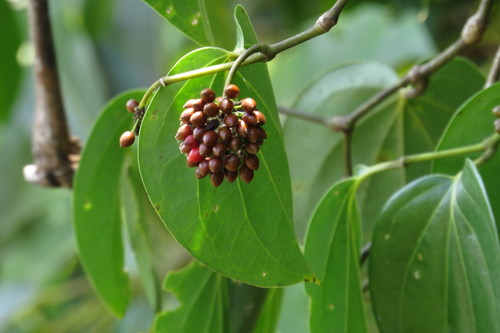
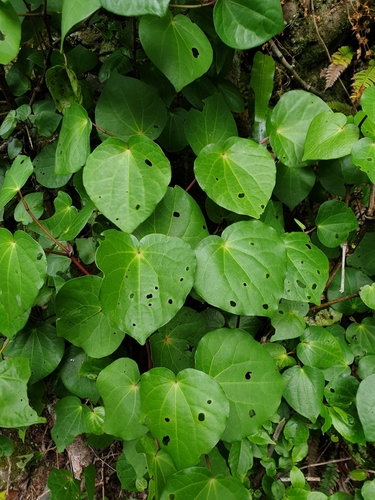
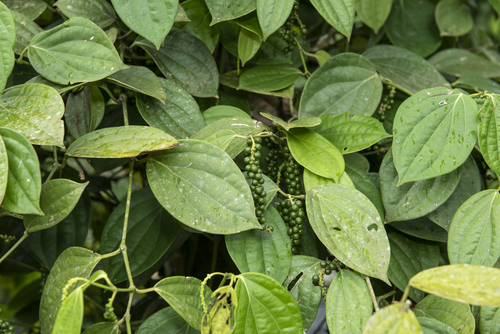
Piper nigrum L., commonly known as black pepper, is a perennial woody vine that reaches up to 4 m (13 ft) in height when growing on supporting trees, poles, or trellises. It is a spreading vine that roots easily wherever its trailing stems make contact with the ground. Its leaves are alternate and entire, measuring 5 to 10 cm (2 to 4 in) long and 3 to 6 cm (1 to 2+1⁄2 in) across. Small flowers grow on pendulous spikes 4 to 8 cm (1+1⁄2 to 3 in) long that form at leaf nodes; these spikes lengthen to 7 to 15 cm (2+3⁄4 to 6 in) as the fruit matures. A single stem produces 20 to 30 fruiting spikes. The fruit of black pepper is a drupe, and when dried it is called a peppercorn. Within the genus Piper, black pepper is most closely related to other Asian species such as P. caninum. Black pepper is native to either Southeast Asia or South Asia, and may originate from the Malabar Coast of India, where Malabar pepper is widely cultivated. Wild black pepper grows in the Western Ghats region of India. Scottish botanist Francis Buchanan recorded that this region held extensive wild pepper vines in its forests through the 19th century. Deforestation has restricted wild black pepper to more limited forest patches between Goa and Kerala, and the wild population has gradually declined as cultivated varieties developed improved fruit quality and yield. To date, no successful grafting of commercial pepper onto wild pepper has been achieved. Black pepper grows best in moist, well-drained soil rich in organic matter that is neither too dry nor prone to flooding. The vines thrive at elevations below 900 m (3,000 ft) above sea level. Black pepper plants are propagated from cuttings roughly 40 to 50 cm (16 to 20 in) long; cultivators typically select cuttings from varieties bred for both high fruit yield and good quality. Cuttings are tied to nearby trees or climbing frames, spaced around 2 m (6+1⁄2 ft) apart. Trees with rough bark are preferred over smooth-barked trees, as pepper plants climb rough bark more easily. Competing vegetation is cleared away, leaving only enough trees to provide shade and allow good air flow. The roots are covered with leaf mulch and manure, and shoots are trimmed twice each year. Young plants growing in dry soil need watering every other day during the dry season for their first three years. Plants start bearing fruit in their fourth or fifth year, and typically continue producing fruit for seven years after that. Harvesting starts when one or two fruits at the base of the fruiting spikes begin to turn red, before the fruit becomes fully mature and while it is still hard. If fruits are left to ripen completely, they lose their pungency, and eventually fall off the plant and are lost. Harvested spikes are collected and spread out to dry in the sun, then the peppercorns are stripped away from the spikes. Like many Eastern spices, black pepper was historically used both as a seasoning and as a traditional medicine. Black pepper is listed in chapter five of the Buddhist Samaññaphala Sutta as one of the few medicines that monks are permitted to carry. Long pepper, which has a stronger effect, was often the preferred medicinal form, but both long pepper and black pepper were used. Black pepper, or possibly long pepper, was historically believed to cure multiple illnesses including constipation, insomnia, oral abscesses, sunburn, and toothaches, among other conditions. Black pepper contains phytochemicals, including amides, piperidines, and pyrrolidines. It is widely known that black pepper causes sneezing. Some sources state that piperine, a compound found in black pepper, irritates the nostrils to trigger sneezing, but very few controlled studies have been conducted to confirm this claim.