About Pipa pipa (Linnaeus, 1758)
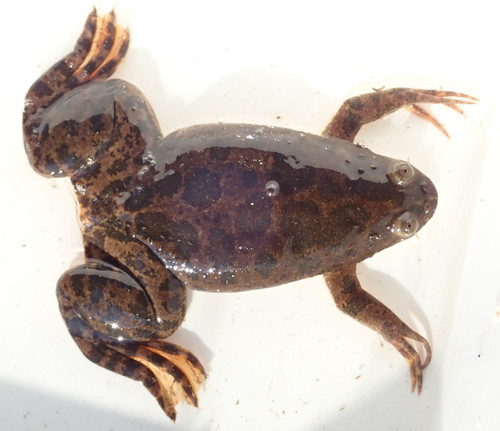
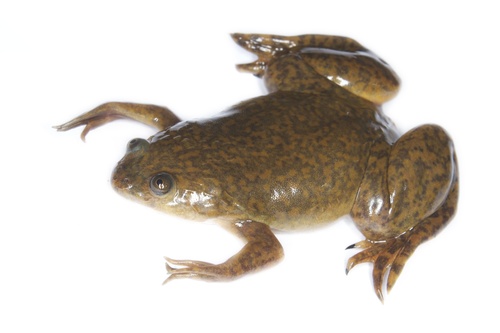
Pipa pipa, commonly known as the Surinam toad, is a strictly aquatic frog and the largest species in its genus. It has an extremely flattened, almost entirely flat body, paired with a broad, flat, triangular head, and lacks a tongue. Its mottled brown body closely resembles a fallen leaf. Its skin is mostly light brown with darker spots on the back, which provides effective camouflage. All four feet are broadly webbed, and the front toes bear small, star-shaped appendages; each fingertip is modified into four small lobes. Males reach a maximum length of 154 mm, while females can grow up to 171 mm. Beyond size difference, females can be identified by their ring-shaped cloacas, which are visible when they are ready to breed. This species has terminal nostrils, very small eyes, and no tympanum. Its limbs are held in a laterally sprawled position aligned with the plane of its body. Because it has no tongue, Pipa pipa cannot capture prey the way most other frogs do, and instead uses suction to catch prey. Its skull is hyperossified, and both its cranial and postcranial bones are heavily modified compared to other anurans. While its eyes are relatively small and narrow, the species has a lateral line system and neuromast organs, which are thought to help it detect prey and predators. Unlike some other amphibians, the Surinam toad does not produce dermal antimicrobial peptides that can inhibit disease agents such as chytridiomycosis and Ranavirus, which may leave it slightly more susceptible to these illnesses. Despite its common name, the Surinam toad is native to multiple South American countries east of the Andes: in addition to Suriname, it is found in Bolivia, Brazil (mainly the states of Acre, Amazonas, Mato Grosso, Pará, and Rondônia), Colombia, Ecuador, French Guiana, Guyana, and Venezuela, in tropical rainforest areas. A small potential population also occurs in the southwestern corner of the island of Trinidad, which lies just north of Venezuela across the Columbus Channel. Within its genus, Pipa pipa has the largest geographic distribution. It lives in warm, acidic, murky, slow-moving or still water bodies, including streams, backwaters, ponds, and seasonal flood pools formed after local flooding. These productive waters typically have low pH due to high concentrations of organic matter and tannins. This species is so highly adapted to an aquatic lifestyle that it is completely helpless and barely able to move on land. Mating occurs during the fall and winter seasons. Surinam toads call most often in the morning and mid-afternoon. Males do not use croaking to attract females; instead, they produce a sharp clicking sound by snapping the hyoid bone in their throat. This clicking sounds similar to metallic noise, with an average rate of four clicks per second, produced in 10 to 20 second blocks. After calling, the male grips the female’s front legs in amplexus, which causes the female’s cloaca and skin to swell. While paired in amplexus, the two individuals rise from the water bottom and flip through the water in arcs. The pair swims through the water, rising to the surface to breathe before returning to the water bottom. Once back on the bottom, the male lies on his back with the female positioned on top of him, belly-down. During amplexus, the female’s back gradually becomes puffy and swollen. The male and female cloacae are brought close together, and many eggs are transferred forward onto the female’s swollen dorsal skin. Each egg is roughly 6.5 mm in diameter, and the eggs implant into the female’s dorsal epidermis. Within the first day after transfer, the eggs sink into the female’s skin, and are fully embedded by the end of the day. By the second day, the yolks of most eggs lie below the skin surface, with only portions of the egg jelly and outer membranes visible above the back. The coverings over the eggs remain in place in the wild until the fully developed young emerge. Embryos develop to the tadpole stage inside these skin pockets, but do not exit as tadpoles. They remain in their individual chambers until they finish developing into fully formed toadlets. Developing young grow a temporary tail that they use to breathe oxygen. After 12 to 20 weeks, the small fully developed toads emerge, and are identical in appearance to adult Surinam toads. Newly emerged toads are only 25 mm long, so they take time to reach full adult size. Once they leave their mother’s back, young toads lead mostly solitary lives. After releasing her offspring, the mother slowly sheds the thin layer of skin that was used to hold the developing young, and can begin the reproductive cycle again.