About Pionopsitta barrabandi (Kuhl, 1820)
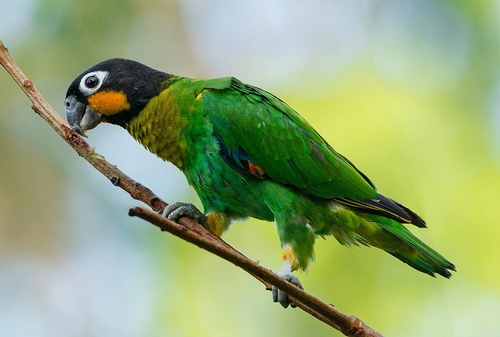
This parrot species, formally named Pionopsitta barrabandi (Kuhl, 1820), measures 25 cm (9.8 in) in size and weighs 165–190 g (5.8–6.7 oz). Adults have a black head, gray to black beak, and a distinct white eye-ring surrounding a brown eye. The nominate subspecies P. b. barrabandi has an olive throat and breast, yellow thighs, bend of the wing and lesser wing coverts ranging from yellow to orange, and carpal edge and underwing coverts ranging from orange to red. The subspecies P. b. aurantiigena has deep orange on the cheeks, bend of the wing, underwing, lesser wing coverts, and thighs, and lacks the yellow seen in the nominate subspecies. For all adults, the tips of the tail and wing feathers are blue, and cheeks are orange to yellow. Juveniles have a brown crown, olive forehead, nape, cheeks and chin, with a brown margin. Juveniles' bend of the wings and lesser wing coverts are green with scattered yellow, while their carpal edge and underwing coverts are red with scattered green feathers. This species is found in northwestern Brazil, western Ecuador and Peru, southern Venezuela and Colombia, and extreme northern Bolivia. It occurs at elevations up to 400 m (1,300 ft), most commonly in lowland terra firme forest, uncommonly in varzea stands, and also inhabits forest edges and partly disturbed forests. These parrots are active in the early morning, and are most often seen singly, in pairs, or in small groups of up to 10 individuals at clay banks.