About Pinus virginiana Mill.
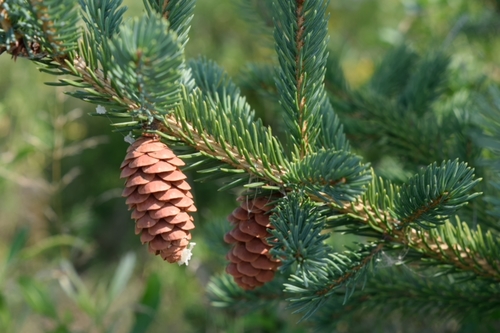
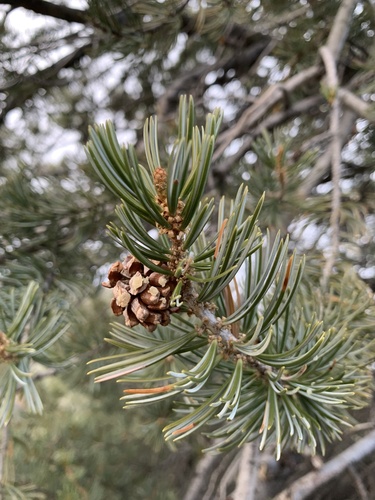
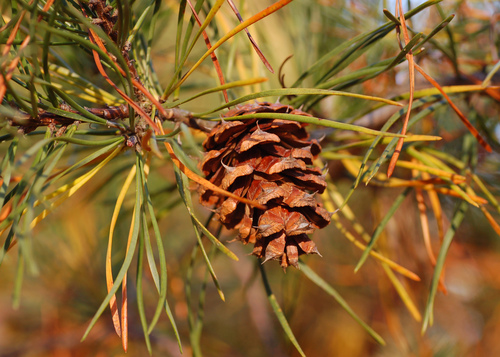
Pinus virginiana Mill. is a pine species endemic to the United States. It can be identified by a key characteristic: its relatively short, twisted needles grow in bundles of two, and typically reach 2 to 8 centimeters in length. Hairs are present on the bracts and bud scales of this species. Its leaf sheath is longer than 2.5 millimeters. Its cones only open once they reach maturity. The species has flexible branches that bend when pressure is applied. Mature Pinus virginiana trees reach between 9 and 18 meters in height. Its bark is red-brown, generally rough, and bears relatively small bark scales. Its pollen cones are round to nearly elliptical, measure 10 to 20 millimeters, and are typically the same color as the tree's bark. Seed cones are distributed across the whole tree; mature seed cones measure 4 to 7 centimeters, much larger than pollen cones. Pinus virginiana prefers to grow in poor, dry loam or clay soils. It can grow on sandy soil, but trees grown in sandy soil are usually smaller than average. This species inhabits dry forested areas, occurring naturally in the U.S. states of New York, New Jersey, Pennsylvania, Virginia, West Virginia, Ohio, Illinois, Kentucky, Tennessee, North Carolina, Georgia, Alabama, Mississippi, Indiana, South Carolina, Maryland and Delaware. In its native range, annual rainfall is typically between 890 and 1400 millimeters. Average summer temperatures range from 21 to 24 degrees Celsius, and average winter temperatures range from approximately -4 to 4 degrees Celsius. Pinus virginiana is poorly adapted to fire, though larger trees are able to survive wildfires. Open-grown Virginia pines can start producing cones when they are only 5 years old. Documented cases exist of trees as young as 18 months beginning to flower. Virginia pine is monecious, meaning it produces both male and female reproductive structures on a single tree, and some self-pollination is possible, but production of a large seed crop requires two separate trees. Cones take two full growing seasons to develop. Pollination occurs 13 months after cone formation starts, and seed dispersal happens the following autumn. Unlike many other pine species, Virginia pine produces cones in all parts of its canopy. Pinus virginiana has been reported as naturalized in southern Ontario. Historically, Pinus virginiana was used for mine timbers, railroad ties, fuel, and tar. Today, it is commonly planted on reclamation sites at former coal mining operations. It is also used to produce wood pulp for paper manufacturing, and as a source of lumber. Its wood weighs 32 pounds (14 kg) per cubic foot.