About Pinus tabuliformis Carrière
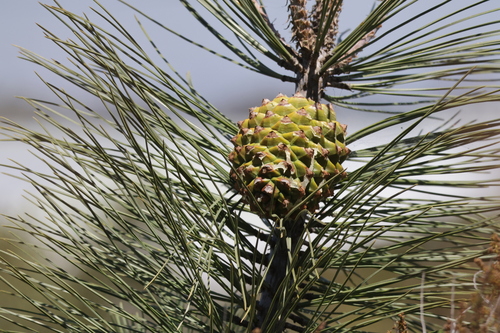
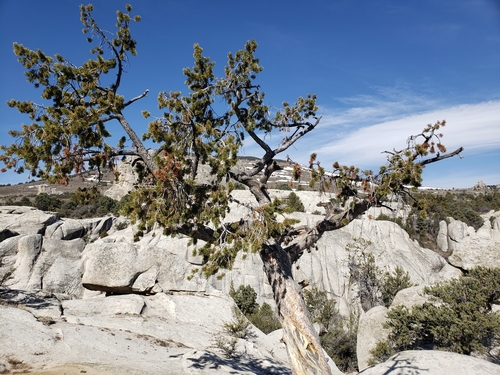
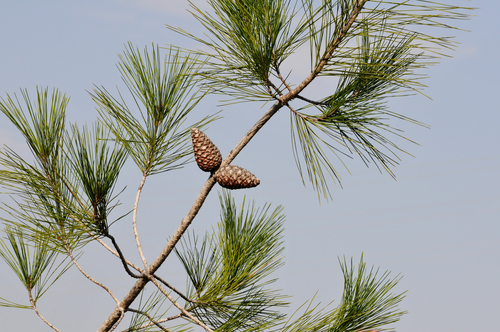
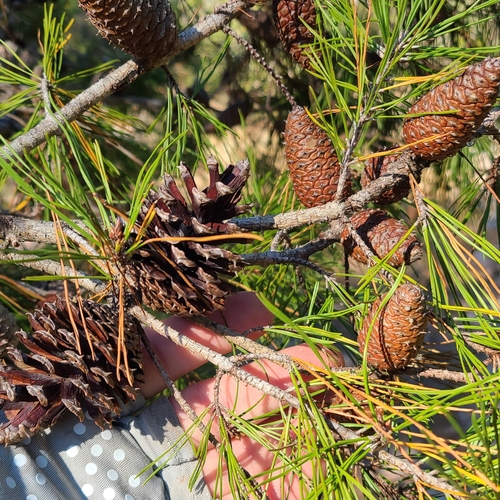
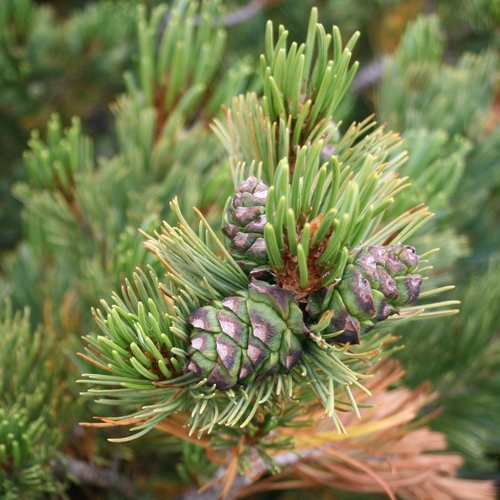
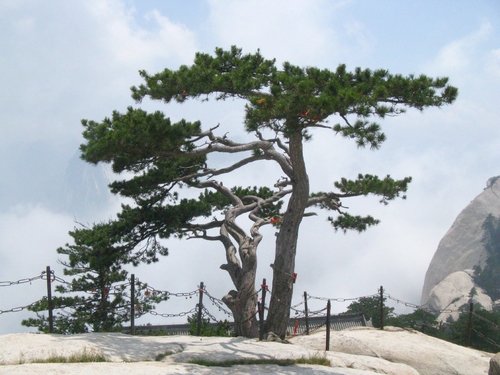
Pinus tabuliformis Carrière is a medium-sized evergreen tree that reaches 20 to 30 meters (66 to 98 feet) in height, and develops a flat-topped crown when mature. Young trees grow quickly, but their growth rate slows as they age. Compared to other tree species, its grey-brown bark develops fissures at an earlier age. Its broadly spreading overall form is very distinct, which is partially caused by its pattern of long, horizontal branches. The needle-like leaves are shiny grey-green, 10 to 17 centimeters (4 to 6 3/4 inches) long and 1.5 millimeters (1/16 inch) broad. They are usually borne in pairs, but occasionally appear in threes at the tips of strong shoots on young trees. The cones start out green, and ripen to brown roughly 20 months after pollination. They are broadly ovoid, 4 to 6 cm (1 5/8 to 2 3/8 inches) long, and have broad scales, each of which bears a small prickle. The seeds are 6 to 7 mm (1/4 to 9/32 inch) long with a 15 to 20 mm (9/16 to 13/16 inch) wing, and are dispersed by wind. This species is native to northern China, where it occurs from Liaoning west to Inner Mongolia and Gansu, and south to Shandong, Henan and Shaanxi. It is also found in northern Korea. The wood of Pinus tabuliformis is used for general construction. Pulpwood from this species produces resins that are used to make vanillin, an artificial vanilla flavoring. Its resin is also processed into turpentine and related products, and is used medicinally to treat a range of respiratory and internal ailments, along with kidney and bladder upsets, wounds, and sores. Its bark is a source of tannin. Pine needles from this tree are also used medicinally; they contain a natural insecticide, and can be used as a source of dye. The needles are brewed to make pine needle tea, known as sollip-cha. During the ancient Chinese Zhou dynasty, Pinus tabuliformis was an official memorial tree, planted on temple grounds and in graveyards near the tombs of kings. It has been widely used for afforestation projects in Northwest China. Cultivation of this species outside of China is uncommon, and it is only grown in botanical gardens there.