About Pinus sabiniana Douglas ex D.Don
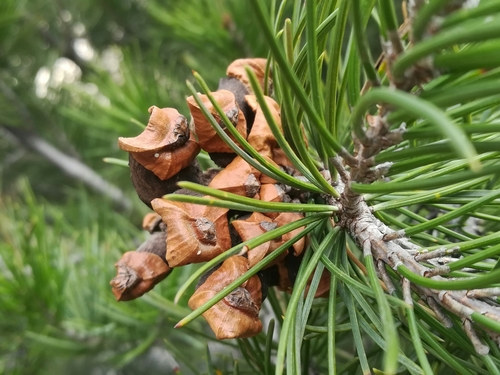
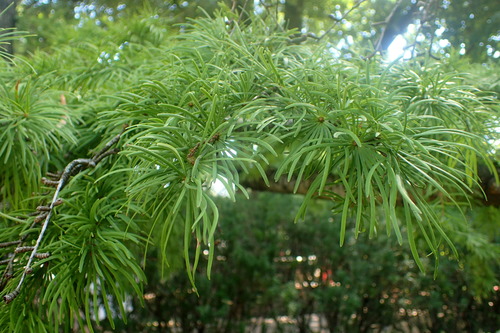
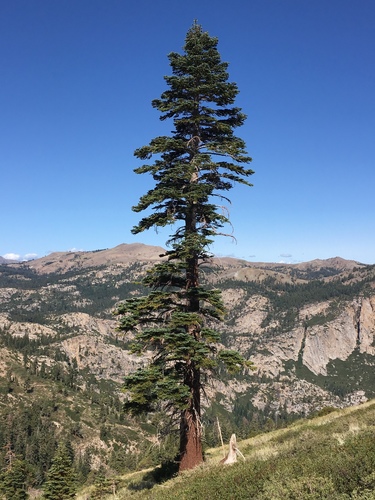
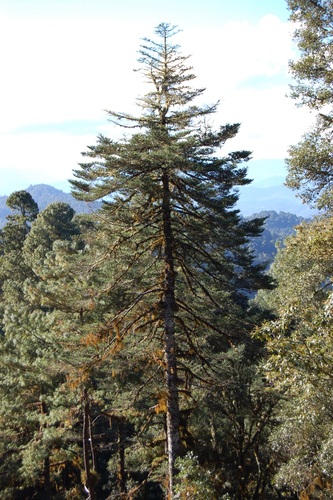
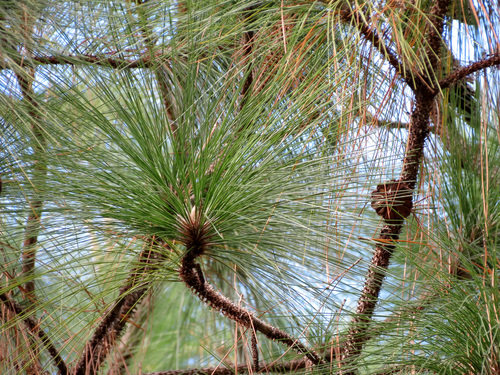
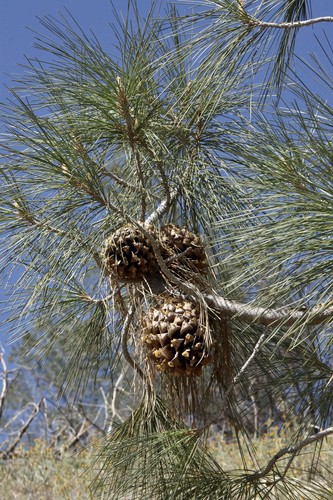
Pinus sabiniana Douglas ex D.Don typically grows 11 to 14 metres (36 to 45 ft) tall, and can reach up to 32 m (105 ft) in height. Its pine needles grow in fascicles, bundles of three, and are distinctively pale gray-green, sparse, drooping, and 20 to 30 centimetres (8 to 12 in) long. The species produces large, heavy seed cones that are 12 to 35 cm (4+3⁄4 to 13+3⁄4 inches) long, and almost as wide as they are long. Fresh seed cones weigh 0.3 to 0.7 kilograms (0.7 to 1.5 lb), and rarely exceed 1 kg (2.2 lb). Its male cones grow at the base of shoots on lower branches.
This pine grows at elevations ranging from sea level to 1,200 m (4,000 ft). It is common in the northern and interior sections of the California Floristic Province, found across the Sierra Nevada and Coast Ranges foothills surrounding the Central, San Joaquin and interior valleys; the Transverse and Peninsular Ranges; and Mojave Desert sky islands. Multiple specimens have also been recorded in Southern Oregon. Pinus sabiniana is adapted to long, hot, dry summers, and occurs in areas with an unusually wide range of average annual precipitation, from 250 mm (10 in) at the edge of the Mojave to 1,780 mm (70 in) in parts of the Sierra Nevada. It prefers rocky, well-drained soil, but can also grow in serpentine soil and heavy, poorly drained clay soils. It commonly grows alongside Quercus douglasii, and the habitat type known as "Oak/Foothill Pine vegetation" (or "Oak/Gray Pine vegetation") characteristic of the California chaparral and woodlands ecoregion in California is named for this association, where Pinus sabiniana forms a sparse overstory above an oak woodland canopy.
In ecological terms, Pinus sabiniana needles are a food source for caterpillars of the gelechiid moth Chionodes sabinianus. Fossil evidence indicates the species has only recently adapted to the Mediterranean climate, as its closest relatives grow in Madrean pine-oak woodlands at higher elevations in the southwestern United States and Mexico. Multiple animals, including scrub jays and acorn woodpeckers, help spread the species' seeds.
Some Native American groups relied heavily on the species' sweet pine nuts as food, and are thought to have shaped its current distribution pattern, including the large gap in its range in Tulare County. Native Americans also consumed its roots. The protein and fat content of Pinus sabiniana seeds is similar to that of Pinus pinea seeds, and the seeds were a regular part of the local indigenous diet.
Historical wood uses for Pinus sabiniana were shaped by its specific characteristics: it has a mean specific gravity of 0.43, nearly equal to Douglas-fir (Pseudotsuga menziesii); strength properties matching ponderosa pine; Kraft pulps with high bursting strength and tensile strength comparable to some northern conifer pulps; and its foothill stands could be logged in winter, when higher-altitude timber species were inaccessible. However, high resin and compression wood content, a typically crooked form, heavy weight, and low stand density made logging, transport, and processing of Pinus sabiniana expensive outside of winter logging use. By the 1960s, its commercial value had decreased, and it is now limited to uses including railroad ties, box shook, pallet stock, and chips. It may still have potential for use as windbreak shelterbelt plantings.
The main turpentine constituent of Pinus sabiniana resin is n-heptane, a linear alkane that makes up roughly 37 percent of the resin from its wood, which is an unusual occurrence in botany. The only other known natural sources of n-heptane are the closely related Pinus jeffreyi, sometimes called the "gasoline tree", and Pittosporum resiniferum, also known as the "petroleum nut" or kerosene tree. Distillation of Pinus jeffreyi resin in the 19th century accidentally produced exceptionally pure n-heptane and caused several accidental explosions. This event led to n-heptane being adopted as the zero point for octane rating.