About Pinus rigida Mill.
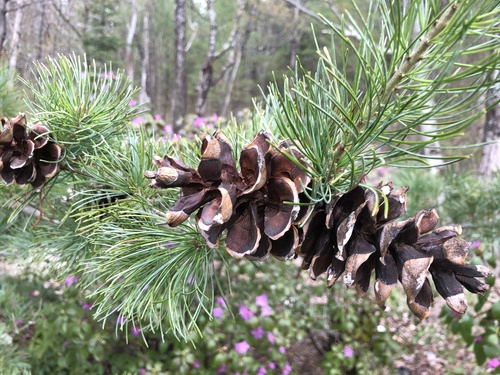
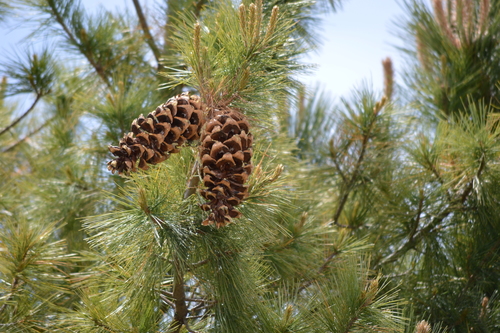
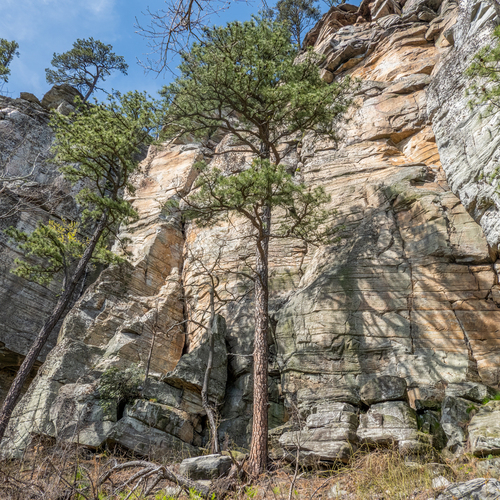
Scientific name: Pinus rigida Mill., commonly known as pitch pine. Pitch pine has an irregular growth form, reaching heights of 6–30 metres (20–98 ft). Its branches are typically twisted, and the species does not self-prune well. Its needles grow in fascicles (bundles) of three, measure around 6–13 centimetres (2+1⁄4–5 inches) in length, are stout (over 1 millimetre or 1⁄16 inch broad), and are often slightly twisted. Its oval cones are 4–7 cm (1+1⁄2–2+3⁄4 in) long, with prickles on their scales. Trunks are usually straight with a slight curve, and are covered in large, thick, irregular plates of bark. Pitch pine has high regenerative ability: if the main trunk is cut or damaged by fire, it can re-sprout via epicormic shoots. This is one of many adaptations to fire; another is its thick bark, which protects the sensitive cambium layer from heat. After burning, pitch pines often become stunted, twisted trees with multiple trunks from resprouting, and this characteristic makes the species popular for bonsai. Pitch pine grows quickly when young, gaining around 30 cm (12 in) of height per year under optimal conditions. Growth slows when the tree reaches 50–60 years of age, and by 90 years of age, annual height gain is minimal. Open-grown trees start producing cones in as little as three years, while shade-grown pitch pines take a few years longer. Cones take two years to mature, and seed dispersal occurs through fall and winter. Pitch pine cannot self-pollinate. The lifespan of pitch pine is around 200 years or longer, with a maximum recorded age of 398 years. Pitch pine occurs mainly in the southern areas of the northeastern United States, ranging from coastal Maine and Ohio to Kentucky and northern Georgia. A few stands grow in southern Quebec and Ontario, mostly in two pockets along the St. Lawrence River. It is classified as a pioneer species, often the first tree to colonize a site after it has been cleared. It forms a climax vegetation type in extreme conditions, but in most cases it is replaced by oaks and other hardwoods. This pine occupies a wide range of habitats, from dry, acidic sandy uplands to swampy lowlands, and can survive in very poor growing conditions. It is the primary tree species of the Atlantic coastal pine barrens ecoregion. Pitch pines provide habitat and food for many wildlife species. Birds including the pine warbler, wild turkey, red-cockaded woodpecker, great-crested flycatcher, blue jay, black-capped chickadee, black-and-white warbler, Nashville warbler, and chestnut-sided warbler use pitch pines for cover and nesting. Deer eat pitch pine seedlings and new sprouts, while small mammals and birds consume its seeds. Because it frequently grows multiple or crooked trunks, pitch pine is not a major timber tree, nor does it grow as fast as other eastern North American pines. However, it grows well on unfavorable sites. In the past, it was a major source of pitch, and its timber was used for ship building, mine timbers, and railroad ties, because the wood’s high resin content resists decay. It has also been used for large, elaborate wood constructions such as radio towers. Today, pitch pine is mainly used for rough construction, pulp, crating, and fuel. Due to its uneven growth pattern, large quantities of high-quality pitch pine are difficult to obtain, and long lengths of the wood can be very costly. Archaeological evidence shows that the Iroquois, Shinnecock, and Cherokee all utilized pitch pine. The Iroquois used its pitch to treat rheumatism, burns, cuts, and boils, and pitch also worked as a laxative. Both the Iroquois and Shinnecock used a pitch pine poultice to open boils and treat abscesses. The Cherokee used pitch pine wood for canoe construction and decorative carvings.