About Pinus resinosa Aiton
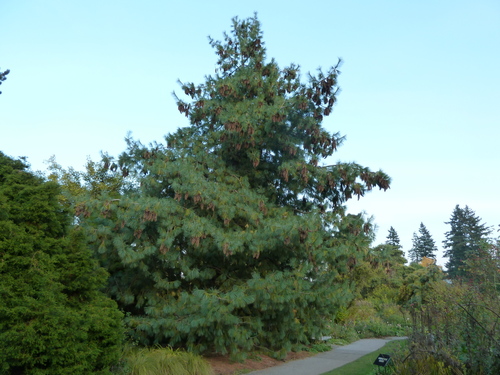
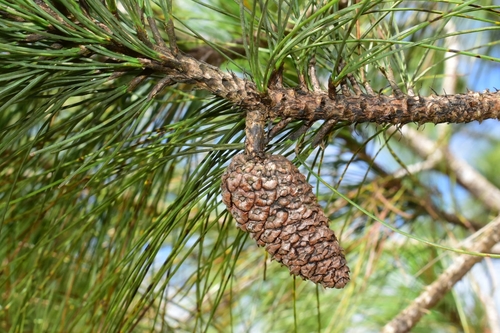
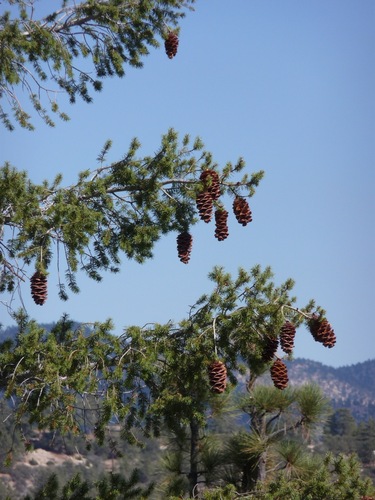
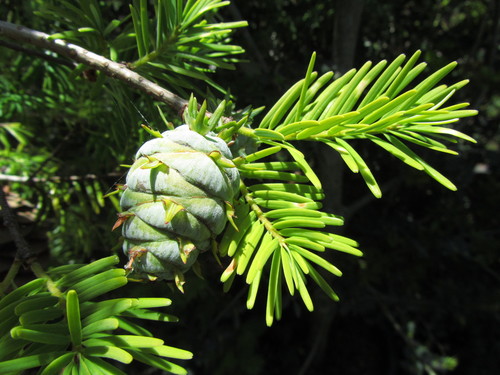
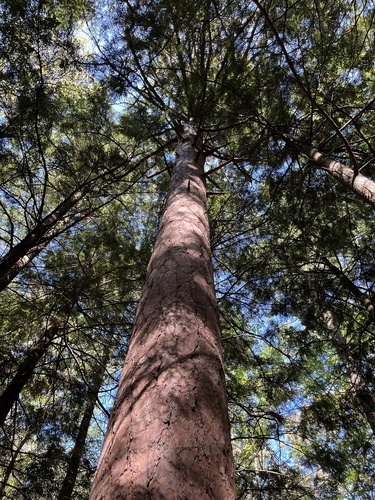
Pinus resinosa Aiton, commonly known as red pine, is a coniferous evergreen tree that typically grows tall and straight. Most mature red pines reach 20 to 35 metres (66 to 115 feet) in height and 1 metre (3 feet 3 inches) in trunk diameter, though exceptional individuals can grow up to 43.77 metres (143 and a half feet) tall. Young trees have a conical crown that develops into a narrow rounded dome as the tree ages. The bark is thick and gray-brown at the tree’s base, but thin, flaky, and bright orange-red in the upper crown; this distinctive feature gives the species its common name. Red tones may also be visible in the fissures of the bark. This species self-prunes, so dead branches are rarely present on trees, and older red pines often have very long sections of branchless trunk below their canopy. Its leaves are needle-like, dark yellow-green, and grow in fascicles of two. The needles measure 12 to 18 centimetres (4 and three quarters to 7 inches) long, are brittle, and snap cleanly when bent. While some sources identify this clean snap as a diagnostic trait for red pine, several other pine species share this characteristic. Red pine cones are symmetrical and ovoid, measuring 4 to 6 centimetres (1 and a half to 2 and a quarter inches) long and 2.5 centimetres (1 inch) broad. They are purple before maturity, ripen to a nut-blue color, and open to 4 to 5 centimetres (1 and a half to 2 inches) broad. The cone scales lack a prickle and are almost stalkless. Red pine grows well in sandy soils and in soils that are too nutrient-poor to support white pine. Its natural range extends from Newfoundland west to Manitoba, and south to Pennsylvania, with several smaller, disjunct populations in the Appalachian Mountains of Virginia and West Virginia, plus a few small pockets in extreme northern New Jersey and northern Illinois. It can occupy a wide variety of habitats. This species is shade-intolerant, but thrives in windy sites, and grows best in well-drained soil. It is long-lived, reaching a maximum age of around 500 years. Commercially, red pine wood is valuable for timber and paper pulp production, and the tree is also planted for landscaping. The wood is light, hard, and very close-grained, but does not resist decay when in contact with soil unless treated with chemicals. It is used in construction for piling, masts, spars, boxes, and crates.