About Pinus radiata D.Don
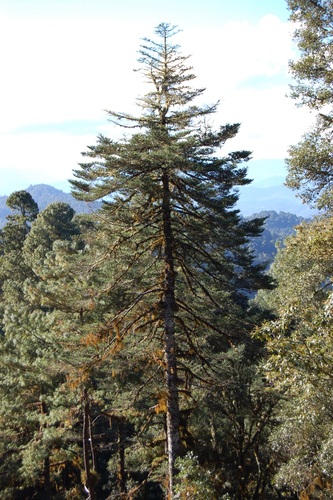
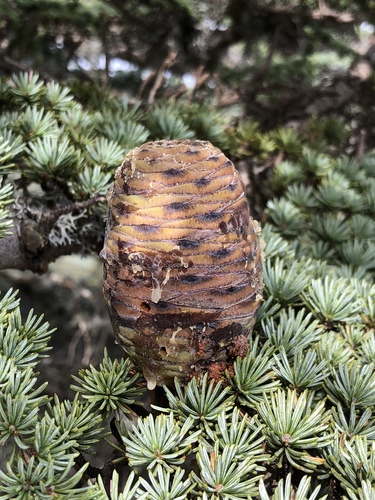
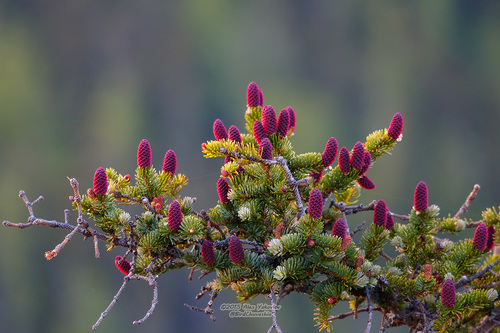
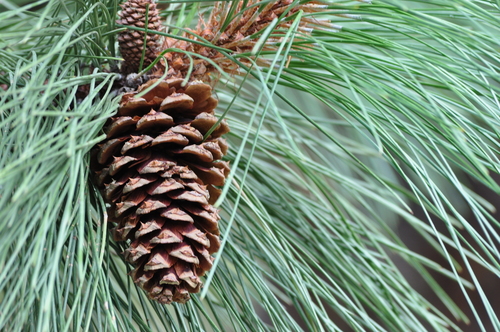
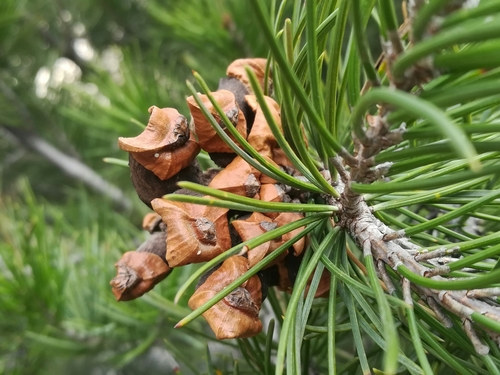
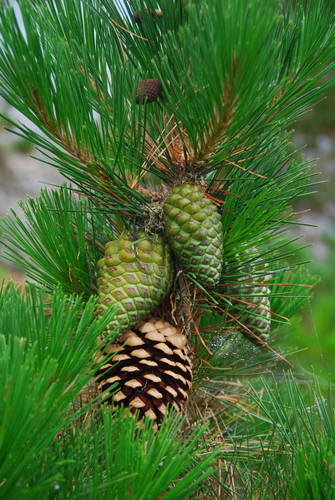
Pinus radiata D.Don, also called Monterey pine, is a coniferous evergreen tree. In the wild, it grows 15–30 m (50–100 ft) tall, and can reach up to 60 m (200 ft) when cultivated in optimum conditions. It has upward-pointing branches and a rounded crown. Its leaves, called needles, are bright green, slender, 8–15 cm (3–6 in) long with a blunt tip, and grow in clusters of three, except for variety binata where they grow in clusters of two. Its ovulate cones are 7–17 cm (3–6+1⁄2 in) long, brown, egg-shaped, and usually grow asymmetrically on a branch, attached at an oblique angle. The bark is fissured and ranges from dark gray to brown. If not killed early by disease or harvesting, the species has a lifespan of 80 to 90 years. The specific epithet radiata refers to cracks that radiate out from the umbo of the cone scales. It is closely related to bishop pine and knobcone pine, and hybridizes readily with both. It can be distinguished from bishop pine by its needles growing in threes rather than pairs, and from both species by its cone scales lacking a sharp spine. Modern plantation-grown Pinus radiata differs greatly from native Monterey trees. In plantations, trees are commonly spaced at 4 square meter intervals across a wide range of landscapes, from flat ground to moderately steep hills. Thanks to selective breeding and more recently the widespread use of growth factor seedlings, forests planted since the 1990s produce very straight tall trunks without the issue of twin leaders. Trees are pruned in three lifts, which leaves the lower two-thirds of a mature tree free of branches and thus knots. In terms of distribution and habitat, Pinus radiata is native to three very small areas in Santa Cruz, Monterey, and San Luis Obispo Counties, California, United States. In Mexico, it grows on two Pacific Ocean islands: Guadalupe Island and Cedros Island. On Guadalupe Island, which sits 280 km (150 nmi) off the mainland coast, the pines grow on the steep northern end of the island at elevations of roughly 500 to 1,200 m (1,600 to 3,900 ft), following ridgetops and steep slopes. On Cedros Island, the pines are more abundant and found in far greater numbers, in part due to the absence of feral goats. They grow at lower elevations than on Guadalupe, around 285 to 690 m (935 to 2,264 ft), on the windward ridges and canyons of the northern and central parts of the island. In both native island locations, the pines are heavily dependent on sites with frequent fog. Pinus radiata is the most prominent introduced tree in Australia, New Zealand, and Spain, and is a major plantation species in Argentina, Chile, Uruguay, Kenya, and South Africa. It has also been introduced to Tristan da Cunha, the world's most remote inhabited island. Ecologically, Pinus radiata is adapted to survive stand-killing fire disturbances. Its cones are serotinous, meaning they remain closed until opened by the heat of a forest fire; abundant seeds are then released to regenerate on the burned forest floor. Cones may also open in very hot weather. In its native range, Pinus radiata is associated with a distinct community of flora and fauna. It is a co-dominant canopy tree alongside Cupressus macrocarpa, which also naturally occurs only in coastal Monterey County. One Pinus radiata pine forest in Monterey, California, was the discovery site of Hickman's potentilla, an endangered species. Piperia yadonii, a rare orchid species, is endemic to the same pine forest adjacent to Pebble Beach. In its native range, Pinus radiata is a main host for the dwarf mistletoe Arceuthobium littorum. The pine habitat on Cedros Island contrasts sharply with the desert scrub found on other parts of the island, forming abrupt transition zones. The numerous groves form a mostly monotypic forest of this species, with very few other plants except seedlings growing in the understory. In some areas, the edges of the forest support chaparral species including Malosma laurina, Diplacus stellatus, and the endemic Eriogonum molle. With their large surfaces to condense fog, the pines create irrigation for themselves and their associated species. Toward the far northern end of the island, there is a succulent community made up mostly of Dudleya, and the endemic Dudleya pachyphytum can sometimes be found growing under the pines in the ecotone. A remnant Pinus radiata stand in Pacific Grove called the Monarch Grove Sanctuary is a key wintering habitat for the monarch butterfly. In South Africa, this non-native tree threatens the country's already scarce water resources. The species has remarkably extensive roots; Monterey pine roots will grow downward as far as subterranean conditions allow, and roots have been found up to 12 meters (39 ft) long. Removal of large numbers of these non-native trees in areas of South Africa has led to significant increases in accessible water. For use as timber, Pinus radiata is suitable for a wide variety of uses, and has a resinous fragrance when being worked. It holds screws and nails well, accepts paint and stain without difficulty, and modern kiln-dried timber is very easy to work. It is roughly one-third heavier than dried western red cedar, and is brittle when bent, so it does not have the same load-bearing capacity as Oregon pine (Douglas fir, Pseudotsuga). Pinus radiata is used in house construction for weatherboards, posts, beams, and plywood, as well as for fencing, retaining walls, and concrete formers. It is also used to a limited extent in boat building, where untreated ply is sometimes used but must be encased in epoxy resin to block moisture. The wood is typically kiln dried to 12% moisture in 6 m (19 ft 8 in) long clear lengths, and is available either treated with a range of chemical salts or untreated. Chemical salt treatment, called tanalizing, is well established, and treated timber is frequently used in the ground as posts and poles for structures such as retaining walls and pole houses. Treatment grades H1 and H2 are suited for indoor use. H3 is the standard grade for house timber and is used for fence palings. H4 and H5 are the standard grades for timber used in the ground. In New Zealand, a 1995 change that removed the requirement for borate treatment in house framing timber was a key factor in the leaky homes crisis, but a series of regulatory changes made since 2003 have improved standards. Lower-grade timber is processed into pulp to make newsprint, while higher-grade timber is used in house construction. Chipped Pinus radiata is used to make particle board sheets, commonly used for flooring. Other sheet products made from the species include hardboard, softboard, and plywood. Most plywood is structural, and available in 7–22 mm (0.28–0.87 in) sizes. A small amount of higher-grade plywood is processed into thinner (4 and 7 mm or 0.16 and 0.28 in) ply suitable for furniture, cabinet work, and boat building. This higher-grade ply is free of knots and cracks and glued with resorcinol waterproof glue. Since the 1990s, finger-jointed joinery-grade wood has been available in lengths up to 6 m (19 ft 8 in) in a wide range of profiles. In 1958, New Zealand boat designer Des Townson began building 186 eleven-foot (3.35 m) cold-moulded Zephyr-class dinghies using Pinus radiata; in 2011, these hand-built boats fetched very high prices and were generally in excellent condition. The bark of Pinus radiata is used as a substrate for potting and re-potting orchids. Pinus radiata is the most common Christmas tree species in Australia and New Zealand. In California, it is commonly planted as a windbreak, noise barrier, or ornamental tree.