About Pinus monophylla Torr. & Frém.
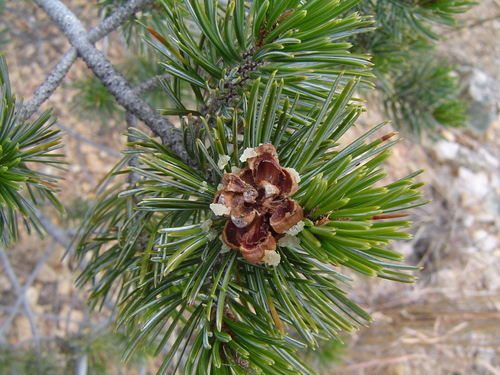
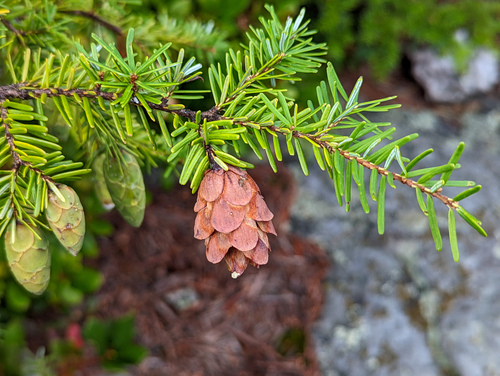
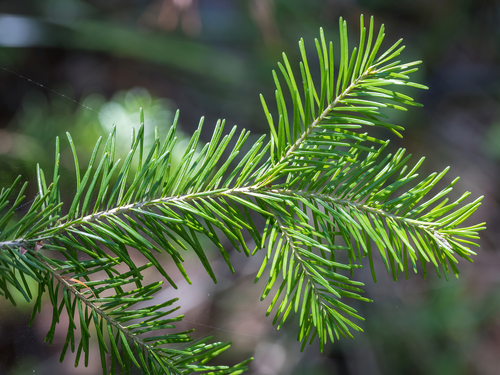
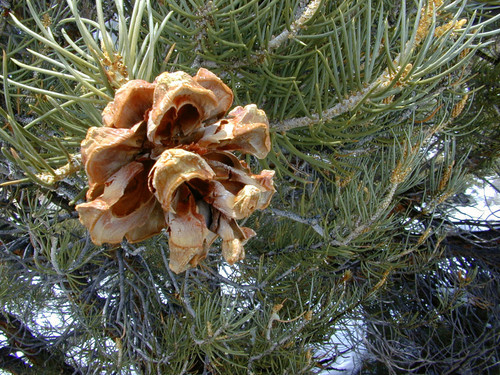
Pinus monophylla Torr. & Frém. is a small to medium-sized tree that grows 10–20 m (33–66 ft) tall, with a trunk diameter that rarely exceeds 80 cm (31+1⁄2 in). Its bark is irregularly furrowed and scaly. Uniquely among pines, its leaves (called needles) are most often single, rather than grouped in fascicles of two or more; trees with paired needles are found occasionally. The needles are stout, 4–6 cm (1+1⁄2–2+1⁄4 in) long, and range in color from grey-green to strongly glaucous blue-green, with stomata covering the entire needle surface; for paired needles, stomata are present on both the inner and outer surfaces. The cones are acute-globose, and are the largest among true pinyons. When closed, they are 4.5–8 cm (1+3⁄4–3+1⁄8 in) long and broad. They start out green, and ripen to a yellow-buff color after 18–20 months. They have only a small number of very thick scales, with typically 8–20 fertile scales. Cones grow on a two-year (26-month) growth cycle, so newer green cones and older, seed-bearing or open brown cones can be found on the same tree at the same time. When mature, seed cones open out to 6–9 cm (2+1⁄4–3+1⁄2 in) broad, and hold the seeds on the scales after opening. The seeds are 11–16 mm (7⁄16–5⁄8 in) long, with a thin shell, a white endosperm, and a vestigial 1–2 mm (1⁄32–3⁄32 in) wing. Empty self-pollinated pine nuts with undeveloped seeds are light tan, while fully developed viable seeds are dark brown. Pine nuts from this species are dispersed by the pinyon jay, which plucks seeds out of open cones, selects only the dark viable seeds, and leaves the light empty seeds behind. Pinyon jays use the seeds as a food source, and bury many stored seeds for later use. Some of these stored seeds are never eaten and are able to grow into new trees. In fact, pinyon seeds from this species rarely germinate in the wild unless they are cached by jays or other animals. The edible seeds, called pine nuts, are collected throughout the species' range; Native American people from the Great Basin region commonly ate them. Various birds and mammals also eat the seeds. Roasted cones from this species are also edible. People may harvest the seeds for personal use on land managed by the Bureau of Land Management and the U.S. Forest Service. Single-leaf pinyon is also cultivated as an ornamental tree for native plant gardens, drought-tolerant gardens, wildlife gardens, and natural landscaping projects. It is used regionally as a Christmas tree. It is rarely available in nurseries, because it is difficult to germinate.