About Pinus merkusii Jungh. & de Vriese
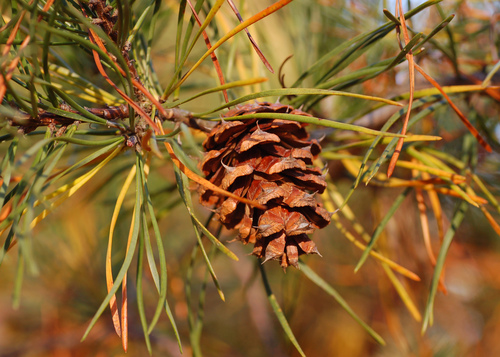
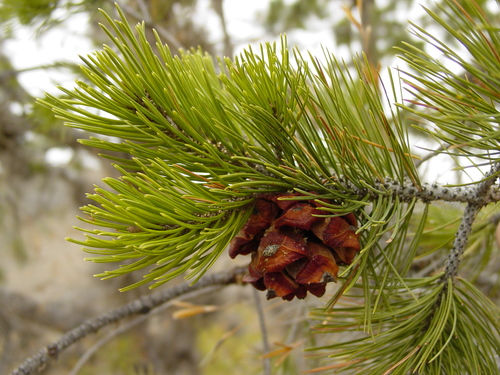
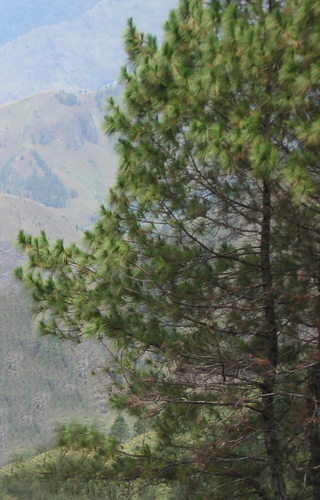
Pinus merkusii Jungh. & de Vriese is a medium-sized to large tree, growing 25 to 45 metres (82 to 148 feet) tall, with a trunk diameter reaching up to 1 m (3 ft 3 in). Its bark is orange-red, thick and deeply fissured at the base of the trunk, and thin and flaky in the upper crown. The leaves, called needles, grow in pairs; they are very slender, 15 to 20 centimetres (6 to 8 inches) long and less than 1 millimetre (1⁄32 in) thick, and range in color from green to yellowish green. The cones are narrow conic, 5 to 8 cm (2 to 3+1⁄4 in) long and 2 cm (3⁄4 in) wide at the base when closed. They are green when young, and ripen to a glossy red-brown. When the cones reach maturity, they open to 4 to 5 cm broad to release their seeds. The seeds are 5 to 6 mm (3⁄16 to 1⁄4 in) long, with a 15 to 20 mm (1⁄2 to 3⁄4 in) wing, and are dispersed by wind. Pinus merkusii is found mainly in the mountains of northern Sumatra, Indonesia. It also has two outlying populations: one in central Sumatra on Mount Kerinci and Mount Talang, and another in the Philippines on Mindoro and in the Zambales Mountains on western Luzon. Isolated populations also grow in Mainland Southeast Asia, including Kirirom National Park in Cambodia’s Cardamom Mountains, and Bidoup Núi Bà National Park on the Đà Lạt Plateau in Vietnam. The central Sumatra population, located between 1° 40' and 2° 06' S latitude, is the only natural occurrence of any member of the Pinaceae family that grows south of the Equator. This species is generally found at moderate altitudes, mostly between 400 and 1,500 m (1,300 to 4,900 ft), but it can occasionally grow as low as 90 m (300 ft) and as high as 2,000 m (6,600 ft).