About Pinus massoniana Lamb.
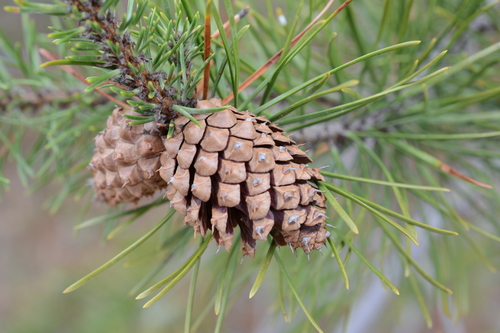
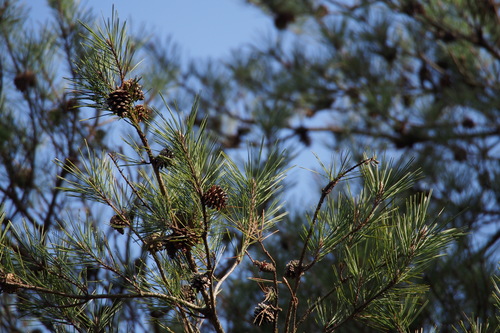
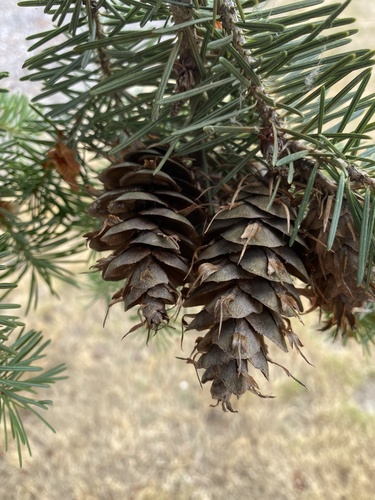
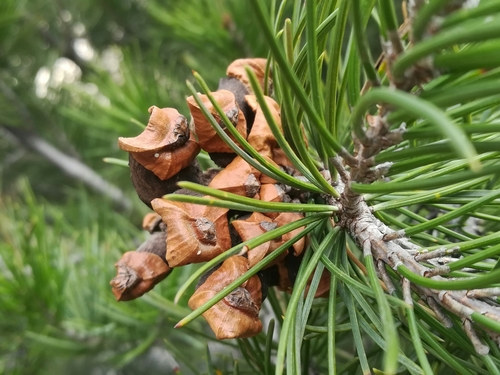
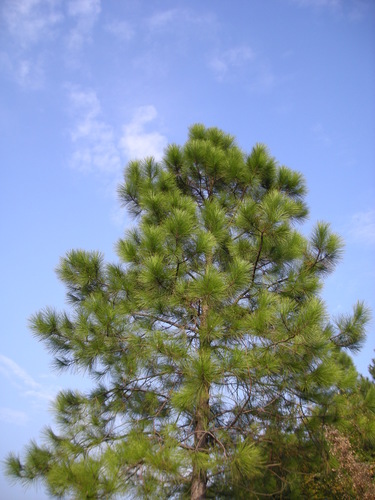
Pinus massoniana Lamb. is an evergreen tree that grows 25 to 45 metres (82 to 148 feet) tall, with a broad, rounded crown formed by long branches. The bark is thick, grayish-brown, and forms scaly plates at the base of the trunk, while higher up the trunk it is orange-red, thin, and flakes off easily. Its leaves are needle-like, dark green, and grow in bundles of two per fascicle. The needles measure 12 to 20 centimetres (4+1⁄2 to 8 inches) long and 0.8 to 1 millimetre (1⁄32 to 3⁄64 inch) wide, with a persistent fascicle sheath that is 1.5 to 2 cm (5⁄8 to 3⁄4 inch) long. Its cones are ovoid, 4 to 7 cm (1+5⁄8 to 2+3⁄4 inch) long, and chestnut-brown. When cones mature in late winter, they open to reach 4 to 6 cm (1+5⁄8 to 2+3⁄8 inch) wide. The seeds are winged; the seed body is 4 to 6 mm (5⁄32 to 1⁄4 inch) long, attached to a wing 10 to 15 mm (3⁄8 to 9⁄16 inch) long. Pollination takes place in mid-spring, and cones mature 18 to 20 months after pollination. Genomic sequencing has found that this species has an exceptionally large genome of 21.91 Gb, with 80,366 protein-coding genes. It is native to Taiwan, a wide area of central and southern China including Hong Kong, and northern Vietnam. It grows at low to moderate altitudes, mostly below 1,500 m (4,900 ft), and rarely reaches up to 2,000 m (6,600 ft) above sea level. This species flowers from April to May, and produces fruit from October to December. Pinus massoniana is a common tree planted in plantation forestry in southern China, to replace or offset the loss of natural forest. It is suited to this use because it tolerates poor soils and drought conditions. Its rapid growth makes it a valuable source of timber, which is used for furniture, construction, and pulp production for paper. Pine trees of the Pinus genus are the primary source of rosin, and P. massoniana is one of the main species harvested for rosin production in China.