About Pinus halepensis Mill.
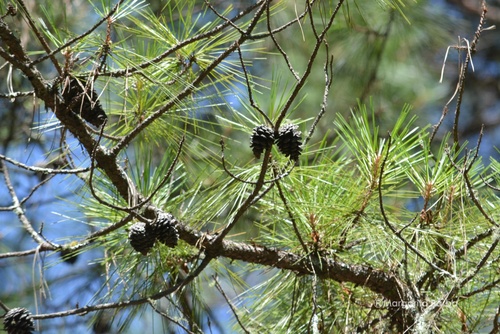
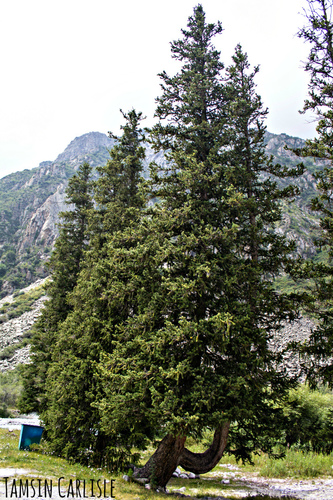
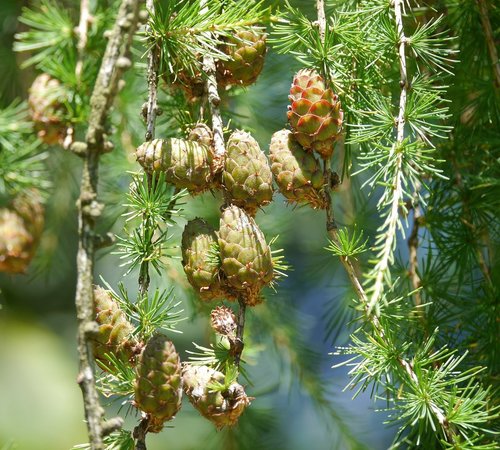
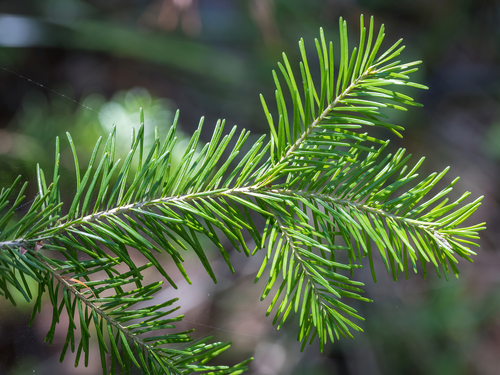
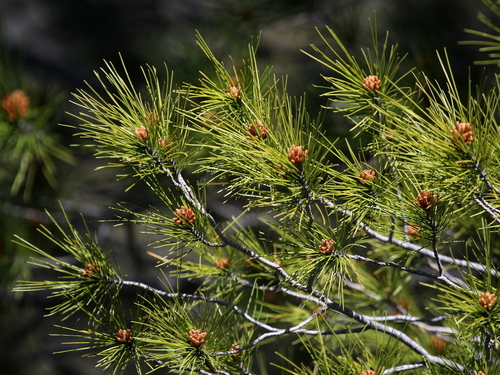
Pinus halepensis Mill., commonly known as Aleppo pine, is a small to medium-sized tree that reaches 15–25 meters (49–82 feet) in height. Its trunk diameter grows up to 60 centimeters (24 inches), and can exceptionally reach 1 meter (3 feet 3 inches). The bark is orange-red, thick and deeply fissured at the base of the trunk, while it is thin and flaky in the upper crown. Its leaves, called needles, are very slender, 6–12 cm (2+1⁄4–4+3⁄4 in) long, distinctly yellowish green, and grow in pairs, with a small number rarely growing in threes. The cones are narrow conic, measuring 5–12 cm (2–4+3⁄4 in) long and 2–3 cm (3⁄4–1+1⁄4 in) broad at the base when closed. They start out green, and ripen to a glossy red-brown color when they are 24 months old. They open slowly over the following few years, and this process speeds up if they are exposed to heat such as during forest fires. When open, the cones reach 5–8 cm (2–3+1⁄4 in) wide to allow seed dispersal. The seeds are 5–6 millimeters (3⁄16–1⁄4 in) long, with a 20 mm (13⁄16 in) wing, and are dispersed by wind. The native range of Pinus halepensis stretches from Morocco, Algeria, Tunisia, and Spain north to southern France, Malta, Italy, Croatia, Montenegro, and Albania, and east to Greece. There is an outlying population, which the species was first described from, in Syria, Lebanon, southern Turkey, Jordan, Israel and Palestine. This species has been introduced into many regions around the world, including Portugal. It is generally found at low altitudes, mostly between sea level and 200 m (660 ft), but it can grow above 1,000 m (3,300 ft) in southern and eastern Spain, grow well over 1,200 m (3,900 ft) on Crete, and grow up to 1,700 m (5,600 ft) in the southern North African countries of Morocco, Algeria and Tunisia. This tree can quickly colonize open and disturbed areas. It is classified as an invasive species in South Africa. It can grow on all substrates and in almost all Mediterranean bioclimates, and it is a diagnostic species of the vegetation class Pinetea halepensis. The resin of the Aleppo pine is used to add flavor to the Greek wine retsina. Aleppo pine pine nuts are used to make a Tunisian pudding called asidet zgougou, which is served in bowls, covered with cream, and topped with almonds and small candies. The Maltese dessert prinjolata also uses these pine nuts, both in its filling and as a topping. Aleppo pine trees are also used for bonsai.