About Pinus engelmannii Carrière
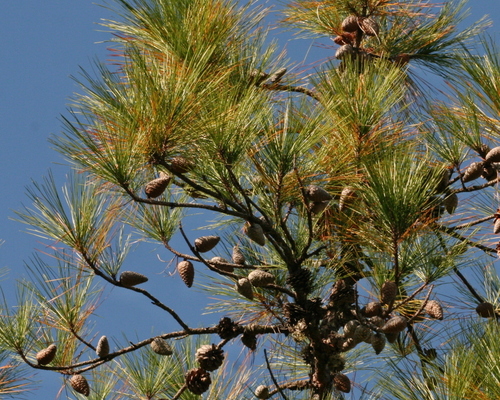
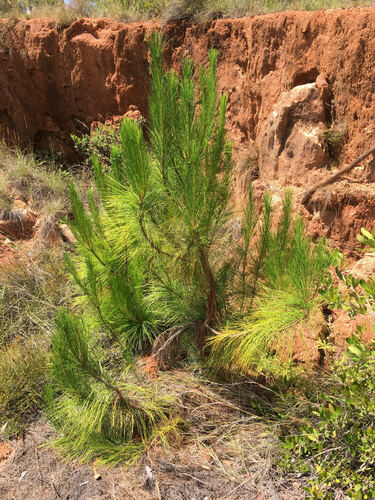
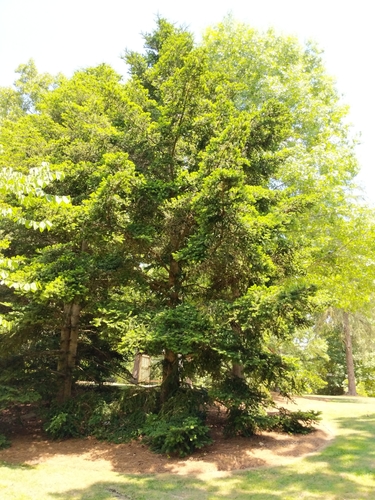
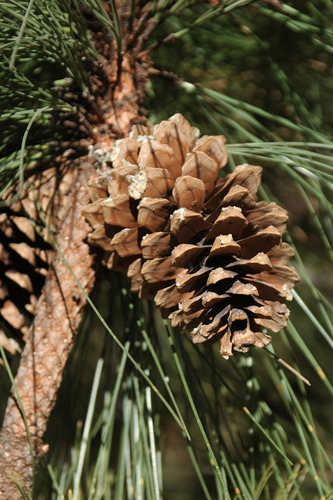
Pinus engelmannii Carrière, commonly known as the Apache pine, is a tree native to Northern Mexico’s Sierra Madre Occidental, with a range that extends into the Southwestern United States. It is a medium-sized pine species, growing 20 to 30 metres (66 to 98 feet) tall, with a trunk diameter between 35 and 80 centimetres (14 to 31 inches). Its branches are sparse and very stout, which gives the tree a distinct look. Its needles, which are among the longest of any pine, grow in bundles of three (occasionally five). They are typically 20 to 40 cm (8 to 16 in) long, though Mirov records needles reaching up to 50 cm (20 in) long; the needles are stout, and grow spreading to slightly drooping. The tree’s cones are 8 to 16 cm (3+1⁄4 to 6+1⁄4 in) long. They are green or purple while growing, and mature to a glossy brown color. The cones are moderately oblique, with stoutly spined scales on the outer side that faces away from the branch. Like its relatives the Michoacan pine (P. devoniana) and longleaf pine (P. palustris), the Apache pine sometimes develops a grass stage. Its common English name refers to its occurrence on lands that belong to the Apache Native American people. Its scientific name honors pioneering American botanist George Engelmann, who discovered the species in 1848. Engelmann originally named the species Pinus macrophylla, but this name had already been used for a different pine, so the species required renaming. This work was done by French botanist Carrière, who chose to rename the species to honor Engelmann. In the past, Apache pine was sometimes classified as a variety of ponderosa pine, under the name P. ponderosa var. mayriana, but it is now universally recognized as its own distinct species.