About Pinus elliottii Engelm.
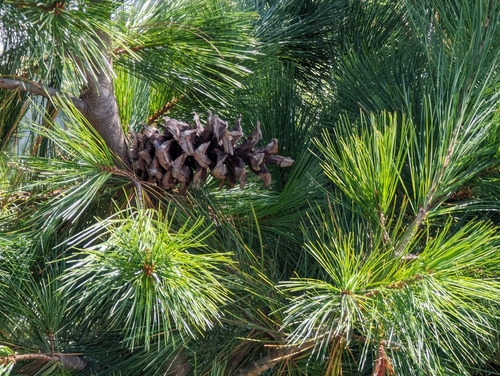
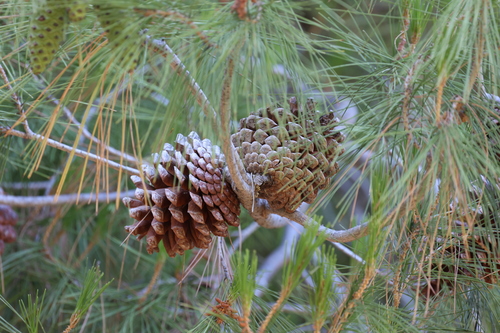
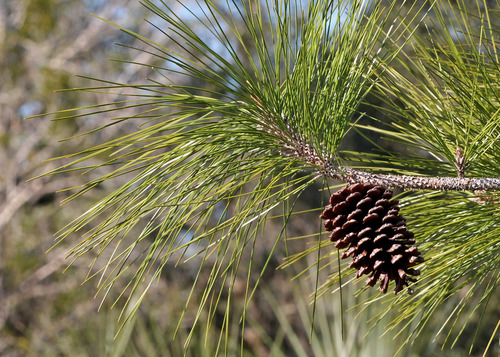
Pinus elliottii Engelm., commonly called slash pine, is a fast-growing pine species that is relatively short-lived for a pine, with a maximum lifespan of 200 years. Mature trees reach 18–30 m (59–98 ft) in height, with a trunk diameter of 0.6–0.8 m (2.0–2.6 ft). Its leaves are very slender needle-like leaves that grow in clusters of two or three, reaching 18–24 cm (7.1–9.4 in) long. Its cones are glossy red-brown, 5–15 cm (2.0–5.9 in) in length, with a short (2–3 mm or 0.079–0.118 in), thick prickle on each scale. Slash pine has a characteristic conical shape and unusual high strength for a pine. Its wood has an average crush strength of 8,140 lb/in² (56.1 MPa), which exceeds that of many hardwoods including white ash (7,410 lb/in²) and black maple (6,680 lb/in²). While it is not as strong as black ironwood (9,940 lb/in²), its average density is less than half that of ironwood, giving slash pine a far greater strength-to-weight ratio. It can be told apart from the related loblolly pine (P. taeda) by its somewhat longer, glossier needles and larger red-brown cones, and from longleaf pine (P. palustris) by its shorter, more slender needles and smaller cones with less broad scales.
Two varieties of P. elliottii have been formally described, but recent genetic studies suggest the two varieties may not be more closely related to each other than to other Southeast pines. If this finding holds, the two varieties would be reclassified as separate species. P. elliottii can hybridize with P. taeda, sand pine (Pinus clausa), and P. palustris. The two commonly accepted varieties are: P. e. var. elliottii (typical slash pine), which ranges from South Carolina to Louisiana, and south to central Florida. Its needles grow in bundles (fascicles) of both twos and threes, mostly threes, and its cones are larger at 7–15 cm (2.8–5.9 in). P. e. var. densa (South Florida slash pine, Dade County pine) is native to the pine rocklands of southern Florida and the Florida Keys, including the Everglades. Its needles are nearly all in bundles of two and are longer than those of the typical variety. Its cones are smaller, at 5–12 cm (2.0–4.7 in), its wood is denser, and the tree grows a thicker taproot. Unlike typical slash pine, P. e. var. densa seedlings have a "grass stage" similar to longleaf pine. P. e. var. densa is not frost tolerant, which restricts its range to South Florida.
Communities dominated by slash pine are called "slash pine forests". Slash pine is predominantly found in Florida and Georgia, with a range extending from South Carolina west to southeastern Louisiana, and south to the Florida Keys. It is common in East Texas, where it was first planted at the E.O. Siecke State Forest in 1926. Its natural habitat is sandy subtropical maritime forests and wet flatwoods. Slash pine generally grows best in warm, humid areas with an average annual temperature above 17 °C (63 °F), and can tolerate extreme temperatures from −18 to 41 °C (0 to 106 °F). Competition, fire, and precipitation are all factors that can limit the species' natural distribution. Slash pines can grow in a wide range of soils, but stands growing near bodies of water such as swamps and ponds grow better due to higher soil moisture and greater seedling protection from wildfire.
Slash pine forests have been managed with controlled fires since the start of the 20th century. Within the first year of growth, P. elliottii seedlings are particularly susceptible to mortality from fire. P. e. var. densa is more fire resistant than P. e. var. elliottii due to its thicker bark. Without regular fire intervals in slash pine forests, the ecosystem changes over time: in the species' northern range, mesic flatwood slash pine forests can convert to denser mixed-hardwood canopies with oaks, hickory, and southern magnolia; in South Florida, pine rocklands can convert to rockland hammock dominated by woody shrubs and invasive plants. Invasive species are a major management issue across the southern United States for this ecosystem. Many native pines and other native plants are fire-adapted, requiring fire disturbance to open their cones, trigger seed germination, and initiate other metabolic processes. Fire works well for invasive species management because many invasive plants are not adapted to fire, so controlled burning can kill invasive parent plants or reduce invasive seed viability. Controlled burning also helps reduce pathogen loads in the ecosystem: it can eliminate pest populations or resting fungal spores that would otherwise infect new seedlings. Low-intensity burns clear understory space and release nutrient pulses that benefit native understory vegetation. Prescribed fire also prevents buildup of fuel — highly flammable plants such as grasses and scrub growing under the canopy that can fuel intense wildfires. Most prescribed burn intervals are every 2–5 years, which lets the ecosystem regenerate after burning. Much of the South Florida pine rockland ecosystem is highly fragmented, and has not been burned due to its proximity to developed areas. Safety issues including smoke, poor air quality, and residual environmental particulate matter make controlled burns near homes and businesses risky. Pinus elliottii is widely grown in tree plantations, and is also used in horticulture.