About Pinus coulteri D.Don
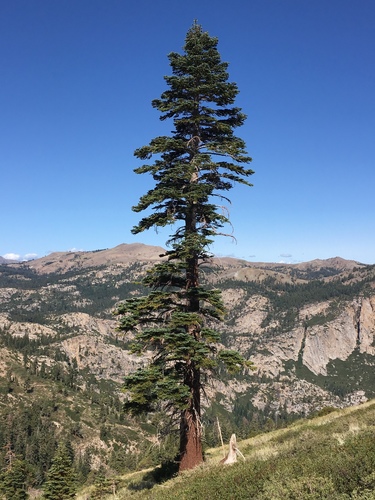
Pinus coulteri is a large coniferous evergreen tree in the pine genus Pinus. Mature trees grow 10–24 m (30–80 ft) tall, with a trunk diameter reaching up to 1 m (3 ft). The trunk grows vertically, with branches ranging from horizontal to slightly upcurved. Its bark is dark gray-brown to nearly black, deeply furrowed, and marked with long, scaly, irregularly connected, rounded ridges. The tree's crown is pyramidal, and can be dense or open depending on its growing site. Its leaves are needle-like, borne in bundles of three, colored glaucous gray-green. They measure 15–30 cm (6–10 in) long and 2 mm (0.08 in) thick, with a stout, thick texture.
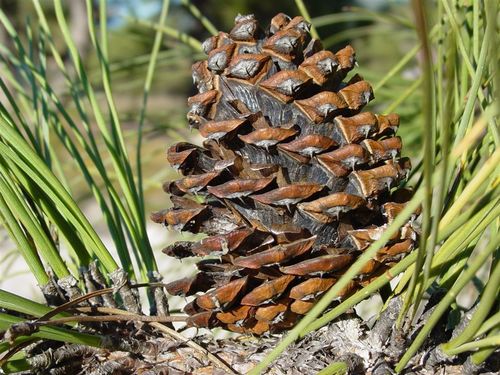
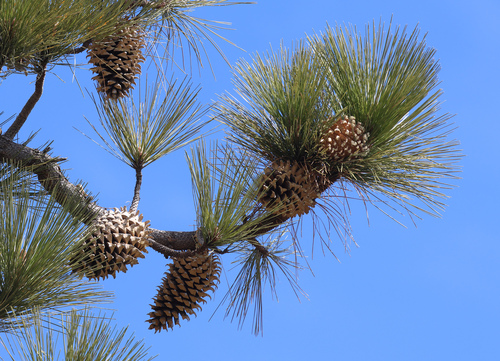
Pinus coulteri's most distinctive feature is its very large, spiny seed cones. These cones are typically 20–40 cm (8–20 in) long (rare specimens have reached 50 cm/20 in in length) and 23 cm (9 in) wide, and weigh 2–5 kg (4–10 lb) when fresh. Every cone scale is tipped with a sharp, talon-like hook. While the longer, more slender cones of sugar pines exceed Coulter pine cones in length, Coulter pines produce the heaviest and overall largest cones of any pine species. Workers in Coulter pine groves are advised to wear hardhats due to the risk of falling heavy cones, and the combination of the cones' large size and sharp hooked scales has earned the tree the local nickname "widowmakers".
Seed cones take two years to reach maturity, then gradually shed seeds after maturing. They remain on the tree for a moderate period after ripening. They are massive, heavy, drooping, asymmetric at the base, narrowly ovoid before opening, and ovoid-cylindric when open. They are pale yellow-brown, resinous, and have stalks up to 3 cm (1.2 in) long. Their apophyses are transverse-rhombic, strongly and sharply cross-keeled, elongated and curved, and connect continuously to umbos to form long, upcurved claws 2.5–3 cm (0.98–1.2 in) long. Seeds are obovoid, dark brown, with a 15–22 mm (0.59–0.87 in) long body, and a wing up to 25 mm (1 in) long.
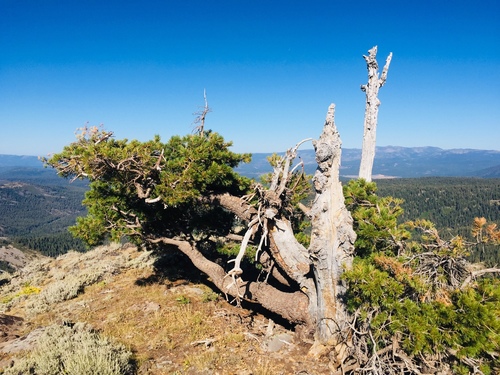
Coulter pine grows most commonly on steep south-facing slopes and ridges. Its growing soils range from poor to fertile, and are typically dry. It is considered an indicator species for serpentine soils, but also grows on a wide variety of other substrates. Soil textures where it occurs range from loamy to gravelly or rocky. It grows at elevations between 150–2,100 m (500–7,000 ft). It is listed as the dominant species in multiple published vegetation classifications, including Terrestrial natural communities of California, Vegetation types of the San Bernardino Mountains, Vegetation of the San Bernardino Mountains, A vegetation classification system applied to southern California, Mixed evergreen forest, Vascular plant communities of California, and Montane and subalpine forests of the Transverse and Peninsular ranges.
Ecologically, Coulter pine is closely related to Pinus sabiniana (foothill pine). It is more distantly related to Jeffrey pine, which it shares native habitats with, and ponderosa pine. It generally grows in drier environments than both ponderosa and Jeffrey pines. This erect, medium-sized pine favors south-facing slopes at elevations from 200–2,300 m (700–8,000 ft), and tolerates dry, rocky soil. It most often grows in mixed forests, and is part of multiple forest plant associations. For example, at higher elevations of the San Jacinto Mountains, Coulter pine is co-dominant with California black oak. Woodpeckers frequently forage on this species, peeling its bark to reach insects underneath.
Wildlife, particularly squirrels, collect the tree's large seeds for food. Native Americans historically ate these seeds as well. The wood of Pinus coulteri is soft and weak, so it has few commercial uses beyond firewood. It is cultivated as an ornamental tree, planted in parks and large gardens, and used in drought-tolerant landscaping. It has been awarded the Royal Horticultural Society's Award of Garden Merit.