About Pinus canariensis C.Sm.
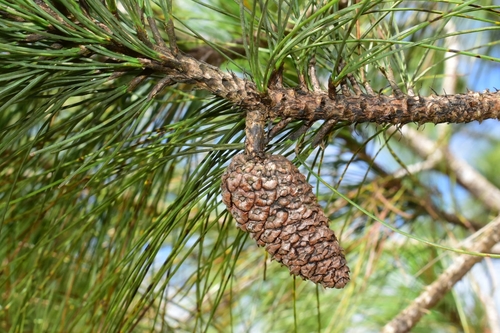
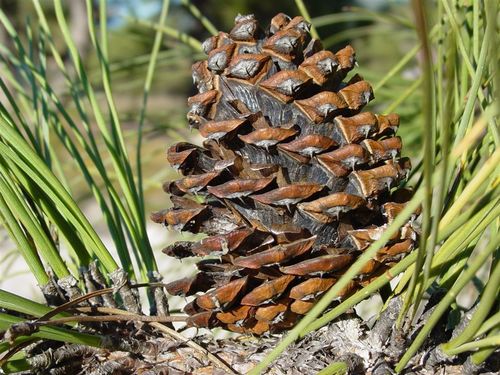
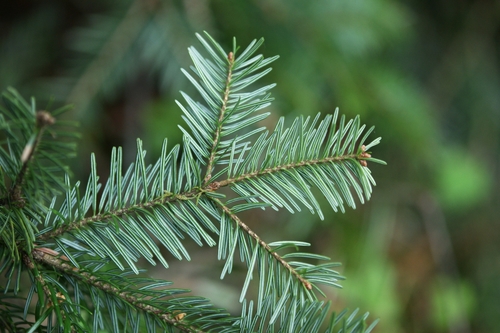
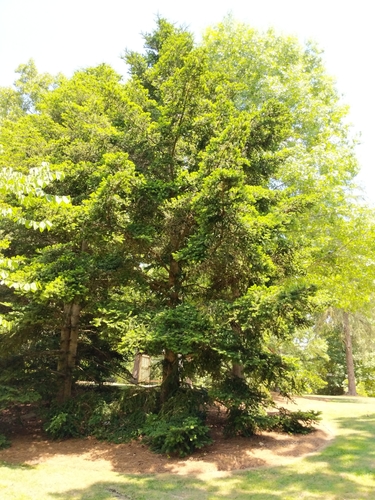
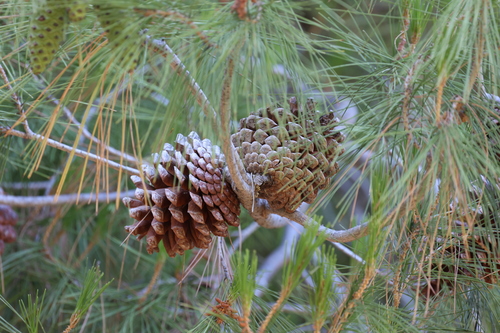
Pinus canariensis C.Sm. is a large evergreen tree. It typically grows 30–40 metres (98–131 feet) tall, with a diameter of 100–120 centimetres (39–47 inches) at breast height. Exceptional specimens can reach up to 56 m (184 ft) tall, with a girth of 988 cm (389 in), equal to 314 cm (124 in) in diameter. Its leaves are needle-like, coloured green to yellow-green, and grow in bundles of three. They measure 20–30 cm (8–12 in) long, have finely toothed margins, and often droop. A defining trait of this species is that epicormic shoots bearing single, glaucous (bluish-green) juvenile leaves (instead of the usual bundles of three) grow from the lower trunk; in its native range, this growth only occurs after damage such as fire. The species produces glossy chestnut-brown cones that are 10–18 cm (4–7 in) long and 5 cm (2 in) wide. These cones are serotinous, meaning they frequently stay closed for several years. Its closest relatives are the Himalayan chir pine (P. roxburghii), and the Mediterranean pines P. pinea, P. halepensis, P. pinaster, and P. brutia from the eastern Mediterranean. This species is native and endemic to the outer Canary Islands: Gran Canaria, Tenerife, El Hierro and La Palma. It is a subtropical pine that does not tolerate low temperatures or hard frost, and can only survive temperatures down to approximately −6 to −10 °C (21 to 14 °F). Within its native range, it grows across extremely variable rainfall regimes, from less than 300 millimetres (12 in) to several thousand millimetres, a difference caused largely by varying amounts of mist captured by its foliage. In warm conditions, it is one of the most drought-tolerant pines, and can survive with less than 200 mm (8 in) of rainfall per year. Over-cutting has reduced the species' native range somewhat: only Tenerife, La Palma, and Gran Canaria still hold large forests of Pinus canariensis, though extensive replanting of deforested areas has been carried out since 1940. Very large specimens are rare due to historical over-cutting. It is the tallest tree native to the Canary Islands; the tallest recorded specimen, 'Pino de las Dos Pernadas' near Vilaflor on Tenerife, measures 56.7 m tall. This pine is one of the most fire-resistant conifers in the world, thanks to several beneficial adaptations. In particular, Pinus canariensis is one of the few pine species that can resprout epicormically after losing all its needles to a fire. The tree's long needles make a significant contribution to the Canary Islands' water supply, by trapping large amounts of cloud droplets that fall as fog drip. This fog input forms when moist Atlantic air arrives on the prevailing north-eastern wind, called locally "alisios" or "tiempo norte". Measured fog drip under these trees can be up to 20 times higher than open rainfall recorded at the same site. The condensed water seeps into the ground after falling, and percolates down to replenish underground aquifers. The aromatic wood of Pinus canariensis, especially the heartwood, is counted among the finest pine woods, as it is hard, strong, and durable. The wood is now growing in popularity as a tonewood for soundboards on guitars and other stringed instruments. The aromatic heartwood, known locally as "tea", is also traditionally used on La Palma to make wine aging containers called pipas. Pinus canariensis is a popular ornamental tree planted in warmer climates, for use in private gardens, public landscapes, and as street trees. It has become naturalised in mainland Spain, South Africa, Sicily, Australia, and California, after being originally planted for landscape use.