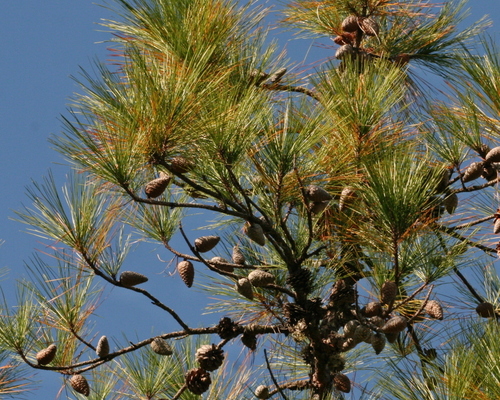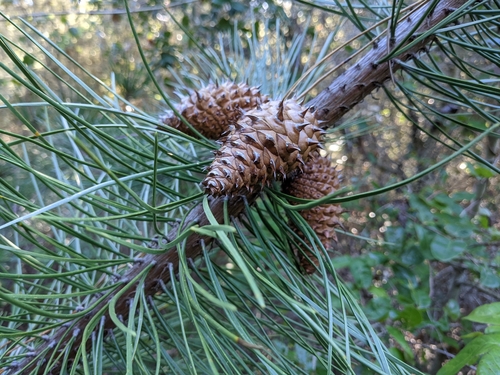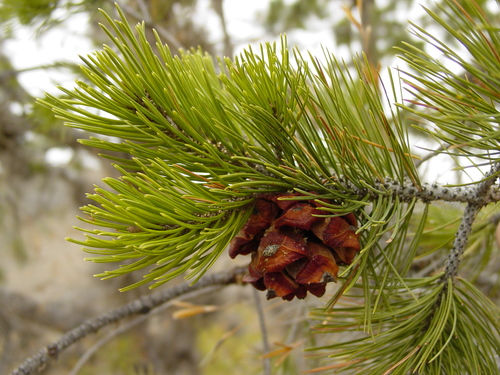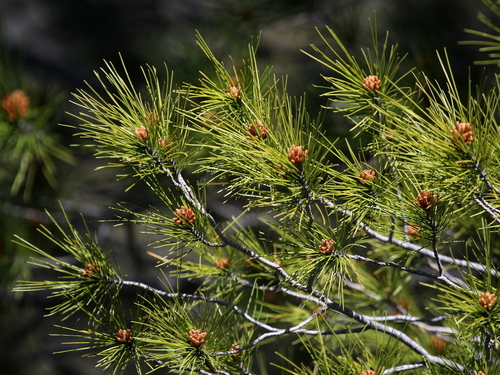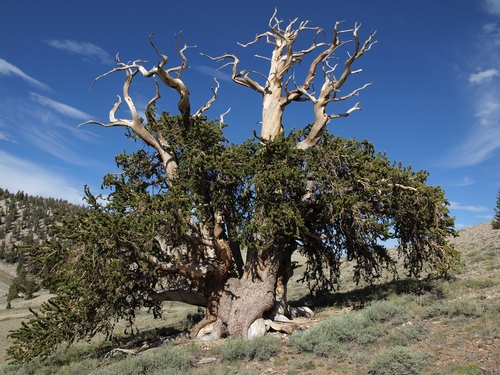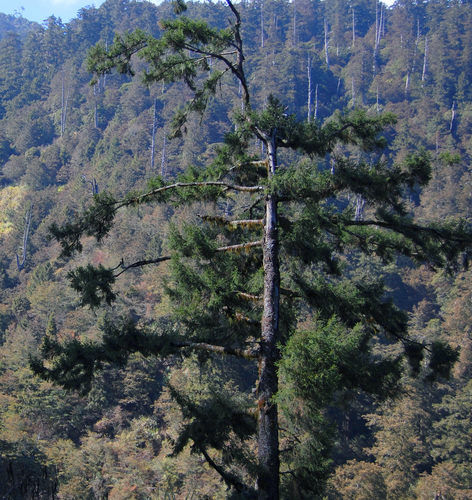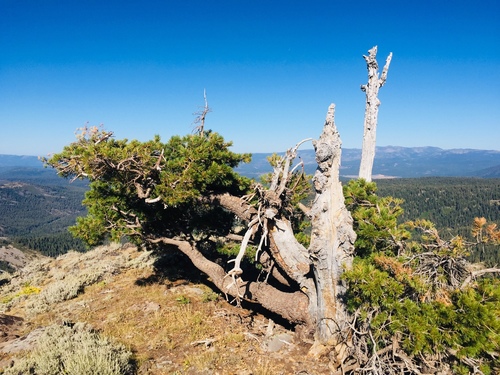
About Pinus albicaulis Engelm.
Pinus albicaulis Engelm., commonly known as whitebark pine, belongs to the white pine group, Pinus subgenus Strobus, section Strobus. Like all members of this group, its needle-like leaves grow in bundles (fascicles) of five, and has a deciduous sheath. This trait distinguishes whitebark pine from three other common pine species: lodgepole pine (Pinus contorta, which has two needles per fascicle), and ponderosa pine (Pinus ponderosa) and Jeffrey pine (Pinus jeffreyi, which both have three needles per fascicle). All three of these comparison species also have a persistent sheath at the base of each fascicle. Whitebark pine gets its common name from the light gray bark of young specimens. It is much more difficult to distinguish whitebark pine from the related white pine group species limber pine (Pinus flexilis), and identification usually requires examining seed or pollen cones. For Pinus albicaulis, seed-bearing female cones are 4–7 centimeters (1+1⁄2–3 in) long, dark purple when immature. They do not open when drying, but their scales break easily when Clark's nutcrackers remove the cones to harvest the seeds. Intact old cones are rarely found in the leaf litter beneath the trees, and the species' pollen cones are scarlet. In comparison, Pinus flexilis cones are 6–12 cm (2+1⁄2–4+1⁄2 in) long, green when immature, open to release their seeds, and have non-fragile scales. Limber pine pollen cones are yellow, and intact old cones are usually found beneath the trees. Without cones present, it can also be hard to tell whitebark pine apart from western white pine (Pinus monticola). Whitebark pine needles are yellow-green and entire, meaning they feel smooth when rubbed gently in either direction. Western white pine needles are silvery green and finely serrated, feeling rough when rubbed gently from tip to base. Whitebark pine needles are also usually shorter, ranging 3–7 cm (1–3 in) long, though their size range overlaps with the larger 5–10 cm (2–4 in) needles of western white pine. Whitebark pine grows at high elevations, found in the Rocky Mountains from central British Columbia to western Wyoming. It occurs in the timberline zone of the Cascades and coastal ranges from British Columbia to the Sierra Nevada, as well as most high mountain ranges between the Rockies and Cascades, such as the Blue Mountains. It is also abundant in the subalpine forests of Montana and Idaho. Whitebark pine is an important food source for many seed-eating birds and small mammals. The most important of these is the Clark's nutcracker (Nucifraga columbiana), which is the pine's major seed disperser. Each Clark's nutcracker caches between 30,000 and 100,000 seeds each year, in small, widely scattered caches that are usually buried under 2 to 3 cm (3⁄4 to 1+1⁄4 in) of soil or gravelly substrate. Nutcrackers retrieve these cached seeds during periods of food scarcity and to feed their young. The cache sites nutcrackers choose are often favorable for seed germination and seedling survival. Caches that are not retrieved before snow melt contribute to forest regeneration, so whitebark pine often grows in clumps of multiple trees that all originated from a single cache holding two to 15 or more seeds. Many other animals depend on whitebark pine. Douglas squirrels cut down and store whitebark pine cones in their middens. Grizzly bears and American black bears often raid these squirrel middens to get whitebark pine seeds, which are an important pre-hibernation food. Squirrels, northern flickers, and mountain bluebirds often nest in whitebark pines. Elk and blue grouse use whitebark pine communities as summer habitat. Fallen needles that accumulate under these trees form beds that deer and wild sheep use for shelter during stormy weather. Interior Salish peoples harvested seeds from this tree's cones for food. They roasted the seeds, ground them into porridge, and mixed them with dried berries.