About Pinna rudis Linnaeus, 1758
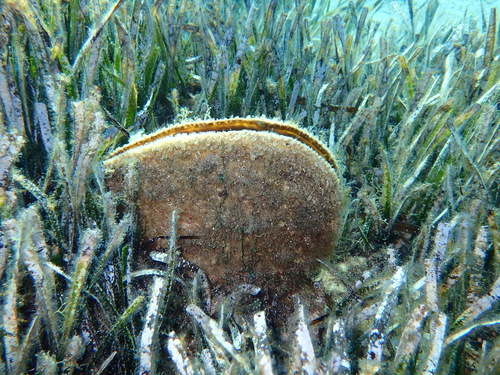
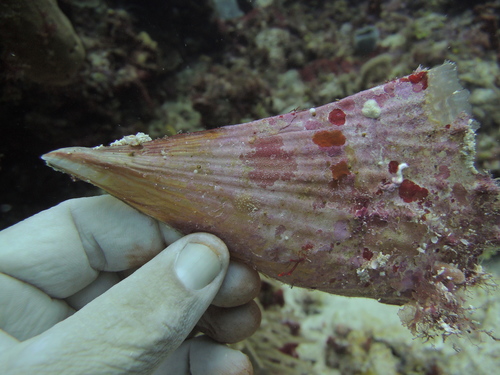
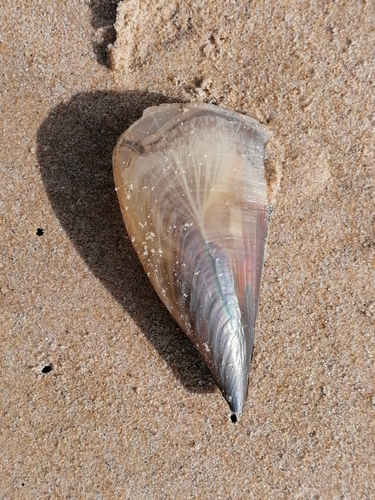
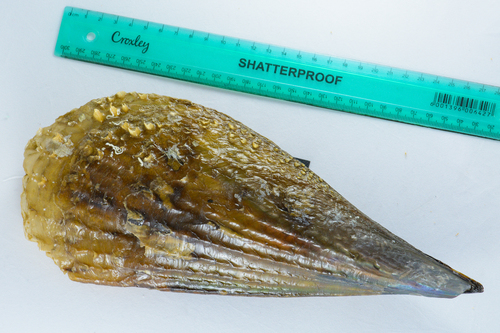
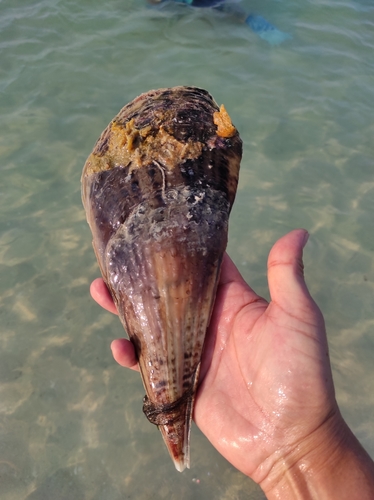
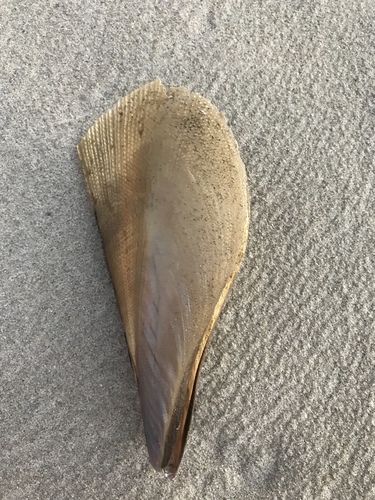
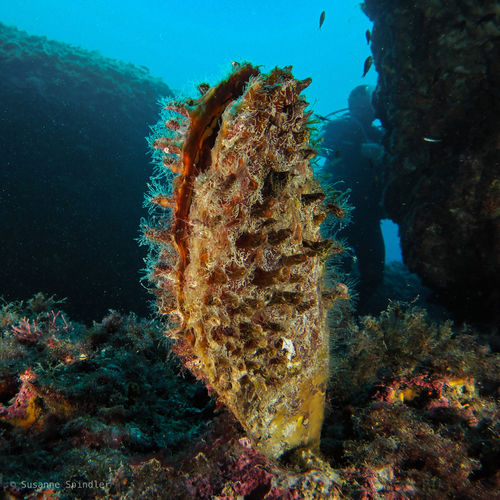
Pinna rudis Linnaeus, 1758, commonly called the rough pen shell or spiny fan-mussel, typically has a shell reaching 25–30 cm (9.8–11.8 in) in length. This species has a pair of very fragile, long, triangular, wedge-shaped shell valves. The valves are covered in large, protruding scales arranged in fairly regular rows, with more prominent scales close to the shell's opening. Around six low ribs radiate from the pointed end of the shell and run the full length of each valve. The valves are almost symmetrical, toothless, and transparent at their ends, and their usual color is reddish brown. Pinna rudis lives with the pointed anterior end of its shell anchored vertically to rock or firm sediment by numerous byssus threads, leaving the rounded rear edge of the shell free and exposed. Pinna rudis can be confused with juvenile Pinna nobilis, but P. rudis has a more triangular, robust shell with fewer and larger protruding scales. P. rudis also has a browner or pink-orange color, while juvenile P. nobilis are uniformly yellowish. Adult P. nobilis grow much larger than P. rudis and completely lose surface protuberances. The two species also differ in habitat: P. nobilis lives on muddy or sandy bottoms, while P. rudis prefers rock crevices. Pinna rudis is distributed across the eastern Atlantic Ocean (including the Azores, Saint Helena, and Morocco), the Mediterranean Sea (including the Strait of Gibraltar, Almeria, Lipari, Sicily, Croatia, the Tyrrhenian Sea, and the Ionian Sea), the Black Sea, and Caribbean waters ranging from the Gulf of Mexico and southern Florida to the West Indies and Bahamas. It inhabits small patches of sand on rocky bottoms and rock crevices, at depths from the surface down to 60 m.