About Pinna bicolor Gmelin, 1791
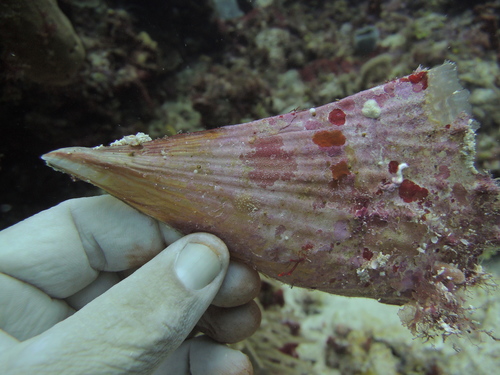
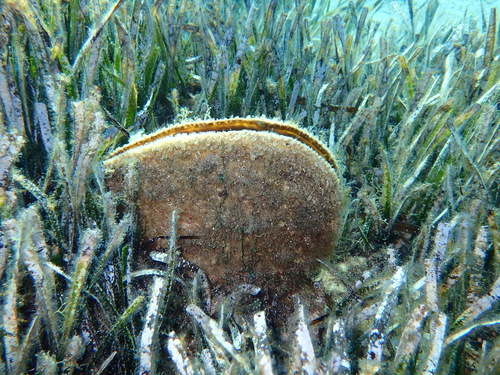
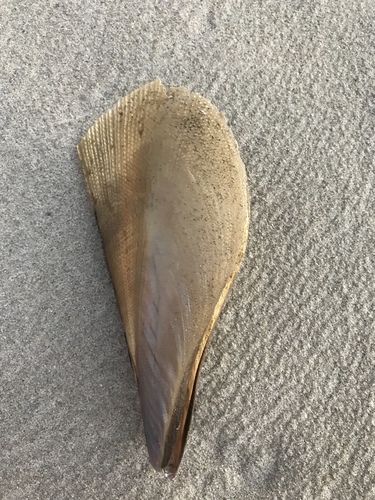
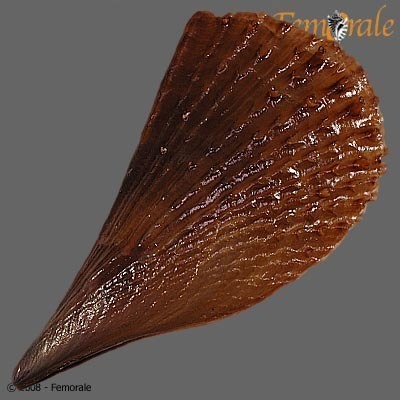
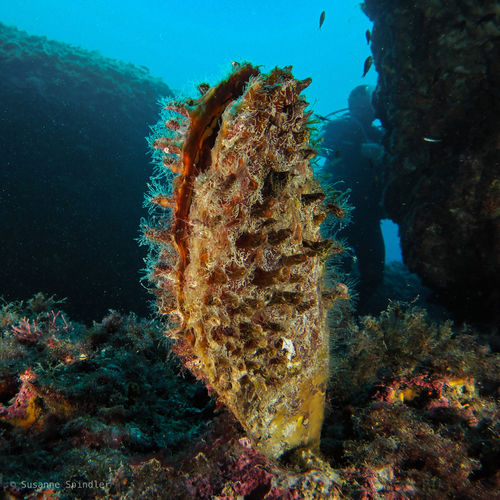
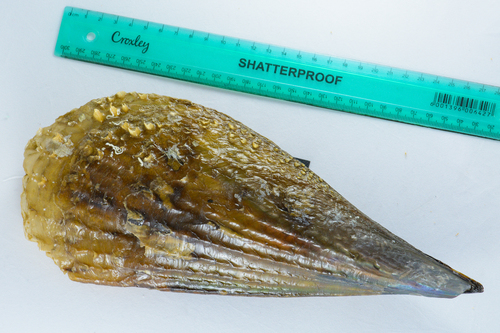
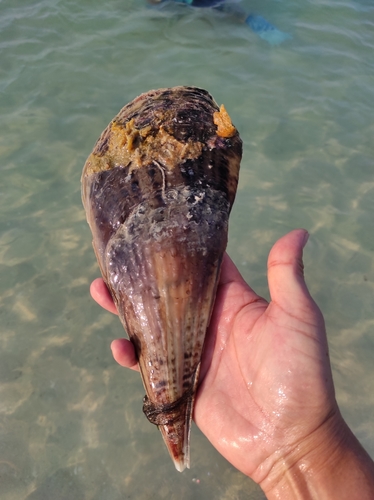
Pinna bicolor Gmelin, 1791 has thin, elongated triangular shells that narrow to a point, with shell color ranging from light yellow-brown to dark brown. Most of the shell is typically buried underground, with only around 2–3 cm protruding, so this species is often overlooked. Glands located near the buried end of the shell secrete byssus threads that anchor the bivalve to buried rocks and stones. When Pinna bicolor buries in mud, it does so with its pointed end facing downward, leaving the shell projecting outward in a fan shape. This species is commonly called "razor clam" in Australia: its strong, sharp shells pose a danger to people wading in shallow water, and it is very abundant at low tide. In South Australia specifically, it is generally known as "razorfish". Pinna bicolor has a bilaterally symmetric body. The average shell length of this species is 40 cm (16 in), with a maximum recorded length of 50 cm (20 in). Its major organs are small and located in the deeply buried pointed end of the shell, which places them out of reach for most predators. This species is native to Kwazulu-Natal, South Africa, and is commonly found in shallow waters up to 50 m (160 ft) deep. It inhabits tropical zones between 35°N–37°S and 29°E–154°W, occurring along the southern and eastern African coasts, Madagascar, the Red Sea, the Persian Gulf, India, the whole East Indies, and across the range from Japan to southern Australia. It is generally absent from mid-oceanic islands, such as those found in the central Indian Ocean. It occurs most commonly at depths of 20 m (66 ft), at low population densities of 2–5 individuals per square meter, a pattern that likely stems from its occupation of low-nutrient environments. Habitat temperatures for this species generally range between 27–30 °C, while salinity ranges from 28–33 parts per thousand. Pinna bicolor is a bottom-dwelling species that sits partially embedded in firm muddy intertidal sediments, seagrass beds, and atop reef flats along continental and island shores, at depths of up to 50 m (160 ft). As a bottom-living species, it has not been heavily impacted by changes in environmental conditions. Pinna bicolor is gonochoric, meaning individuals are either male or female. It releases gametes into the water column for external fertilization. Fertilized gametes develop into teleplanic veliger larvae, which may be carried long distances by ocean currents to spread the species. The average growth rate for this species is 1.42 cm (0.56 in) per month. Individuals reach approximate shell lengths of 17 cm at 1 year, 25 cm at 2 years, and 30 cm at 3 years. They reach the reproductive size of 15 cm (5.9 in) shell length in just over one year. Pinna bicolor is long-lived, with a maximum age of 18 years, low reproductive investment per individual, and a low mortality rate. There are no known external markers that indicate age, so the age of live pen shell specimens is estimated by measuring total shell length. Pinna bicolor is a filter feeder that consumes plankton and other small organisms. At high tide, it opens its shell slightly to generate a water current, and sieves food out of the water using enlarged gills. When the tide goes out, it clamps its shell tightly closed to prevent water loss. This species plays an important ecological role in marine ecosystems, providing both habitat and food for other organisms, and supporting diverse communities of plants and animals. Seaweed and encrusting organisms often settle on the portion of Pinna bicolor that protrudes above sand, even while the individual is still alive. Small animals including tiny crabs and shrimp use these bivalves as shelter and a source of food.