About Pinguicula planifolia Chapm.
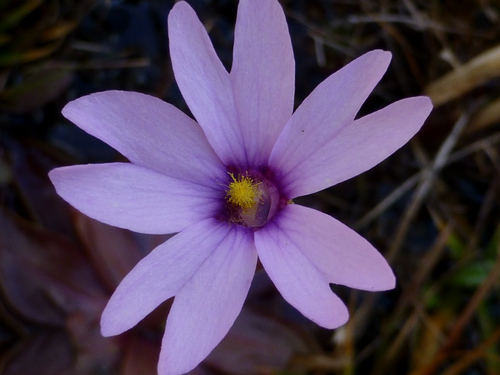
Pinguicula planifolia Chapm., commonly known as Chapman's butterwort, is a carnivorous plant species in the genus Pinguicula. The typical variety produces purple flowers when blooming, which are sometimes pinkish or white. Like other butterworts, it has sticky adhesive leaves that attract, capture, and digest arthropod prey to get nutrients. A key identifying feature of this species is its thin, flat leaves, which often turn deep red to purple when grown in full sun. It is native to the southeastern United States, specifically southern Mississippi, Alabama, the Florida panhandle, and the extreme southeast of Louisiana. Across its native range, Chapman's butterwort grows alongside many other carnivorous plants including Sarracenia and Drosera. It is commonly found in pineland depressions, bogs, wet prairies, swamps, as well as man-made drainage ditches, retention ponds, and roadside edges. Because of this plant's moisture requirements, its habitat is often partially submerged during wet seasons due to weather events. Chapman's butterwort can grow successfully in both terrestrial, exposed environments and fully submerged conditions. It can capture and digest insects both above water and underwater. This species is listed as threatened in the state of Florida, due to habitat loss caused by wetland drainage, development, lack of prescribed burns, and illegal collection.