About Pinguicula moranensis Kunth
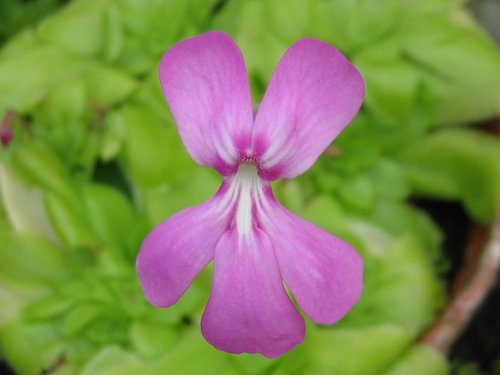
Pinguicula moranensis Kunth is a perennial, rosette-forming insectivorous herb that belongs to the flowering plant family Lentibulariaceae, and is a species of butterwort. It is native to El Salvador, Guatemala, Honduras, and Mexico. In summer, it produces rosettes of flat, succulent leaves up to 10 centimeters (4 inches) long. These leaves are covered in sticky mucilaginous glands that attract, trap, and digest arthropod prey. Nutrients gained from this prey help supplement the low nutrient content of the substrate the plant grows in. During winter, the plant forms a non-carnivorous rosette of small, fleshy leaves to conserve energy when food and moisture supplies are low. Single pink, purple, or violet flowers bloom twice a year on upright stalks that can reach up to 25 centimeters long. The species was first collected by Humboldt and Bonpland on the outskirts of Mina de Morán in the Sierra de Pachuca, located in what is now the Mexican state of Hidalgo, during their 1799–1804 Latin American expedition. Carl Sigismund Kunth formally described this species in Nova Genera et Species Plantarum in 1817, based on these original collections. This species is extremely variable, and has been redefined at least twice since its original description. Several new species have been separated from it based on geographical or morphological differences, though the legitimacy of some of these new segregations remains debated. P. moranensis is still the most common and most widely distributed member of Section Orcheosanthus. It has a long history of cultivation for its carnivorous nature and attractive flowers, and is one of the most common butterwort species kept in cultivation. The generic name Pinguicula comes from the Latin pinguis, which means "fat", a reference to the buttery texture of the surface of the plant's carnivorous leaves. The specific epithet moranensis refers to the species' type location, Mina de Moran. Pinguicula moranensis is the most widely distributed member of Section Orcheosanthus, and it is also the most common and widely distributed Pinguicula species in Mexico. It occurs across all of Mexico's major mountain ranges, except the Sierra Madre Occidental and Baja California. Documented locations include the Mexican states of Tamaulipas, Guanajuato, Nuevo León, Campeche, Chiapas, Oaxaca, Puebla, Distrito Federal, Veracruz, México, Querétaro, San Luis Potosí, Morelos, Hidalgo, Guerrero, Zacatecas, Tlaxcala, Quintana Roo, and Michoacán, as well as the Guatemalan departments of Huehuetenango, Quiché, San Marcos, Quetzaltenango, Totonicapán, Sololá, Chimaltenango, Baja Verapaz, Guatemala and El Progreso. It grows in mountainous regions at altitudes between 800 and 3200 meters (2600–10500 ft). The species generally grows on sedimentary outcrops from the Cretaceous period. However, P. moranensis var. neovolcanica typically grows on igneous rocks of the Trans-Mexican Volcanic Belt. Pinguicula moranensis most often grows in oak, pine-oak, or temperate montane woodlands. Its range also extends into tropical forests, xerophytic shrublands, and humid gorges and canyon walls. It prefers humid, shady environments, including slopes alongside streams, gullies, road cuts, and areas among leaf litter in sandy soil with high organic matter content. Its ability to obtain nutrients from captured arthropod prey allows it to grow in low-nutrient environments where other plants would usually outcompete it. Because of this, it is often found in disturbed areas, or on steep cliffs and hillsides. The plant's roots only serve to anchor it, so it requires little to no soil. Dense clusters can grow clinging to boulders, moss, or crags on rock faces, and it can even grow epiphytically on tree trunks. Common companion plants include mosses, Selaginella, ferns, other herbaceous plants, and canopy trees such as pines and oaks. Pinguicula moranensis is one of the most popular and commonly cultivated Pinguicula species, in part because of its large size, large attractive flowers, and the ease of growing it as a container plant. Most growers use an open soil mix made from a combination of washed sand, perlite, vermiculite, peat moss, gypsum, and/or decomposed granite. The soil should be kept well drained, and watered regularly with distilled water during the summer. Once the plant forms its winter rosette, it should only be watered very rarely. This species grows easily on well-lit windowsills, under fluorescent lights, or in warm to hot greenhouses.