About Pinguicula macroceras Pall. ex Link
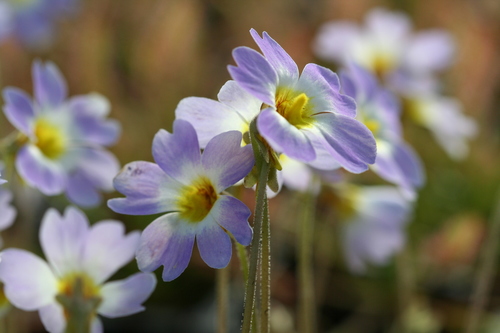
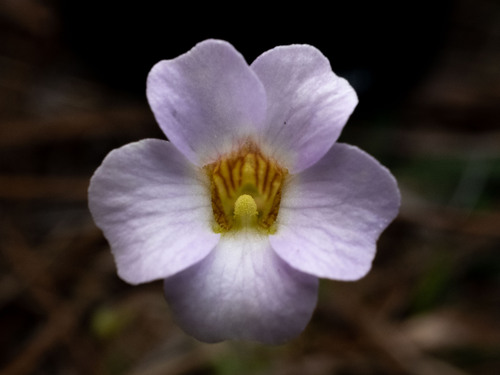
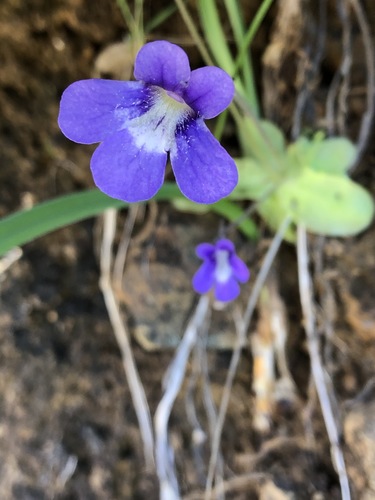
Pinguicula macroceras is a carnivorous perennial herb that grows less than 20 cm tall. It produces simple, fleshy green to dark brown leaves arranged in a basal rosette. The leaves are typically slimy or sticky, and occasionally curl inward over captured prey. The upper leaf surface is glandular: stalked glands catch small organisms, while sessile glands digest the trapped prey. A single rosette can produce 1 to 5 inflorescences, each held on its own individual stem. Each inflorescence holds one purple-blue flower, with two flowers being a rare occurrence, and flowers have no bracts. The upper lip of the flower’s calyx is 3-lobed, while the lower 2-lobed lip has white coloring at its center. The corolla is 13–21 mm long; the lip is often hairy and generally does not block the flower’s throat. Flowers develop a distinct horn-shaped structure at the top, which gives the species its common name: horned butterwort. Pinguicula macroceras grows in moist habitats, very often in serpentine conditions. It is most commonly found on moist slopes and serpentine banks along creeks and rivers, at altitudes below 1800 m. It has also been documented growing on north-facing serpentine cliff sides with fast-flowing seeps. In these moist habitats, moss usually forms a thick layer; Pinguicula macroceras grows its basal rosette on top of this moss, and buries its roots underneath the moss layer. In North America, Pinguicula macroceras is found within 750 km of the Pacific coast, occurring in California, Oregon, Washington, and extending into Canada. Additional populations are known to exist in Russia and Japan. There is ongoing taxonomic debate over whether Pinguicula macroceras should be classified as a full species, or treated as a subspecies of Pinguicula vulgaris. The two species are also difficult to distinguish morphologically, which makes defining the distribution of Pinguicula macroceras challenging in regions where the two taxa occur together. Pinguicula macroceras occupies an ecological niche that is unsuitable for most other plant life, with only moss as a common co-occurring plant. It grows in water-rich, nutrient-poor serpentine soils and cliff sides, and uses its carnivorous adaptation to supplement the nutrients that are lacking in these serpentine habitats.