About Pinguicula longifolia DC.
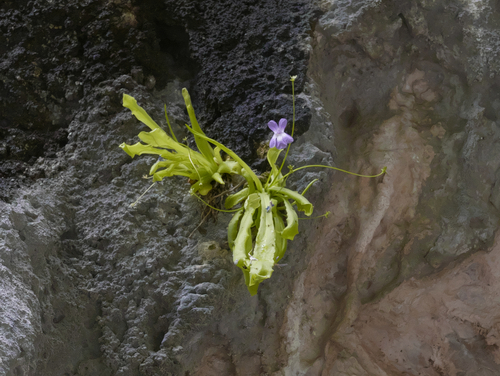
Pinguicula longifolia DC. catches prey using modified ground-lying leaves that are densely covered in stalked glands, each bearing a droplet of sticky mucilage at the tip. This carnivorous adaptation evolved because the soil it grows in lacks sufficient nutrients. Pinguicula longifolia subsp. longifolia gets most of its nutrients from flying insects, primarily diptera, which supply the plant with nitrogen. This subspecies grows in wet, shady locations, and on vertical or overhanging limestone walls, at altitudes between 700 and 1900 meters. In spring, its winter buds open and the first carnivorous leaves emerge; flowers follow in early summer. By summer, mature leaves can reach up to 14 centimeters in length, and glands are present on both sides of the leaves — this is a key characteristic of the subspecies. New carnivorous leaves continue to grow throughout the summer. When conditions become unfavorable in autumn, the plant forms a protective winter bud called a hibernaculum, made of scale-like leaves, at the center of its leaf rosette. Leaf growth stops, old leaves wither and decay, and the plant enters winter dormancy. Successful summer growth is required for this subspecies, as poor growth produces weak hibernacula that rot easily. Pinguicula longifolia subsp. longifolia is endemic to the Pyrenees, meaning habitat destruction could reduce the area available for it to reproduce. It is also threatened by carnivorous plant enthusiasts who collect rare wild specimens. Members of the genus Pinguicula have a number of human uses. They produce a strong bactericide that stops captured insects from rotting before digestion is complete. Europeans have known of this beneficial property for centuries, and have applied the bactericide to cattle wounds to promote healing. Additionally, Pinguicula leaves have been used to curdle goat's milk to make Filmjölk, a Swedish fermented milk product.