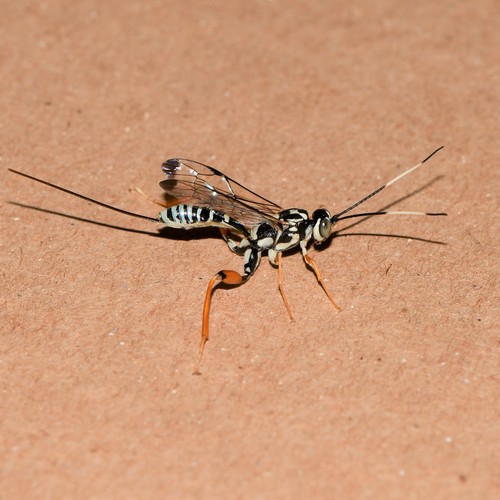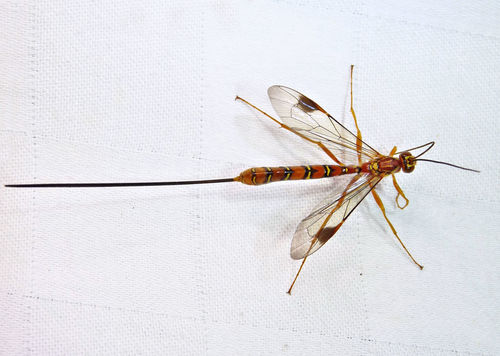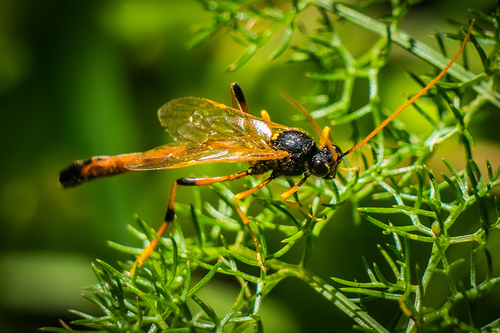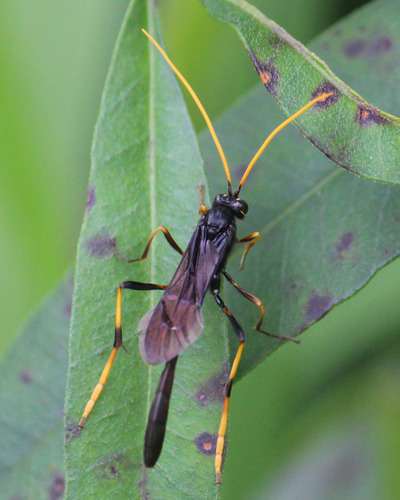
About Pimpla rufipes Brulle, 1846
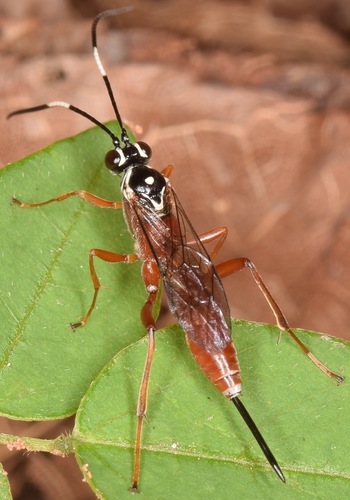
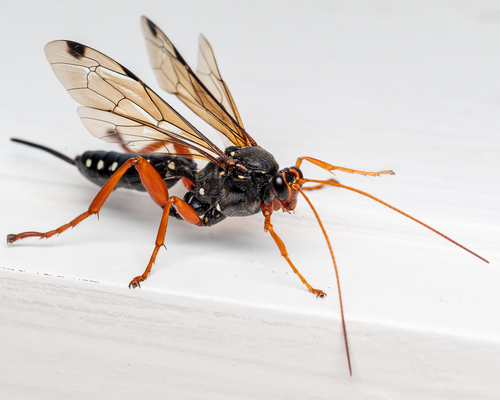
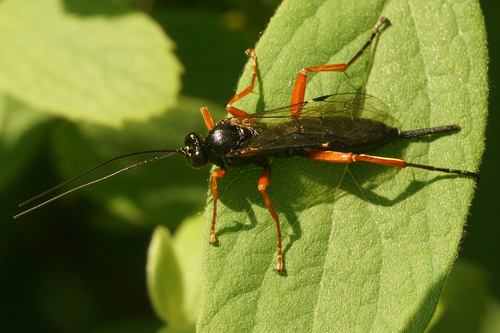
Pimpla rufipes, first described by Brulle in 1846, reaches an approximate body length of 15 mm (0.59 in) and has a rather slender body. These wasps are generally black with bright orange legs, and the hind legs are larger than the other two pairs. Females of this species have a straight, quite short, thick ovipositor, while male Pimpla rufipes do not have an ovipositor at all.
Pimpla rufipes is often confused with Apechthis compunctor because the two species share a similar size, and males of both species cannot be distinguished from one another based on photographs. The main distinguishing feature between the two species is the shape of the female ovipositor: Pimpla rufipes females have a straight ovipositor, while Apechthis compunctor females have curved ovipositors.
The front wing of Pimpla rufipes measures 5.5 to 15 mm in length. This species does not have a pale submedian band on its hind tibia. Its abdomen has a texture ranging from finely matte to subpolished, and is usually rather closely covered in tiny pits. The first abdominal tergite is long, with a prominent dorsal hump positioned just past its midpoint. The upper valve of the female ovipositor is either not flattened, or only weakly flattened.
This species is distributed across Afghanistan, Albania, Algeria, Armenia, Austria, Azerbaijan, the Azores, Belarus, Belgium, Bulgaria, China, Croatia, Cyprus, Czech Republic, Denmark, Egypt, Estonia, Finland, France, Georgia, Germany, Greece, Hungary, India, Iran, Ireland, Italy, Japan, Kazakhstan, Korea, Kyrgyzstan, Latvia, Libya, Lithuania, Macedonia, the Madeira Islands, Malta, Moldova, Mongolia, Morocco, Netherlands, Norway, Poland, Romania, Russia, Serbia & Montenegro, Slovakia, Spain, Sri Lanka, Sweden, Switzerland, Tajikistan, Tunisia, Turkey, Turkmenistan, Ukraine, the United Kingdom, and Uzbekistan. It primarily inhabits hedgerows and vegetated areas.
Pimpla rufipes is an idiobont endoparasitoid, meaning its hosts do not mature after being parasitized. This species develops through five larval stages. Even the first instar larva is already very large, so females can only carry a small number of eggs at a time. Pimpla rufipes undergoes morphological changes with each larval instar. Most instars last approximately 24 hours each, while the fifth and final instar lasts an average of around 9 days.