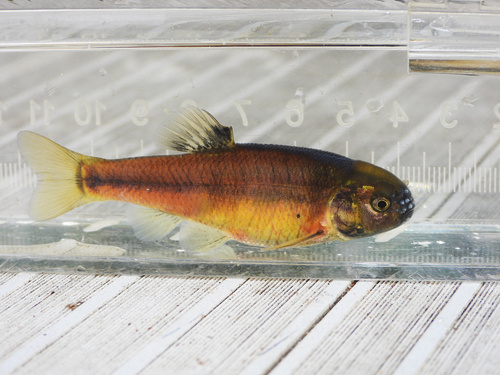
About Pimephales promelas Rafinesque, 1820
Scientific name: Pimephales promelas Rafinesque, 1820. Physical description: Wild-type fathead minnows are generally dull olive-grey, with a dusky stripe running along their back and side and a lighter belly. A dusky blotch appears halfway along the dorsal fin. Breeding males develop a large, grey fleshy growth on the nape, along with around 16 white breeding tubercles on the snout. This species typically reaches a total length of 7 to 10 cm (2.8 to 3.9 inches). Distribution and habitat: Fathead minnows are native across North America, ranging from Chihuahua, Mexico, north to Canada's Maritime Provinces and the Great Slave Lake drainage. They have been introduced to Atlantic and Pacific coastal drainage basins in the United States. Their tolerance for a wide range of environmental conditions, their life history traits, and their popularity as a bait fish all contribute to their widespread distribution. This species is highly tolerant of turbid, low-oxygen water, and is most commonly found in small lakes, ponds, and wetlands. It can also inhabit larger lakes, streams, and other habitat types. Use as an aquatic toxicity indicator: Because the fathead minnow is tolerant of harsh conditions, it can live in bodies of water that are uninhabitable for other fish, including waste drainage sites. It has been widely used in research to study the effects of waste materials on aquatic life. Natural and synthetic estrogens such as estradiol and estrone are found in effluent from sewage treatment works. When male fathead minnows are exposed to these steroidal compounds, their plasma vitellogenin levels rise to levels higher than those of mature female fathead minnows. Vitellogenin levels in blood plasma are a standard indicator to test whether chemicals have estrogenic activity in fish. Exposure also causes inhibition of testicular growth, even at low concentrations or over short exposure periods. These studies demonstrate that natural estrogens, likely originating from human activity, present a new ecotoxicological issue. Bisphenol A, a chemical used to produce polycarbonate plastic, epoxy resin, and other chemicals, is also weakly estrogenic, and causes many of the same effects seen with estradiol and estrone. Exposure leads to reduced somatic growth in male fathead minnows. In females, it reduces egg production and hatchability, and effects appear faster in females than in males. The effects of low pH on fathead minnows have also been studied. Extended exposure to low pH has minimal impact on survival, but causes abnormal stress behaviors including surface swimming and hyperactivity. Long-term exposure also causes developmental deformities: the heads of both males and females grow smaller than normal. Males become less brightly colored, while females become egg-heavy but may not spawn, and produce fewer eggs. Eggs laid after low pH exposure develop abnormally, becoming fragile and lacking turgidity, and hatching success decreases as pH gets lower. Fathead minnows exposed to cattle feedlot effluent develop altered sex characteristics: males are feminized, while females are defeminized. Exposed males have reduced testicular testosterone synthesis, altered head shape, and smaller testes, while exposed females have a decreased estrogen-to-androgen ratio, a defeminized sex hormone profile. Toxicity indicator: This species is an important indicator species and biological model in aquatic toxicology studies, similar to Ceriodaphnia dubia, Hyalella azteca, and Chironomus dilutus. Due to its relative hardiness and high offspring output, EPA guidelines outline its use for evaluating acute and chronic toxicity of samples or chemical compounds in vertebrate animals.