About Pimephales notatus (Rafinesque, 1820)
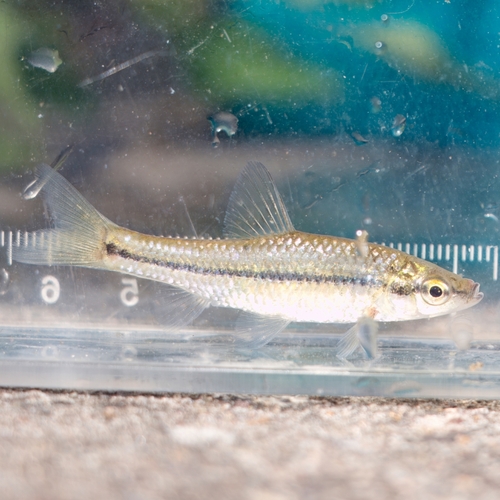
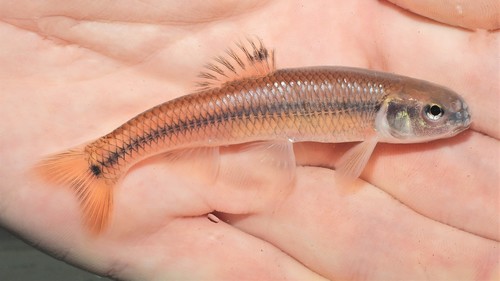
Bluntnose minnow (Pimephales notatus (Rafinesque, 1820)) individuals are commonly 6.5 cm (2.6 in) long, with a maximum recorded length of 11 cm (4.3 in). Dark pigmented spots appear on the first two or three of its dorsal rays. The scales located between its head and dorsal fin are smaller than the scales covering the rest of its body. It has a rounded head and a terminal mouth, with a snout that extends slightly over the mouth. Dark pigment on the edges of its scales gives the body a cross-hatched appearance. Its scales are cycloid scales, a type of leptoid scale, and the growth rings on these scales can be used to determine the fish’s age. The bluntnose minnow’s lateral line runs from its head to its tail, and ends in a distinct black spot that differentiates this species from the fathead minnow. This species has a pale olive upper body above the lateral line, a silvery lower body below the lateral line, and silvery-blue scales along the area near the lateral line.
In North America, bluntnose minnows are native to the Hudson Bay and Mississippi River basins, ranging from southern Quebec to southern Manitoba in Canada, down to Louisiana in the United States. They are also native to the Atlantic coast range stretching from the Saint Lawrence River in Quebec to the Roanoke River on the US east coast. Many non-indigenous populations have been recorded in Connecticut, Georgia, Maryland, Massachusetts, New York, Ohio, South Dakota, Utah, Virginia, West Virginia, and Michigan; these non-native populations are thought to have been established through bait bucket release or stock contamination. Bluntnose minnows are considered the most abundant freshwater fish in the eastern United States.
Bluntnose minnows inhabit lakes, rivers, ponds, and streams, and prefer shallow, clear water with a sandy bottom. Their habitat range extends from headwater bogs, swamps, and springs to larger rivers, ponds, and lakes. Up to a dozen distinct minnow species may be found living together in a single moderate-sized stream. Bluntnose minnows may swim either in large groups or alone.
Bluntnose minnows spawn from early spring to midsummer, with the timing varying based on their location. The fish lay their eggs and attach them underneath stones, inside depressions they have dug. During the mating season, mature males develop darker heads, bluish body coloration, and three rows of nuptial tubercles (small bumps) on their heads. Eggs hatch 8 to 14 days after being laid.