About Pimelea linifolia Sm.
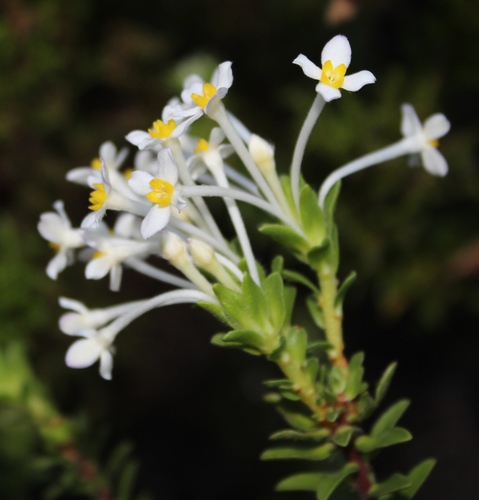
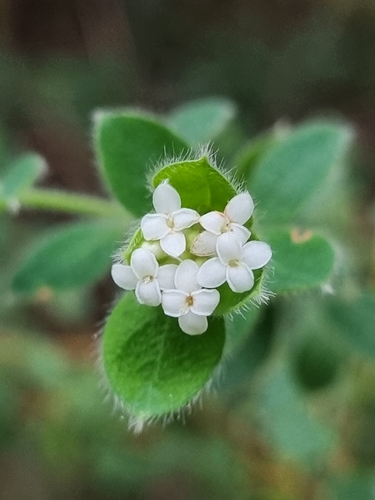
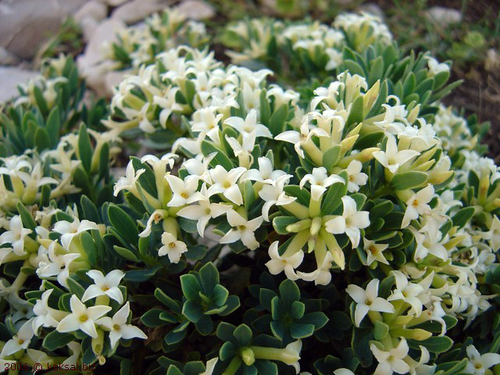
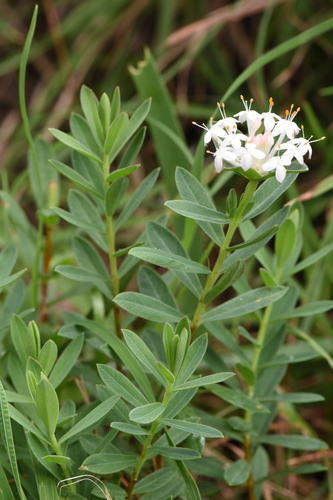
Pimelea linifolia Sm., commonly known as slender rice flower, is a variable shrub species. It can grow as a prostrate plant, or reach up to 1.5 meters (4 feet 11 inches) in height, and has glabrous stems. Its leaves are also glabrous, with a shape ranging from narrow egg-shaped to elliptic, measuring 3 to 40 millimeters (0.12 to 1.57 inches) long and 1 to 9 millimeters (0.039 to 0.354 inches) wide. The flowers are usually white, sometimes pink, and mostly 10 to 20 millimeters (0.39 to 0.79 inches) long. Flowers are arranged in clusters called heads at the ends of stems, with between seven and sixty flowers per head. Four, sometimes eight, bracts are present at the base of each flower head. Individual flowers can be bisexual or female, and female flowers are shorter than bisexual ones. The bracts are sessile, with a shape ranging from lance-shaped to egg-shaped, measuring 7 to 17 millimeters (0.28 to 0.67 inches) long and 3 to 11 millimeters (0.12 to 0.43 inches) wide. The fruit produced by this species is green, and 3 to 5 millimeters (0.12 to 0.20 inches) long. This species is widespread and common across eastern Australia. It most often grows in wet forest, and sometimes grows on rainforest margins. Its natural range extends from north-east Queensland, through the eastern half of New South Wales, all of Victoria except the far north-west, the south-east of South Australia, and across all of Tasmania. Pimelea linifolia is suspected to be poisonous to sheep, but the evidence supporting this suspicion is inconclusive. The bark of Pimelea linifolia can be processed into fine, strong thread used for catching bogong moths. A traditional processing method involving wetting, drying, beating and rolling the bark produces this string, which is called a 'Bushman's bootlace'.