About Pimelea humilis R.Br.
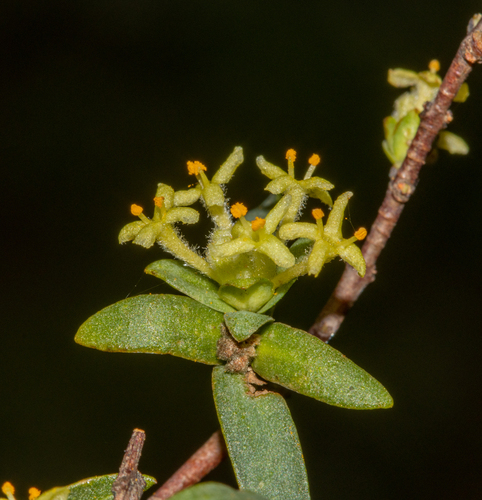
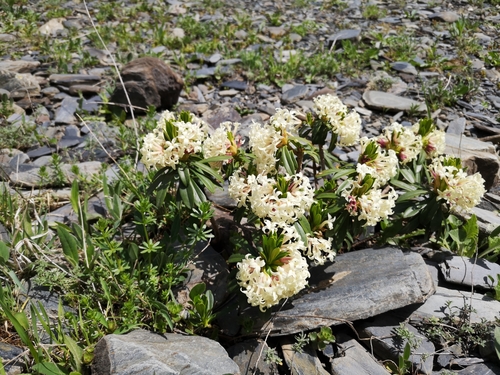
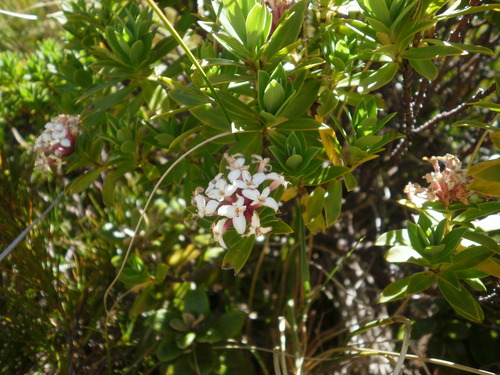
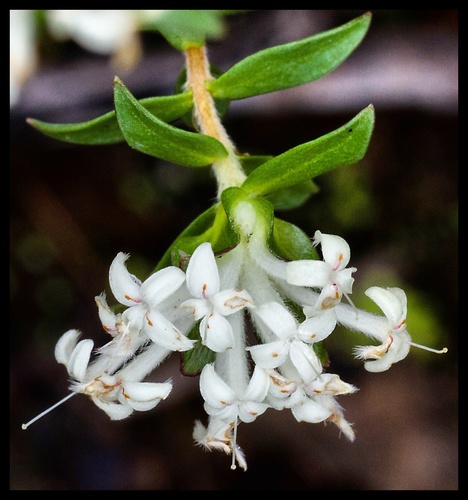
Pimelea humilis R.Br., commonly known as common riceflower, is an erect or scrambling shrub that typically grows to a height of 5–50 cm (2.0–19.7 in) and has densely hairy young stems. Its leaves are arranged in opposite pairs, and are narrowly elliptic to lance-shaped. Most leaves are 5–16 mm (0.20–0.63 in) long and 1–9 mm (0.039–0.354 in) wide, and grow on a short petiole. The flowers are arranged in clusters of 12 to 52 on a peduncle 2–19 mm (0.079–0.748 in) long. The clusters are surrounded by 4 or 6 egg-shaped involucral bracts that are 6–18 mm (0.24–0.71 in) long and 3–11 mm (0.12–0.43 in) wide, green with a yellow base. The flowers are creamy-white, with a flower tube 8–15 mm (0.31–0.59 in) long and sepals 1–5 mm (0.039–0.197 in) long. The stamens are shorter than the sepals. Flowering occurs from September to December, and the fruit is green and about 4 mm (0.16 in) long. Common riceflower is similar to Pimelea linifolia, but is smaller, softer, and has hairy stems. Common riceflower grows in heath, woodland, forest and grassland, often in sandy soil. It is widespread and common in Victoria, but less common in New South Wales, where it grows at Robertson and south of Eden. It also occurs east of the Mount Lofty Range in South Australia and in north-eastern Tasmania.