About Pilumnus hirtellus (Linnaeus, 1761)
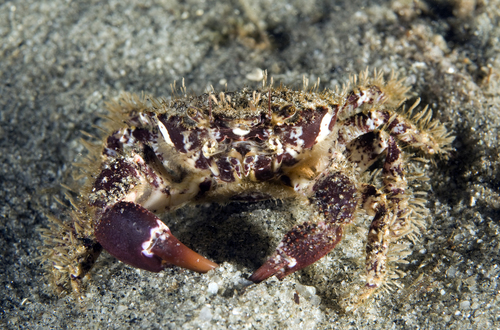
Pilumnus hirtellus (Linnaeus, 1761) is a small crab species. Its carapace can reach up to 28 millimetres (1.1 in) wide and 20 millimetres (0.79 in) long. The carapace and legs are typically reddish brown or purple, while the inner surfaces of the legs are orange or a paler shade. Both the carapace and walking legs are densely covered in setae. The first pair of legs bears large chelae, or claws: usually the right claw is larger than the other, and the fingers of both claws are brown. Female crabs have smaller, less hairy claws. Young crabs that are less than 5 millimetres (0.20 in) in size are entirely chalky white. The front edge of the carapace has five teeth on each side, where the first two teeth are smaller than the remaining three.
Pilumnus hirtellus ranges from the North Sea to Morocco, the Azores, Madeira, the Canary Islands and the Cape Verde Islands, and also occurs in the Mediterranean Sea and Black Sea. Its distribution is limited by hard frosts, violent storms and pollution, and it is concentrated in regions near the Mediterranean, such as the Sado River estuary in Portugal.
This species lives at depths of up to 80 metres (260 ft), and prefers areas shallower than 10 metres (33 ft). It can occupy a variety of substrates, including muddy, sandy and rocky bottoms, spaces under stones, and even among the holdfasts of seaweeds. In the Black Sea specifically, Pilumnus hirtellus favors stony areas with abundant algae and mussels. Its diet consists mainly of carrion.
In the life cycle of Pilumnus hirtellus, females can carry up to 4000 eggs between April and August. The eggs hatch into planktonic zoea larvae that are released between May and September. These zoea larvae develop into megalopa larvae before maturing into the adult crab form.