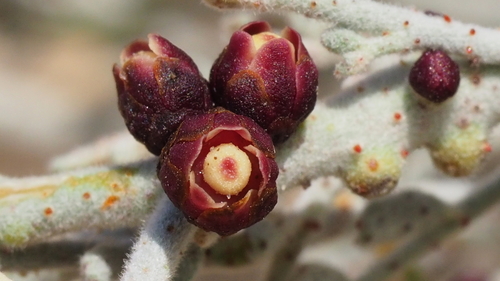
About Pilostyles thurberi A.Gray
Pilostyles thurberi A.Gray is a tiny parasitic plant that reaches only a few millimeters in length. It lives inside the stem tissues of host plants, which are species of legume shrubs, often from the genus Psorothamnus, especially Emory's indigo bush or dyebush (Psorothamnus emoryi). This species lacks roots, leaves, and chlorophyll, and gets all of its water and nutrients from its host. It grows as microscopic strands similar to fungal filaments that remain completely inside the host's stems until it blooms, when it pushes tiny flowers out through the host plant's surface. Pilostyles thurberi is dioecious, meaning male and female individuals each produce only one type of flower. Both male and female flowers are brown or maroon, and no more than 2 millimeters across, appearing as small specks on the host plant's stem. Blooming typically occurs in January, but can start as early as November. As the fruit capsule develops inside the female flower, the flower swells slightly. Each capsule can hold over 100 minute seeds. This species is found in both the United States and Mexico. In the United States, it has been recorded in Arizona, California, New Mexico, Nevada, and Texas. In Mexico, it occurs in Baja California ranging from Mexicali to San Felipe, as well as in the states of Sonora and Chihuahua. It grows primarily in open desert scrub, at elevations between 100 and 1000 meters.

