About Pilophorus acicularis (Ach.) Th.Fr.
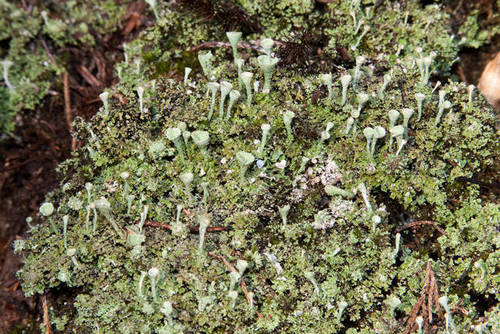
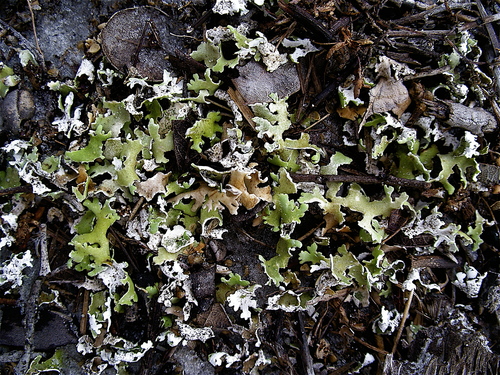
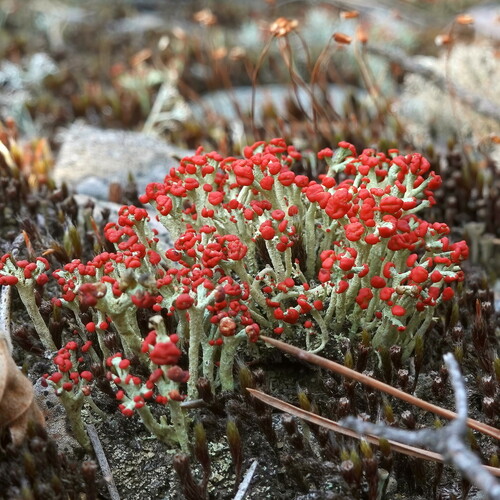
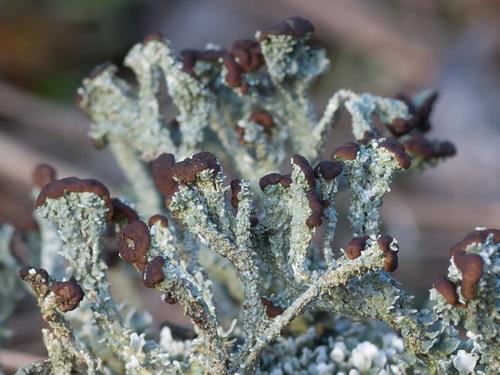
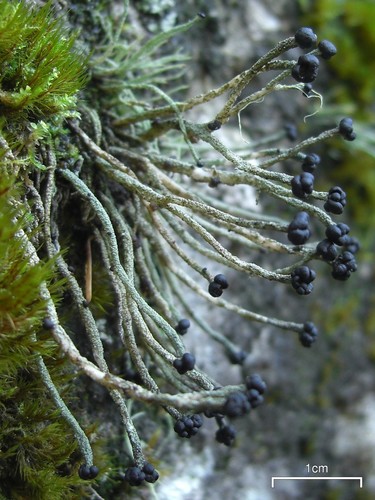
Pilophorus acicularis (Ach.) Th.Fr. is a species of tripartite lichen that hosts three symbiotic partners: a fungus (mycobiont), a green alga, and a cyanobacterium (photobiont). The green algal symbiont associated with it is Asterochloris magna, previously named Trebouxia magna. The cyanobacterial partner, which belongs to the genus Nostoc, is held in specialized structures called cephalodia. Cephalodia are nitrogen-fixing, lichenized cyanobacterial aggregations that are hemispherical to irregularly shaped and range in color from light to dark brown; they grow on the primary thallus, with smaller cephalodia also occurring on pseudopodetia. As a lichen with cyanobacterial cephalodia, it can fix nitrogen and contributes nitrogen to ecosystems. The vegetative body of this lichen, called the thallus, has a primary form (thallus horizontalis) that grows as a spreading granular crust directly on its substrate. Young primary thalli are light green, turning gray as they age or when they dry out. Upright, stalk-like vegetative extensions of the thallus called pseudopodetia grow in dense clusters; they measure 0.5 to 3 cm (0.2 to 1.2 in) tall, about 1 mm thick. Most pseudopodetia are either unbranched or forked into two branches, with curved stalks that give a combed appearance. Less commonly, pseudopodetia grow erect like pins and reach up to 1 cm (0.4 in) tall. Uncommon specimens have extensive branching in the upper pseudopodetia, which makes them resemble Pilophorus robustus. Internally, young pseudopodetia are solid, become hollow with age, and are made of long, thin, heavily gelatinized hyphae with narrow cavities 0.5 μm wide. The internal lower portion of older pseudopodetia turns black. Unlike many lichens with stratified thalli that have a continuous discrete photobiont layer, the algal layer of P. acicularis is not continuous. Instead, photobiont cells occur mixed with fungal mycobiont in distinct granules, and these granules may be absent from some sections of the thallus surface. Flasked-shaped conidia-producing structures called pycnidia, which resemble perithecia, form at the tips of small sterile pseudopodetia or at the tips of small lateral branches of older pseudopodetia. The conidiophores of this lichen are unbranched and 30 μm long, and they produce terminal sickle-shaped conidia that measure 6 by 1 μm. Abundant apothecia (reproductive structures holding spore-producing asci) typically grow one or several at the tips of pseudopodetia. Apothecia are black, hemispherical or roughly triangular, and reach up to 1.5 mm in diameter. The hymenium, the fertile spore-bearing cell layer that contains the asci, can be up to 240 μm thick; around two-thirds of the hymenium is pigmented, and the lower section is sterile, made up only of paraphyses. Each ascus holds eight spores. Young ascospores are rounded, becoming spindle-shaped when mature, with dimensions of 21.0–29.5 by 4.5–5.5 μm. The generative tissue, the hyphal tissue that eventually develops into the thallus, is made of closely interwoven short, broad cells with large cavities. This tissue is colored black-brown, with the most intense color located below the paraphyses, fading toward the pseudopodetial stalk. This lichen most commonly grows on silicate stone, and rarely grows on decaying wood. It typically occurs in partial shade within openings of low to mid-elevation moist forests, and is also frequently found on rocky roadcuts. It is likely the most abundant species in the genus Pilophorus. Most known collections of the species come from the west coast of North America, ranging as far north as Alaska; it is reported most often from British Columbia and Washington. It has also been recorded in China, Japan, Taiwan, and the Russian arctic. It prefers an oceanic climate without extremely low temperatures, when compared to other species in the genus. This preference is supported by its occurrence further south than other Pilophorus species, with 34 recorded finds in California, and its lower frequency in northern Alaska where P. robustus and P. vegae are more common. Pilophorus acicularis is rare east of the Rocky Mountains.