About Piliocolobus tephrosceles (Elliot, 1907)
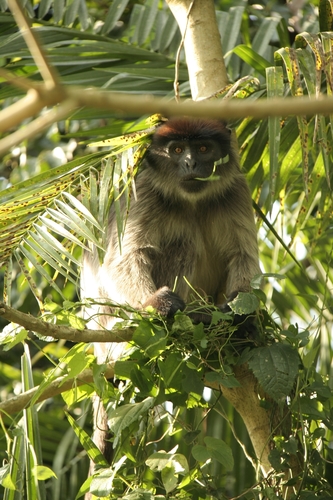
The Ugandan red colobus (Piliocolobus tephrosceles) has a rust-red cap and a dark grey to black face; infants are born with fully black faces. Its coat colour varies widely: back colour ranges from black to dark grey to reddish brown, while the sides of the body, arms, and legs are light grey. This species has very long tails that vary in colour from dark to light brown, which it uses for balance when climbing and leaping through the canopy. It has dark grey to black hands and feet, and its very long feet help it leap large distances. Like all colobus monkeys, the Ugandan red colobus has extremely reduced thumbs that are almost absent, a feature thought to assist with brachiation when moving through the canopy. This species shows strong sexual dimorphism, with males being much larger than females. The average male weighs approximately 10.5 kg (23 lb), while the average female weighs approximately 7 kg (15 lb).
The Ugandan red colobus is found only in Africa, with a range spanning 1,000 km (620 mi) across East Africa. However, its populations are restricted to five separate forested areas: west Tanzania at the edge of Lake Victoria, the Gombe and Mahale Mountains at the edge of Lake Tanganyika, the Ufipa Plateau, and west Uganda's Kibale National Park. The Ugandan population is the largest, and it has been suggested that this is the only viable population, with around 17,000 individuals. It remains unconfirmed whether the Ugandan red colobus also occurs in Rwanda, Burundi, and the eastern Democratic Republic of the Congo.
Habitat for this species varies between populations. Kibale National Park, Uganda, which hosts the largest population, is a moist evergreen tropical forest. This park has been a protected area since 1993; before 1993, parts of the forest experienced varying degrees of logging. The Ugandan red colobus habitat in Mbisi Forest Reserve on the Ufipa Plateau is fragmented and severely degraded, unlike Kibale which retains large expanses of undisturbed forest.
Male Ugandan red colobuses reach sexual maturity at 5 years old, while females reach sexual maturity between 4 and 5 years old. The gestation period lasts 5 to 6 months, and females give birth to their first infant between 4 and 5 years old. There is no distinct breeding season, so infants are born year-round, but birth rates peak during rainier months, which aligns with the emergence of new leaf food. Both males and females initiate copulation. During copulation, other group members sometimes harass the mating pair by making loud calls, lunging, or leaping around or onto the male's back. Harassers are typically either adult males competing for mates, or juveniles when the female copulating is their mother.