About Pilgerodendron uviferum (D.Don) Florin
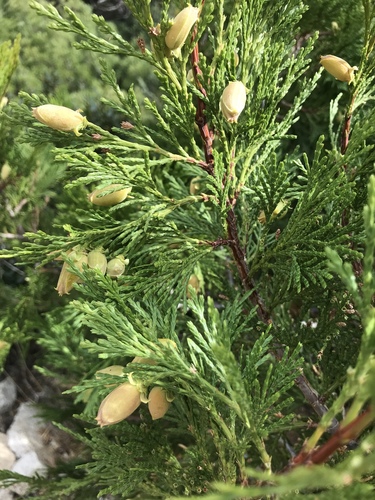
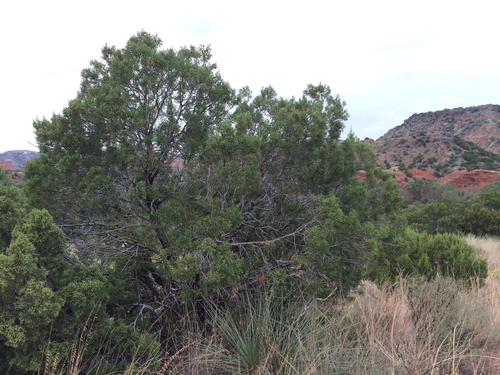
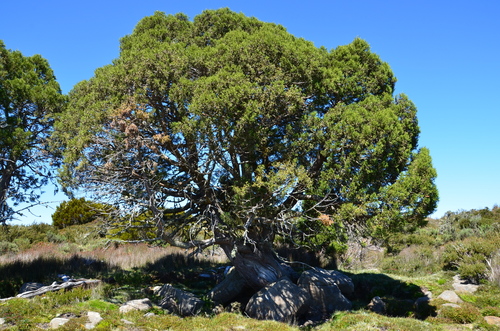
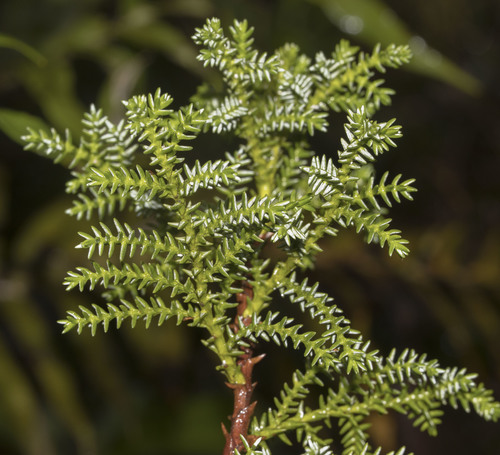
Pilgerodendron is a genus of conifer in the cypress family Cupressaceae. This genus contains only one species: Pilgerodendron uviferum (D.Don) Florin. The species is endemic to the Valdivian temperate rain forests and Magellanic subpolar forests of southern Chile and southwestern Argentina. Its growth range extends from 40° S to 54°20' S in Tierra del Fuego, making it the southernmost conifer species in the world. It belongs to the subfamily Callitroideae, a group of distinct Southern Hemisphere genera associated with Antarctic flora. Pilgerodendron is very closely related to Libocedrus, a genus native to New Zealand and New Caledonia. Many botanists reclassify P. uviferum within this genus as Libocedrus uvifera (D.Don) Pilg., and it also holds the taxonomic synonym Libocedrus tetragona (Hooker). Locally, the species is called ciprés de las Guaitecas, named after the Guaitecas Archipelago. It is referred to by its scientific name, pilgerodendron, in other regions. The genus is named for Robert Knud Friedrich Pilger. P. uviferum is a dioecious, slow-growing, narrowly conical evergreen tree, reaching 2–20 m in height with a trunk up to 1.5 m in diameter. Taller specimens and wider trunks, reportedly up to 3 m in diameter, existed before the species was overexploited. This species has scale-like leaves arranged in decussate pairs, with each leaf equal in size. This arrangement gives the shoots a square cross-section, which differs from Libocedrus species, where pairs of larger leaves alternate with pairs of smaller leaves to produce a somewhat flattened shoot. The seed cones of P. uviferum measure 5–12 mm long and 4–6 mm broad, and have four scales: two sterile basal scales and two fertile scales. Each scale bears a slender spine-like bract, and each fertile scale holds two winged seeds that are 3–4 mm long. The pollen cones are 5–10 mm long and 2 mm broad, with 12–20 scales. P. uviferum grows in evergreen coastal lowland forests along the Pacific coast of southern Patagonia, where it grows alongside the broadleaf evergreens Nothofagus betuloides and Drimys winteri. It also forms open stands in sheltered bogs further inland, where it is often locally dominant, and ranges as far as the eastern slopes of the Andes in southwestern Argentina. Forests dominated by Pilgerodendron are called cipresales. These forests are common across the southern half of Chiloé Island, where they cover many flattish areas. At the northern end of its range, P. uviferum grows in association with Fitzroya cupressoides. The northernmost natural stands are located at 39°50' S near the city of Valdivia. In the far north of its natural distribution, the conservation status of P. uviferum is poor: populations are fragmented by exotic plantations, threatened by livestock, and were heavily damaged by logging and wildfires in the past. The species has also been planted along the northern part of the Pacific Coast of the United States. Today, most wild P. uviferum grows in the Andes and the Chilean Coast Range. During the interstadials of the region's last glacial period, however, P. uviferum grew in lowland areas such as the Central Valley, where it is no longer found. Remaining lowland populations are thought to be relict populations that have survived the warmer Holocene climate. The wood of P. uviferum is yellow-reddish, has a distinct spicy-resinous smell, and is highly resistant to decay. This has made it a very valuable timber source for building construction in its native range. Much of the species' original lowland habitat has been cleared for timber harvesting and other uses. Due to over-exploitation, P. uviferum is now much rarer than it was historically. It is listed under CITES Appendix I, which prohibits commercial international trade in the species. The World Conservation Monitoring Centre considers P. uviferum threatened, and the International Union for Conservation of Nature classifies it as vulnerable.