About Pilea peperomioides Diels
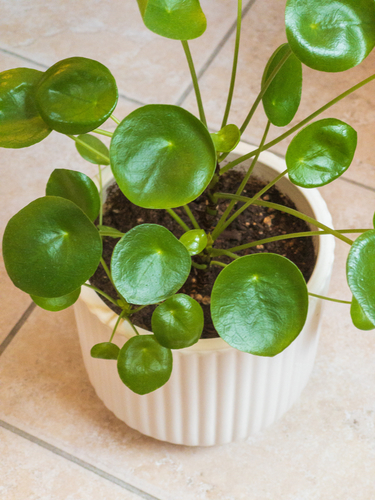
Pilea peperomioides Diels is an erect, evergreen perennial hairless plant. It produces shiny dark green circular leaves, which grow up to 10 cm (4 in) across and attach to long petioles. Its leaves are peltate, meaning the petiole connects to the leaf near the center of the circular blade. In the wild, this plant grows to roughly 30 cm (12 in) in both height and width, and it can grow larger when kept indoors. Its stem is greenish to dark brown, typically upright and unbranched, and becomes woody (lignified) at the base when mature. When grown in poor conditions, the plant loses leaves from the lower portion of its stem and develops a distinct growth habit. Its flowers are not showy or easily noticeable. This plant bears a superficial similarity to some species of Peperomia, which is why it is given the specific epithet peperomioides. Peperomia species are also popular cultivated plants, but they belong to the different plant family Piperaceae. It is also sometimes confused with other peltate-leaved plants including Nasturtium, Umbilicus and Hydrocotyle.
This species is native only to China, where it occurs in southwestern Sichuan province and western Yunnan province. It grows on shady, damp rocks in forests, at elevations between 1,500 and 3,000 m (4,900 to 9,800 ft). It is classified as endangered in its native wild habitat, but it is grown as an ornamental plant in China and across the world.
In temperate regions, Pilea peperomioides is most commonly grown as a houseplant. Cultivation guides recommend a minimum temperature between 13 °C (55 °F) and 5 °C (41 °F), but the species tolerates periods near or below freezing in its native range. This means it can be kept in unheated indoor spaces, or even grown outdoors in temperate climates; frost will kill above-ground foliage, but the plant will regrow from underground growth in spring. Wessel Marais, the Kew Gardens botanist who confirmed the plant's identity in the 1980s, later grew the species outdoors in Cazillac, France. He recorded it surviving for 6 to 7 years through temperatures as low as −9 °C (16 °F), and noted that above-ground stems are killed but the plant regrows from below ground, so deep planting helps it survive cold conditions. Pilea peperomioides can be propagated from plantlets called offshoots that sprout on the parent plant's trunk, or from underground shoots called rhizomes. These offshoots are often shared as a "lucky plant" (also called "lucky thaler") or friendship plant. Steady temperatures and high humidity improve the growth of this species, so it is well suited for growing in terrariums.
Even though it is endangered in its native habitat, Pilea peperomioides is one of the most popular modern houseplants. It is in high demand for its compact form, easy care requirements, and tolerance for dry environments. It is widely available from retail plant sellers, which are supplied by large-scale commercial plant growers. This species has earned the Royal Horticultural Society's Award of Garden Merit. Three distinct cultivars have been introduced in recent years: 'Sugar', 'White Splash' and 'Mojito'.