About Pieris rapae (Linnaeus, 1758)
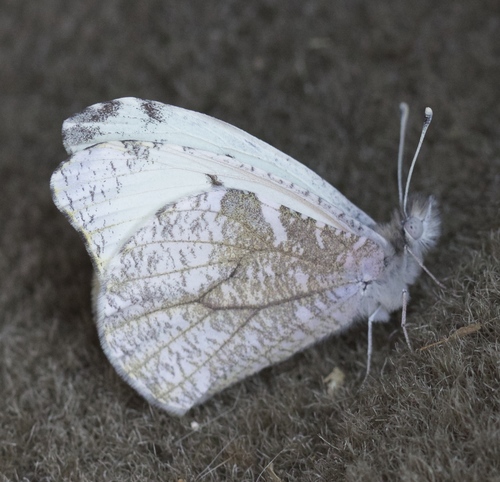
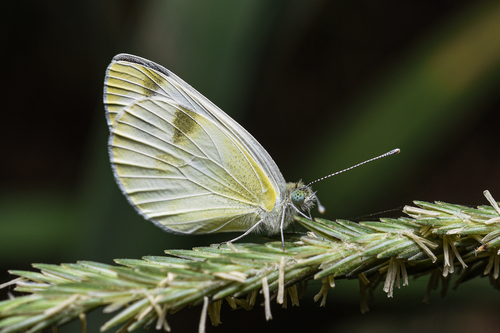
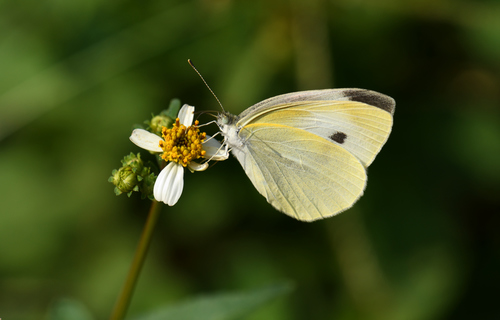
Pieris rapae, commonly called the small white or cabbage white, resembles a smaller version of the large white butterfly (Pieris brassicae). Its upperwings are creamy white with black tips on the forewings; females additionally have two black spots in the center of their forewings. Its underwings are yellowish with black speckles. Due to its plain appearance, it is sometimes mistaken for a moth. Adult wingspan measures roughly 32–47 mm (1.3–1.9 in), and the species has an average wingbeat frequency of 12.8 flaps per second.
The species’ natural range spans Europe, Asia, and North Africa. It was accidentally introduced to Quebec, Canada around 1860, and spread rapidly across North America, reaching all North American life zones from Lower Austral/Lower Sonoran to Canada. It is absent or scarce in desert and semidesert regions, except for irrigated areas. It does not occur north of the Canadian life zone, nor on the Channel Islands off the coast of southern California. By 1898, it had spread to Hawaii; by 1929 it had reached New Zealand and the area around Melbourne, Australia, and it arrived in Perth as early as 1943. It does not appear to have become established in South America.
In Britain, the species has two flight periods: April–May and July–August. In North America it is continuously brooded, and it is one of the first butterflies to emerge from the chrysalis in spring, flying until hard freeze in the fall. It can be found in any open area with diverse plant associations, and is commonly seen in towns as well as natural habitats, most often in valley bottoms. Though it prefers open areas, it has even been found entering small forest clearings in recent years. The nominate subspecies P. r. rapae occurs in Europe, while Asian populations are classified as the subspecies P. r. crucivora. Other recognized subspecies include atomaria, eumorpha, leucosoma, mauretanica, napi, novangliae, and orientalis.
Females readily lay eggs on both cultivated and wild members of the cabbage family (Brassicaceae), such as charlock (Sinapis arvensis) and hedge mustard (Sisymbrium officinale). P. rapae lays eggs singly on host plants. Eggs are yellowish and marked with 12 longitudinal ridges. In laboratory settings, egg production peaks about one week after the butterfly reaches adulthood, and females can live up to three weeks. Females tend to lay fewer eggs on plants that grow in clumps than on isolated plants.
It has been suggested that isothiocyanate compounds in Brassicaceae evolved to reduce herbivory by small white caterpillars, but this suggestion is not generally accepted. The small white was later found to be immune to the isothiocyanate forming reaction thanks to a specific biochemical adaptation, and the species and its relatives actually evolved as a consequence of this adaptation to the isothiocyanate-forming glucosinolates found in Brassicaceae.
Traditionally called the imported cabbage worm in the United States, and now more commonly called the cabbage white, the caterpillar stage is bluish-green with tiny black spots, a black ring around the spiracles, a lateral row of yellow dashes, and a yellow middorsal line. Caterpillars rest on the undersides of leaves, making them less visible to predators. While larval instars have not been fully studied, different instars are easily differentiated by size alone, particularly the size of the head. In the first and second instar, the entire head is black; in the third instar the clypeus is yellow while the rest of the head remains black. In the fourth and fifth instar, there is a dark greenish-yellow dot behind each eye, with the rest of the head still black. However, caterpillar head color does not always indicate a specific instar, as the timing of the color change is not fixed. In the larval stage, P. rapae is a pest of cultivated cabbages, kale, radish, broccoli, and horseradish, and is considered a serious pest for commercial production of cabbage and other Brassicaceae crops.
The pupa of P. rapae is very similar to that of P. napi. It ranges from brown to mottled-gray or yellowish, and matches the color of its background. It has a large head cone, a vertical abdomen, and a flared subdorsal ridge. P. rapae and P. napi pupae can be easily distinguished by comparing their proboscis sheaths: in P. rapae, the proboscis sheath extends far beyond the antennal sheath, while in P. napi it extends only a very short distance.
Like its close relative the large white, the small white is a strong flyer. In most years, the British population is increased by immigrants from continental Europe. Adults are diurnal and fly throughout the day, except for early morning and evening. There is occasional activity during the later part of the night, which ceases as dawn breaks. Adult P. rapae can travel many kilometers in a single flight, with observations of individuals flying up to 12 km in one flight. On average, a female flies about 0.7 km per day, and moves 0.45 km from her starting point. Males patrol all day around host plants to find females to mate with.
When a male spots a female, he flies in zigzags above, below, and in front of her until she lands. He flutters, catches her closed forewings with his legs, and spreads his wings, causing the female to lean over. He usually flies a short distance with her dangling beneath him. An unreceptive female may reject the male by flying vertically, or by spreading her wings and raising her abdomen. Most host plants of P. rapae contain mustard oils, and females use these oils to locate suitable plants to lay eggs, which they deposit singly on host leaves. In the northern hemisphere, adults appear as early as March and continue brooding well into October. Spring adults have smaller black spots on the wings and are generally smaller than summer adults. Males gain increased reproductive success from sodium uptake via mud-puddling behaviour.