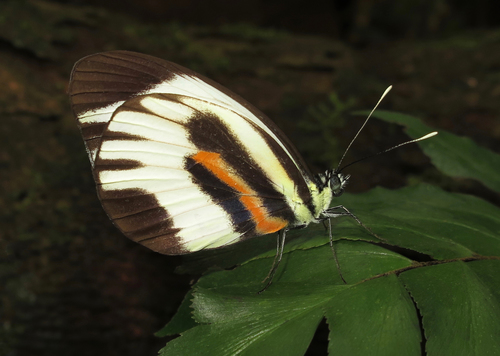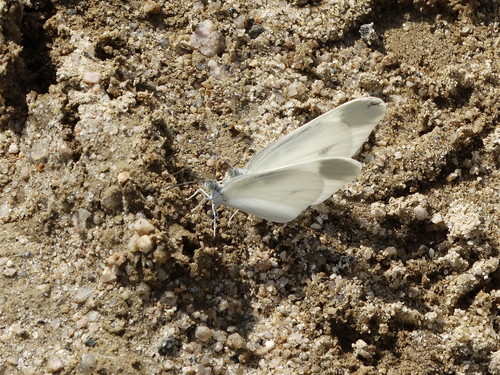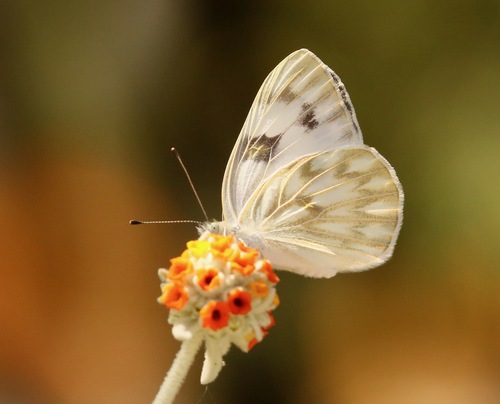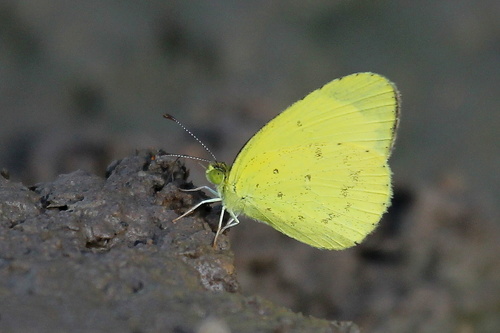
About Pieris napi (Linnaeus, 1758)
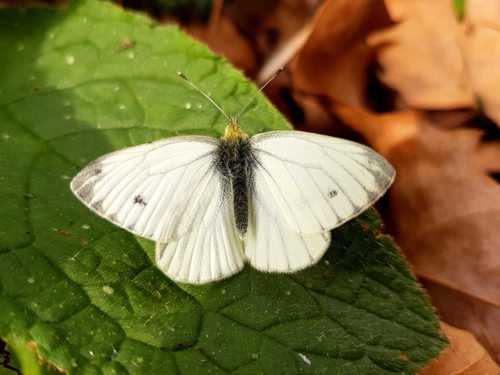
The green-veined white, with the scientific name Pieris napi (Linnaeus, 1758), is a butterfly belonging to the family Pieridae. This is a circumboreal species that is widespread across Europe and Asia, including the Indian subcontinent, Japan, the Maghreb, and North America. It occupies meadows, hedgerows, and woodland glades, and is encountered less often in gardens and parks than its close relatives the large and small whites, for which it is frequently mistaken. Like other "white" butterflies, Pieris napi shows visible differences between sexes. Females have two spots on each forewing, while males only have one. Wing veins are usually more heavily marked on females. The underside of the hindwings is pale yellow, with veins highlighted by black scales that give the wings a greenish tint — this coloration gives the species its common name, green-veined white. Unlike the large and small whites, Pieris napi rarely chooses garden cabbages to lay its eggs, and instead prefers wild crucifers. Males of this species produce a human-perceptible sex pheromone: citral, the primary component that gives lemon peel oil its characteristic flavor. Some authors classify the North American mustard white and West Virginia white as the same species as P. napi, or treat P. napi as a superspecies. Even with this classification overlap, North American butterflies cannot successfully use garlic mustard as a host plant, unlike P. napi. North American females will lay eggs on this non-native plant, mistaking it for a compatible native mustard, which leads to the death of their offspring. Classification of the European dark-veined white also remains unresolved. Pieris napi occurs in damp, grassy areas with partial shade, including forest edges, hedgerows, meadows, and wooded river valleys. Later generations of the butterfly expand their habitat use to search for alternative food plants in drier, flowery locations. In the Mediterranean region, the species is also found in scrub around mountain streams or springs, and on floodplains where Nasturtium officinale grows. It occurs from sea level up to high elevations, reaching 2500 m in central Europe, 2600 m in Italy, and 3600 m in Morocco. Females lay their eggs singly on a broad range of food plants, which include hedge mustard (Sisymbrium officinale), garlic mustard (Alliaria petiolata), cuckooflower (Cardamine pratense), water-cress (Rorippa nastutium-aquaticum), charlock (Sinapis arvensis), large bitter-cress (Cardamine amara), wild cabbage (Brassica oleracea), and wild radish (Raphanus raphanistrum). Because of its use of wild food plants, it is rarely a pest in gardens or agricultural field crops. The caterpillar of Pieris napi is green and well-camouflaged. A full-grown caterpillar is green on its upper side with black warts that bear whitish and blackish hairs. It has a darker line running along its back, and a yellow line low on its sides. The underside of the caterpillar is whitish-grey. The spiracular line is dusky and not conspicuous, and spiracles are blackish and surrounded by yellow. In some wild populations, such as those in Morocco, there is extensive overlap between this caterpillar and leaf-feeding larvae of the large and small white. It often feeds on the same plants as the orange tip butterfly, but rarely competes for food: Pieris napi caterpillars typically feed on leaves, while orange tip caterpillars feed on flowers and developing seed pods. Like other species in the Pieris genus, Pieris napi overwinters in the pupal stage. The pupa is green, with yellowish and brown raised parts; this is the most common form, but pupal color varies from yellowish to buff or greyish, and some pupae have no markings at all.