About Pieris canidia (Sparrman, 1768)
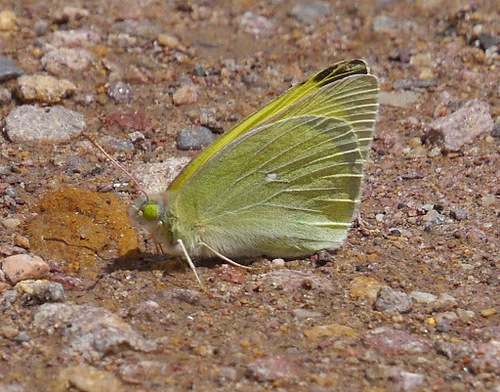
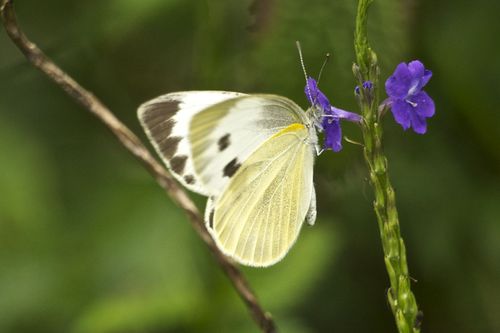
Pieris canidia (Sparrman, 1768) has the following morphological characteristics. The upperside of adult males ranges from white to pale cream. Black scales are scattered across the base of the forewing, the basal portion of the costa, and the base and upper margin of the cell. The region from the forewing apex to approximately the middle of the terminal margin is black. This black pigment extends a very short distance triangularly along the veins on the terminal margin, and a round black spot is present in interspace 3. The hindwing bears a subcostal black spot similar to that of Pieris rapae, but this spot is generally larger and more noticeable, alongside a series of four or five terminal black spots of varying size at the vein apices. On the underside, the forewing is white; the cell and costa are lightly speckled with black scales, and the apex is broadly tinged with ochraceous yellow. Conspicuous subquadrate black spots occur in interspaces 1, 3 and 5: the spot in interspace 1 sometimes extends outside of this interspace, while the spot in interspace 5 is ill-defined. The hindwing ranges from pale, almost white, to dark ochraceous, and is thickly speckled all over with black scales, with the exception of a longitudinal streak in the cell, and similar longitudinal streaks in the interspaces of darker specimens; the area of the costa above vein 8 is chrome yellow. Antennae are black with tiny white specks. Long hairs on the head and thorax are greenish grey, and the abdomen is black. The underside of the head, thorax, and abdomen is white. Females match males in underside appearance, but their scattered black scales are more prominent. The black markings on the forewing apex and termen, and the black spots on the hindwing termen are broader and extend further inwards. An extra black spot is present in forewing interspace 1; in many specimens, this spot and the spot in interspace 3 are connected to the outer black border by a line of black scales along the veins, and the spot in interspace 1 often extends across vein 1 into the interspace below. This species has a wingspan of 42 to 60 mm. Its distribution includes sub-Himalayan India and Pakistan, ranging from Chitral and Kashmir to Sikkim and Bhutan, at elevations from 610 to 3350 m (2000 to 11000 ft). It also occurs in the hills of southern India, Assam, Upper Myanmar's Shan States, and extends into China.